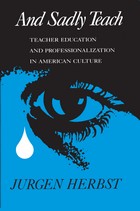
front cover of And Sadly Teach
And Sadly Teach
Teacher Education and Professionalization in American Culture
Jurgen Herbst
University of Wisconsin Press, 1991

To lend weight to his charge that the public school teacher has been betrayed and gravity to his indictment of the educational establishment for that betrayal, Jurgen Herbst goes back to the beginnings of teacher education in America in the 1830s and traces its evolution up to the 1920s, by which time the essential damage had been done.
    Initially, attempts were made to upgrade public school teaching to a genuine profession, but that ideal was gradually abandoned. In its stead, with the advent of newly emerging graduate schools of education in the early decades of the twentieth century, came the so-called professionalization of public education. At the expense of the training of elementary school teachers (mostly women), teacher educators shifted their attention to the turning out of educational "specialists" (mostly men)—administrators, faculty members at normal schools and teachers colleges, adult education teachers, and educational researchers.
    Ultimately a history of the neglect of the American public school teacher, And Sadly Teach ends with a plea and a message that ring loud and clear. The plea: that the current reform proposals for American teacher education—the Carnegie and the Holmes reports—be heeded. The message: that the key to successful school reform lies in educating teacher’s true professionals and in acknowledging them as such in their classrooms.

[more]

logo for Harvard University Press
The Uncertain Profession
Harvard and the Search for Educational Authority
Arthur Powell
Harvard University Press, 1980

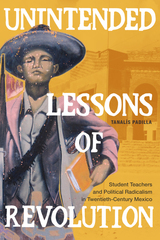
front cover of Unintended Lessons of Revolution
Unintended Lessons of Revolution
Student Teachers and Political Radicalism in Twentieth-Century Mexico
Tanalís Padilla
Duke University Press, 2021
In the 1920s, Mexico established rural normales—boarding schools that trained teachers in a new nation-building project. Drawn from campesino ranks and meant to cultivate state allegiance, their graduates would facilitate land distribution, organize civic festivals, and promote hygiene campaigns. In Unintended Lessons of Revolution, Tanalís Padilla traces the history of the rural normales, showing how they became sites of radical politics. As Padilla demonstrates, the popular longings that drove the Mexican Revolution permeated these schools. By the 1930s, ideas about land reform, education for the poor, community leadership, and socialism shaped their institutional logic. Over the coming decades, the tensions between state consolidation and revolutionary justice produced a telling contradiction: the very schools meant to constitute a loyal citizenry became hubs of radicalization against a government that increasingly abandoned its commitment to social justice. Crafting a story of struggle and state repression, Padilla illuminates education's radical possibilities and the nature of political consciousness for youths whose changing identity—from campesinos, to students, to teachers—speaks to Mexico’s twentieth-century transformations.
[more]


Send via email Share on Facebook Share on Twitter