
 A SCHOLARLY BOOK REPOSITORY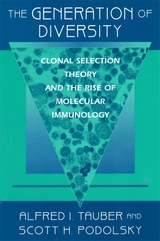
In recent decades immunology has been one of the most exciting--and successful--fields of biomedical research. Over the past thirty years immunologists have acquired a detailed understanding of the immune system's unique recognition mechanism and of the cellular and chemical means used to destroy or neutralize invading organisms. This understanding has been formulated in terms of the clonal selection theory, the dominant explanation of immune behavior. That story is the subject of The Generation of Diversity.
A major problem for immunologists had long been to determine how cells of the immune system could produce millions of distinct antibodies--and produce them on demand. The clonal selection theory explains that cells with genetic instructions to produce each antibody exist in the body in small numbers until exposure to the right molecule--the antigen--triggers the selective cloning that will reproduce exactly the cell needed. But how can so many different antibody-producing cells be generated from such limited genetic material? The solution to this question came from new applications of molecular biology, and, as the authors argue, the impact of the new techniques changed both the methods and the concepts of immunology.
The Generation of Diversity is an intellectual history of the major theoretical problem in immunology and its resolution in the post-World War II period. It will provide for immunologists essential background for understanding the conceptual conflicts occurring in the field today.

Tauber, a leading figure in history and philosophy of science, offers a unique autobiographical overview of how science as a discipline of thought has been characterized by philosophers and historians over the past century. He frames his account through science’s – and his own personal – quest for explanatory certainty.
During the 20th century, that goal was displaced by the probabilistic epistemologies required to characterize complex systems, whether in physics, biology, economics, or the social sciences. This “triumph of uncertainty” is the inevitable outcome of irreducible chance and indeterminate causality. And beyond these epistemological limits, the interpretative faculties of the individual scientist (what Michael Polanyi called the “personal” and the “tacit”) invariably affects how data are understood. Whereas positivism had claimed radical objectivity, post-positivists have identified how a web of non-epistemic values and social forces profoundly influence the production of knowledge.
Tauber presents a case study of these claims by showing how immunology has incorporated extra-curricular social elements in its theoretical development and how these in turn have influenced interpretive problems swirling around biological identity, individuality, and cognition. The correspondence between contemporary immunology and cultural notions of selfhood are strong and striking. Just as uncertainty haunts science, so too does it hover over current constructions of personal identity, self knowledge, and moral agency. Across the chasm of uncertainty, science and selfhood speak.
READERS
Browse our collection.
PUBLISHERS
See BiblioVault's publisher services.
STUDENT SERVICES
Files for college accessibility offices.
RECENTLY PUBLISHED






UChicago Accessibility Resources
home | accessibility | search | about | contact us
BiblioVault ® 2001 - 2026
The University of Chicago Press