front cover of Crabgrass Catholicism
Crabgrass Catholicism
How Suburbanization Transformed Faith and Politics in Postwar America
Stephen M. Koeth
University of Chicago Press, 2025
How suburbanization was a crucial catalyst for reforms in the Catholic Church.
 
The 1960s in America were a time of revolt against the stifling conformism embodied in the sprawling, uniform suburbs of the 1950s. Typically, the reforms of the Catholic Church’s Second Vatican Council, which aimed to make the Church more modern and accessible, are seen as one result of that broader cultural liberalization. Yet in Crabgrass Catholicism, Stephen M. Koeth demonstrates that the liberalization of the Church was instead the product of the mass suburbanization that began some fifteen years earlier. Koeth argues that postwar suburbanization revolutionized the Catholic parish, the relationship between clergy and laity, conceptions of parochial education, and Catholic participation in US politics, and thereby was a significant factor in the religious disaffiliation that only accelerated in subsequent decades.

A novel exploration of the role of Catholics in postwar suburbanization, Crabgrass Catholicism will be of particular interest to urban historians, scholars of American Catholicism and religious studies, and Catholic clergy and laity.
 
[more]

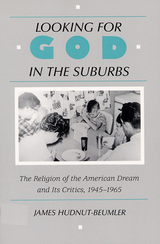
front cover of Looking for God in the Suburbs
Looking for God in the Suburbs
The Religion of the American Dream and its Critics, 1945-1965
Hudnut-Beumler, James
Rutgers University Press, 1994

In the 1950s, 99 percent of adult Americans said they believed in God. How, James Hudnut-Beumler asks, did this consensus about religion turn into the confrontational debates over religion in the 1960s? He argues that post-World War II suburban conformity made church-going so much a part of middle-class values and life that religion and culture became virtually synonymous. Secular critics like David Riesman, William Whyte, C. Wright Mills, and Dwight Macdonald, who blamed American culture for its conformism and lack of class consciousness, and religious critics like Will Herberg, Gibson Winter, and Peter Berger, who argued that religion had lost its true roots  by incorporating only the middle class,  converged in their attacks on popular religion.

Although most Americans continued to live and worship as before, a significant number of young people followed the critics' call for a faith that led to social action, but they turned away from organized religion and toward the counterculture of the sixties. The critics of the 1950s deserve credit for asking questions about the value of religion as it was being practiced and the responsibilities of the affluent to the poor—and for putting these issues on the social and cultural agenda of the next generation.


                                                           

[more]


Send via email Share on Facebook Share on Twitter