
 A SCHOLARLY BOOK REPOSITORY
Results by Title
4 books about Speculative fiction
4 books about Speculative fiction
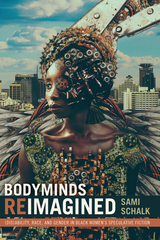
Bodyminds Reimagined
(Dis)ability, Race, and Gender in Black Women's Speculative Fiction
Sami Schalk
Duke University Press, 2018
In Bodyminds Reimagined Sami Schalk traces how black women's speculative fiction complicates the understanding of bodyminds—the intertwinement of the mental and the physical—in the context of race, gender, and (dis)ability. Bridging black feminist theory with disability studies, Schalk demonstrates that this genre's political potential lies in the authors' creation of bodyminds that transcend reality's limitations. She reads (dis)ability in neo-slave narratives by Octavia Butler (Kindred) and Phyllis Alesia Perry (Stigmata) not only as representing the literal injuries suffered under slavery, but also as a metaphor for the legacy of racial violence. The fantasy worlds in works by N. K. Jemisin, Shawntelle Madison, and Nalo Hopkinson—where werewolves have obsessive-compulsive-disorder and blind demons can see magic—destabilize social categories and definitions of the human, calling into question the very nature of identity. In these texts, as well as in Butler’s Parable series, able-mindedness and able-bodiedness are socially constructed and upheld through racial and gendered norms. Outlining (dis)ability's centrality to speculative fiction, Schalk shows how these works open new social possibilities while changing conceptualizations of identity and oppression through nonrealist contexts.
[more]
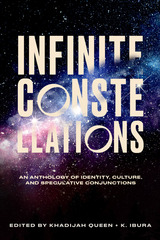
Infinite Constellations
An Anthology of Identity, Culture, and Speculative Conjunctions
Edited by Khadijah Queen and K. Ibura
University of Alabama Press, 2023
A gathering of innovative, speculative fictions by writers of color, both established and emerging
The innovative fictions in Infinite Constellations showcase the voices and visions of 30 remarkable writers, both new and established, from the global majority: Native American/First Nation writers, South Asian writers, East Asian writers, Black American writers, Latinx writers, and Caribbean and Middle Eastern writers. These are visions both familiar and strange, but always rooted in the mystery of human relationships, the deep honoring of memory, and the rootedness to place and the centering of culture.
The writers in this anthology mirror, instruct, bind and unbind, myth-make and myth-invert, transform and transmute, make us belly-laugh or hum our understanding, gasp or whisper gently, and remember that sometimes we need to holler and fight as we grieve. Any dangers herein, imagined or observed in poem and story, transport us: moving from latent to extant, then unleashed.
This work does not presume; it presents and blossoms, creating a constellation of appearances, a symphony of belonging.
“In collecting this work,” note editors Khadijah Queen and K. Ibura, “we felt humbled by the love threaded throughout the voices speaking to us in stories and poems that vault beyond expectation and settle in our consciousness as an expansion of what’s possible when we tend to one another with intention. We felt lifted, held aloft in these arrangements of language. We hope that as you read each story and poem, you will find the same sense of empowerment and celebration that we know has sustained us over countless generations, and in their beauty and humor and intelligence and complexity, continue to enrich us still.”
CONTRIBUTORS
George Abraham / Kenzie Allen / Shreya lla Anasuya / Thea Anderson / Wendy Chin-Tanner / Alton Melvar M. Depanas / Yohanca Delgado / Jennifer Elise Foerster / Aerik Francis / André O. Hoilette / Brian K. Hudson / K. Ibura / Pedro Iniguez / Ruth Ellen Kocher / Ra’Niqua Lee / Tonya Liburd / Kenji C. Liu / Shalewa Mackall / Lucien Darjeun Meadows / Melanie Merle / Juan J. Morales / Thirii Myo Kyaw Myint / Cindy Juyound Ok / Daniel José Older / Soham Patel / Lynn C. Pitts/ Khadijah Queen / Sheree Renée Thomas / Sarah Sophia Yanni / dg nanouk okpik / shakirah peterson
The innovative fictions in Infinite Constellations showcase the voices and visions of 30 remarkable writers, both new and established, from the global majority: Native American/First Nation writers, South Asian writers, East Asian writers, Black American writers, Latinx writers, and Caribbean and Middle Eastern writers. These are visions both familiar and strange, but always rooted in the mystery of human relationships, the deep honoring of memory, and the rootedness to place and the centering of culture.
The writers in this anthology mirror, instruct, bind and unbind, myth-make and myth-invert, transform and transmute, make us belly-laugh or hum our understanding, gasp or whisper gently, and remember that sometimes we need to holler and fight as we grieve. Any dangers herein, imagined or observed in poem and story, transport us: moving from latent to extant, then unleashed.
This work does not presume; it presents and blossoms, creating a constellation of appearances, a symphony of belonging.
“In collecting this work,” note editors Khadijah Queen and K. Ibura, “we felt humbled by the love threaded throughout the voices speaking to us in stories and poems that vault beyond expectation and settle in our consciousness as an expansion of what’s possible when we tend to one another with intention. We felt lifted, held aloft in these arrangements of language. We hope that as you read each story and poem, you will find the same sense of empowerment and celebration that we know has sustained us over countless generations, and in their beauty and humor and intelligence and complexity, continue to enrich us still.”
CONTRIBUTORS
George Abraham / Kenzie Allen / Shreya lla Anasuya / Thea Anderson / Wendy Chin-Tanner / Alton Melvar M. Depanas / Yohanca Delgado / Jennifer Elise Foerster / Aerik Francis / André O. Hoilette / Brian K. Hudson / K. Ibura / Pedro Iniguez / Ruth Ellen Kocher / Ra’Niqua Lee / Tonya Liburd / Kenji C. Liu / Shalewa Mackall / Lucien Darjeun Meadows / Melanie Merle / Juan J. Morales / Thirii Myo Kyaw Myint / Cindy Juyound Ok / Daniel José Older / Soham Patel / Lynn C. Pitts/ Khadijah Queen / Sheree Renée Thomas / Sarah Sophia Yanni / dg nanouk okpik / shakirah peterson
[more]
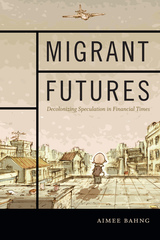
Migrant Futures
Decolonizing Speculation in Financial Times
Aimee Bahng
Duke University Press, 2018
In Migrant Futures Aimee Bahng traces the cultural production of futurity by juxtaposing the practices of speculative finance against those of speculative fiction. While financial speculation creates a future based on predicting and mitigating risk for wealthy elites, the wide range of speculative novels, comics, films, and narratives Bahng examines imagines alternative futures that envision the multiple possibilities that exist beyond capital’s reach. Whether presenting new spatial futures of the US-Mexico borderlands or inventing forms of kinship in Singapore in order to survive in an economy designed for the few, the varied texts Bahng analyzes illuminate how the futurity of speculative finance is experienced by those who find themselves mired in it. At the same time these displaced, undocumented, unbanked, and disavowed characters imagine alternative visions of the future that offer ways to bring forth new political economies, social structures, and subjectivities that exceed the framework of capitalism.
[more]
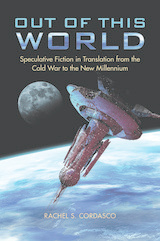
Out of This World
Speculative Fiction in Translation from the Cold War to the New Millennium
Rachel S. Cordasco
University of Illinois Press, 2021
The twenty-first century has witnessed an explosion of speculative fiction in translation (SFT). Rachel Cordasco examines speculative fiction published in English translation since 1960, ranging from Soviet-era fiction to the Arabic-language dystopias that emerged following the Iraq War. Individual chapters on SFT from Korean, Czech, Finnish, and eleven other source languages feature an introduction by an expert in the language's speculative fiction tradition and its present-day output. Cordasco then breaks down each chapter by subgenre--including science fiction, fantasy, and horror--to guide readers toward the kinds of works that most interest them. Her discussion of available SFT stands alongside an analysis of how various subgenres emerged and developed in a given language. She also examines the reasons a given subgenre has been translated into English.
An informative and one-of-a-kind guide, Out of This World offers readers and scholars alike a tour of speculative fiction's new globalized era.
[more]
READERS
Browse our collection.
PUBLISHERS
See BiblioVault's publisher services.
STUDENT SERVICES
Files for college accessibility offices.
RECENTLY PUBLISHED




UChicago Accessibility Resources
home | accessibility | search | about | contact us
BiblioVault ® 2001 - 2024
The University of Chicago Press