
 A SCHOLARLY BOOK REPOSITORY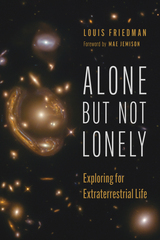
Friedman argues that intelligent life is probably rare in the universe (maybe even uniquely on Earth) but that simple life is likely abundant on millions or billions of planets waiting now to be discovered. He asserts that studying and searching for extraterrestrial life cannot be done by interstellar probes—due to the vastness of space and the comparative brevity of human lifespans—but it can be done remotely by a new technique involving the solar gravity lens that can magnify exoplanets by tens of billions. This technique will allow humankind to explore exoplanets and open up an exciting new field of comparative astrobiology.
Wide-ranging in scope, this book discusses the history of searching for extraterrestrial life, the scientific evidence thereof, and finally his own conclusions on what’s next. Included in the book are three appendices: an explanation of interstellar messaging, a reprint of a debate between Carl Sagan and Ernst Mayr on extraterrestrial intelligence, and an opinion essay on the search for extraterrestrial intelligence.
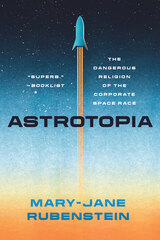
As environmental, political, and public health crises multiply on Earth, we are also at the dawn of a new space race in which governments team up with celebrity billionaires to exploit the cosmos for human gain. The best-known of these pioneers are selling different visions of the future: while Elon Musk and SpaceX seek to establish a human presence on Mars, Jeff Bezos and Blue Origin work toward moving millions of earthlings into rotating near-Earth habitats. Despite these distinctions, these two billionaires share a core utopian project: the salvation of humanity through the exploitation of space.
In Astrotopia, philosopher of science and religion Mary-Jane Rubenstein pulls back the curtain on the not-so-new myths these space barons are peddling, like growth without limit, energy without guilt, and salvation in a brand-new world. As Rubenstein reveals, we have already seen the destructive effects of this frontier zealotry in the centuries-long history of European colonialism. Much like the imperial project on Earth, this renewed effort to conquer space is presented as a religious calling: in the face of a coming apocalypse, some very wealthy messiahs are offering an other-worldly escape to a chosen few. But Rubenstein does more than expose the values of capitalist technoscience as the product of bad mythologies. She offers a vision of exploring space without reproducing the atrocities of earthly colonialism, encouraging us to find and even make stories that put cosmic caretaking over profiteering.
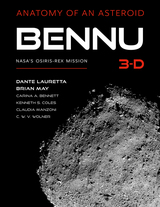
In 2020 the OSIRIS-REx spacecraft successfully landed on the surface of Bennu and collected pristine asteroid material for delivery to Earth in September 2023. Scientific studies of the samples, along with data collected during the rendezvous, promise to help find answers to some of humanity’s deepest questions: Where did we come from? What is our destiny in space?
This book, the world’s first complete (and stereoscopic) atlas of an asteroid, is the result of a unique collaboration between OSIRIS-REx mission leader Dante Lauretta and Brian May’s London Stereoscopic Company. Lauretta’s colleagues include Carina Bennett, Kenneth Coles, and Cat Wolner, as well as Brian May and Claudia Manzoni, who became part of the ultimately successful effort to find a safe landing site for sampling. The text details the data collected by the mission so far, and the stereo images have been meticulously created by Manzoni and May from original images collected by the OSIRIS-REx cameras.
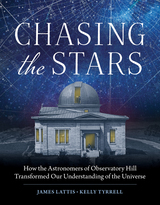
Explore the remarkable story of Wisconsin astronomers whose curiosity, persistence, and innovation helped us better understand our universe.
Chasing the Stars traces the history of the University of Wisconsin’s Washburn Observatory, where some of the world’s most cutting-edge astronomical inventions were born. Learn about the earliest Indigenous stargazers, the women who worked as the first human computers, the astronomers who sold time by the stars, the scientists who shrank the Milky Way, and the crucial role Wisconsin astronomers played in the development of modern astrophysics and space astronomy.
This extraordinary book features more than 100 modern and historic photographs that illustrate the people and science behind Wisconsin’s astronomical innovations. Designed for lay readers and astronomers alike, Chasing the Stars inspires all of us to look up at the sky in wonder.
A History Today Book of the Year
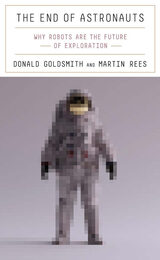
A world-renowned astronomer and an esteemed science writer make the provocative argument for space exploration without astronauts.
Human journeys into space fill us with wonder. But the thrill of space travel for astronauts comes at enormous expense and is fraught with peril. As our robot explorers grow more competent, governments and corporations must ask, does our desire to send astronauts to the Moon and Mars justify the cost and danger? Donald Goldsmith and Martin Rees believe that beyond low-Earth orbit, space exploration should proceed without humans.
In The End of Astronauts, Goldsmith and Rees weigh the benefits and risks of human exploration across the solar system. In space humans require air, food, and water, along with protection from potentially deadly radiation and high-energy particles, at a cost of more than ten times that of robotic exploration. Meanwhile, automated explorers have demonstrated the ability to investigate planetary surfaces efficiently and effectively, operating autonomously or under direction from Earth. Although Goldsmith and Rees are alert to the limits of artificial intelligence, they know that our robots steadily improve, while our bodies do not. Today a robot cannot equal a geologist’s expertise, but by the time we land a geologist on Mars, this advantage will diminish significantly.
Decades of research and experience, together with interviews with scientific authorities and former astronauts, offer convincing arguments that robots represent the future of space exploration. The End of Astronauts also examines how spacefaring AI might be regulated as corporations race to privatize the stars. We may eventually decide that humans belong in space despite the dangers and expense, but their paths will follow routes set by robots.
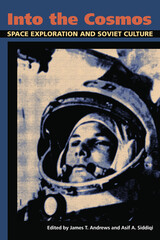
The launch of the Sputnik satellite in October 1957 changed the course of human history. In the span of a few years, Soviets sent the first animal into space, the first man, and the first woman. These events were a direct challenge to the United States and the capitalist model that claimed ownership of scientific aspiration and achievement.
The success of the space program captured the hopes and dreams of nearly every Soviet citizen and became a critical cultural vehicle in the country’s emergence from Stalinism and the devastation of World War II. It also proved to be an invaluable tool in a worldwide propaganda campaign for socialism, a political system that could now seemingly accomplish anything it set its mind to.
Into the Cosmos shows us the fascinating interplay of Soviet politics, science, and culture during the Khrushchev era, and how the space program became a binding force between these elements. The chapters examine the ill-fitted use of cosmonauts as propaganda props, the manipulation of gender politics after Valentina Tereshkova’s flight, and the use of public interest in cosmology as a tool for promoting atheism. Other chapters explore the dichotomy of promoting the space program while maintaining extreme secrecy over its operations, space animals as media darlings, the history of Russian space culture, and the popularity of space-themed memorabilia that celebrated Soviet achievement and planted the seeds of consumerism.
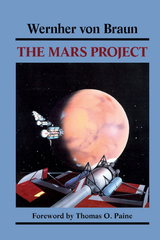
Today von Braun is recognized as the person most responsible for laying the groundwork for public acceptance of America's space program. When President Bush directed NASA in 1989 to prepare plans for an orbiting space station, lunar research bases, and human exploration of Mars, he was largely echoing what von Braun proposed in The Mars Project.

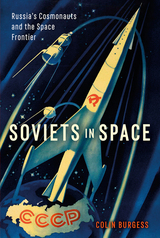
In this deeply researched chronology, Colin Burgess describes the then Soviet Union’s extraordinary success in the pioneering years of space exploration. Within a decade, the Soviets not only launched the world’s first satellite, Sputnik, in 1957, but they also were the first to send an animal and a human being into Earth orbit. In the years that followed, their groundbreaking missions sent a woman into space, launched a three-man spacecraft, and included the first person to walk in space. Six decades on from the historic spaceflight of cosmonaut Yuri Gagarin, Burgess guides us through the amazing achievements of Russia’s spaceflight program through to the present day, introducing the men and women who have flown the missions that drive us to delve ever deeper into the wonders and complexities of the cosmos.
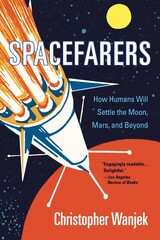
A Telegraph Best Science Book of the Year
“A witty yet in-depth exploration of the prospects for human habitation beyond Earth…Spacefarers is accessible, authoritative, and in the end, inspiring.”
—Richard Panek, author of The Trouble with Gravity
It’s been over fifty years since Apollo 11 landed on the moon. So why is there so little human presence in space? Will we ever reach Mars? And what will it take to become a multiplanet species? While many books have speculated on the possibility of living beyond the Earth, few have delved into the practical challenges.
A wry and compelling take on the who, how, and why of near-future colonies in space, Spacefarers introduces us to the engineers, scientists, planners, dreamers, and entrepreneurs who are striving right now to make life in space a reality. While private companies such as SpaceX are taking the lead and earning profits from human space activity, Christopher Wanjek is convinced this is only the beginning. From bone-whittling microgravity to eye-popping profits, the risks and rewards of space settlement have never been so close at hand. He predicts we will have hotels in low-earth orbit, mining and tourism on the Moon, and science bases on Mars—possibly followed (gravity permitting) by full blown settlements.
“Nerdily engaging (and often funny)…Technology and science fiction enthusiasts will find much here to delight them, as Wanjek goes into rich detail on rocketry and propulsion methods, including skyhooks and railguns to fling things into orbit…He is a sensible skeptic, yet also convinced that, in the long run, our destiny is among the stars.”
—The Guardian
“If the events of this year have had you daydreaming about abandoning the planet entirely, [Spacefarers] is a geekily pleasurable survey of the practicalities and challenges.”
—The Telegraph
“The best book I’ve read on space exploration since Isaac Asimov.”
—Michael Shermer, publisher of Skeptic
READERS
Browse our collection.
PUBLISHERS
See BiblioVault's publisher services.
STUDENT SERVICES
Files for college accessibility offices.
RECENTLY PUBLISHED






UChicago Accessibility Resources
home | accessibility | search | about | contact us
BiblioVault ® 2001 - 2024
The University of Chicago Press