logo for Central European University Press
Religious Failure, Geopolitics, and Forced Displacement in Russia, Eastern Europe, and the South Caucasus
Lucian N. Leustean
Central European University Press, 2026
What happens when states fail to provide support to populations in need? What are the mechanisms of religious and political engagement with populations affected by organized violence, displacement, and resettlement? The book argues that when state structures fail to respond to violence, religious institutions are often among the first actors to assist and empower forcibly displaced populations. Establishing humanitarian initiatives, fostering transnational conservative networks, and promoting geopolitical interests has defined the interplay between religion, politics, and society in the Eastern Christian world from the end of the Cold War to the present day. This book advances a Religious Failure Index, which highlights the ways in which religious institutions engage with state governance, geopolitics, and international affairs. It offers a rigorous narrative of the ways in which Eastern Orthodox and Oriental Christian communities exert authority in a multi-faith geographical space marked by political rivalry, conflict, inequality, and forced displacement in Armenia, Bulgaria, Georgia, Moldova, Russia, Serbia, and Ukraine.
[more]


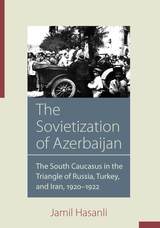
front cover of The Sovietization of Azerbaijan
The Sovietization of Azerbaijan
The South Caucasus in the Triangle of Russia, Turkey, and Iran, 1920–1922
Jamil Hasanli
University of Utah Press, 2017
Utah Series in Middle East Studies 

World War I and the fall of tsarist Russia brought brief independence to Azerbaijan, but by 1920 the Bolshevik revolution pushed south with the twofold purpose of accessing the oil-rich fields near Baku on the Caspian Sea and spreading communism into the Caucasus. Azerbaijan, the richest and earliest significant source of oil in the world, was the first republic in the South Caucasus occupied by the Red Army, which then advanced into neighboring Armenia and Georgia. Pulling from confidential, newly accessed archives, Hasanli describes Soviet Russia’s aggressive policy toward the three South Caucasian nations, which led to their absorption into the USSR by the end of 1922.

The book highlights the Caucasian peoples’ struggle to retain political independence against Soviet Russia and an international cast that included European powers wanting to retain petroleum concessions; Kemalist Turkey, which claimed special ties to the Turkic Azeris; and Iran, which controlled South Azerbaijan and was thus a possible route of expansion eastward for Bolshevik movement. The author also considers the impact on Azerbaijani-Armenian relations of the first two years of Sovietization and explains how Azerbaijan provided space for Bolshevik experiments. Throughout his book, Hasanli illuminates the tragedy of the complex, confused period of Sovietization of the South Caucasus. 
[more]


Send via email Share on Facebook Share on Twitter