
logo for Duke University Press
Naturalization
A Queer Genealogy of US Citizenship, Race, and Sexuality
Siobhan B. Somerville
Duke University Press, 2026
Amid contentious debates about citizenship, borders, and belonging, naturalization tends to stand apart, widely celebrated as the culmination of immigrant narratives and American ideals of liberalism. In Naturalization, Siobhan B. Somerville unsettles this story, showing how the process of citizen-making has historically been embedded in normative assumptions about race, indigeneity, and sexuality that have sustained the US settler colonial project. Tracing an alternative genealogy of naturalization from the eighteenth century through the mid-twentieth, Somerville investigates overlooked stories not only of immigrants but also of Indigenous people, formerly enslaved people of African descent, and inhabitants of US territories, many of whom became US citizens through collective naturalization, often without their consent. Somerville’s interdisciplinary approach to a wide-ranging archive—including federal law, photographs, letters, and memoirs—shows how naturalization has long functioned as both a powerful metaphor and a contradictory material practice at the core of the US settler colonial state.
[more]

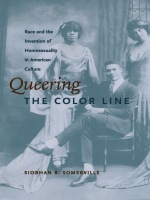
front cover of Queering the Color Line
Queering the Color Line
Race and the Invention of Homosexuality in American Culture
Siobhan B. Somerville
Duke University Press, 2000
Queering the Color Line transforms previous understandings of how homosexuality was “invented” as a category of identity in the United States beginning in the late nineteenth century. Analyzing a range of sources, including sexology texts, early cinema, and African American literature, Siobhan B. Somerville argues that the emerging understanding of homosexuality depended on the context of the black/white “color line,” the dominant system of racial distinction during this period. This book thus critiques and revises tendencies to treat race and sexuality as unrelated categories of analysis, showing instead that race has historically been central to the cultural production of homosexuality.
At about the same time that the 1896 Supreme Court Plessy v. Ferguson decision hardened the racialized boundary between black and white, prominent trials were drawing the public’s attention to emerging categories of sexual identity. Somerville argues that these concurrent developments were not merely parallel but in fact inextricably interrelated and that the discourses of racial and sexual “deviance” were used to reinforce each other’s terms. She provides original readings of such texts as Havelock Ellis’s late nineteenth-century work on “sexual inversion,” the 1914 film A Florida Enchantment, the novels of Pauline E. Hopkins, James Weldon Johnson’s Autobiography of an Ex-Coloured Man, and Jean Toomer’s fiction and autobiographical writings, including Cane. Through her analyses of these texts and her archival research, Somerville contributes to the growing body of scholarship that focuses on discovering the intersections of gender, race, and sexuality.
Queering the Color Line will have broad appeal across disciplines including African American studies, gay and lesbian studies, literary criticism, cultural studies, cinema studies, and gender studies.
[more]

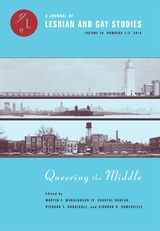
front cover of Queering the Middle
Queering the Middle
Race, Region, and a Queer Midwest, Volume 20
Martin Manalansan, Chantal Nadeau, Richard T. Rodríguez, and Siobhan B. Somerville
Duke University Press
When imagined in relation to other regions of the United States, the Midwest is often positioned as the norm, the uncontested site of white American middle-class heteronormativity. This characterization has often prevailed in scholarship on sexual identity, practice, and culture, but a growing body of recent queer work on rural sexualities, transnational migration, regional identities, and working-class culture suggests the need to understand the Midwest otherwise. This special issue offers an opportunity to think with, through, and against the idea of region. Rather than reinforce the idea of the Midwest as a core that naturalizes American cultural and ideological formations, these essays instead open up possibilities for unraveling the idea of the heartland.

The introduction provides a discussion of the theoretical and critical motivations for understanding the middle as a queer vantage, while the six articles focus on social movements, queer community networks, Midwest-based expressive cultures, and local and diasporic rearticulations of racial, gender, and sexual politics.

At the University of Illinois at Urbana-Champaign, Martin Manalansanis Associate Professor in the Department of Anthropology, Chantal Nadeau is Professor and Chair of Gender and Women’s Studies, and Richard T. Rodríguez and Siobhan B. Somerville are Associate Professors in the Department of English.

[more]


Send via email Share on Facebook Share on Twitter