
 A SCHOLARLY BOOK REPOSITORY
Results by Title
2 books about Sobel, Andrew Carl
2 books about Sobel, Andrew Carl
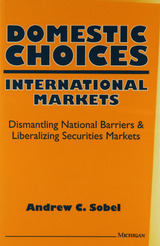
Domestic Choices, International Markets
Dismantling National Barriers and Liberalizing Securities Markets
Andrew C. Sobel
University of Michigan Press, 1994
The internationalization of financial markets moved to center stage in the international political economy during the 1980s. These markets affect trade, investment, venture enterprises, growth, and competitiveness. Domestic Choices, International Markets uses the internationalization and liberalization of securities markets to examine interdependence, leadership, and the mechanisms of change in an increasingly global political economy.During the 1970s and 1980s, the United States began relaxing government oversight of the security markets, promoting price competition, lowering national barriers, dismantling barriers between individual sectors of the financial industry, encouraging innovation, and easing international capital flows. The United Kingdom and Japan soon adopted similar policies, thereby transforming markets in New York, London, and Tokyo. Yet during this time, the United States’ leadership in international finance was seen to be waning. Why did Japan and the United Kingdom follow the United States’ lead so completely and quickly?Most emphasize the interdependence of the world’s financial markets to explain this phenomenon. If this were the case, though, one would expect regulation and transaction costs to converge across markets by competitive deregulation. This has not happened. Significantly, the markets have remained overwhelmingly national with only a modest increase in international activity. In an alternate explanation, Andrew Sobel argues that opening up national doors was really a secondary consequence of policy competitions among sectors of the domestic financial services industry. Changes that occurred earlier in the United States served as examples and constrained the range of choices considered by policy makers in other nations. The author shows how information and reputation networks award disproportionate influence to U.S. actors and institutions. Thus U.S. leadership persists.
[more]
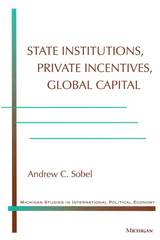
State Institutions, Private Incentives, Global Capital
Andrew C. Sobel
University of Michigan Press, 2002
The growth of global finance since 1960 constitutes one of the most important transformations in social relations during the twentieth century. Using historical, statistical, and graphical techniques, State Institutions, Private Incentives, and Global Capital examines three important aspects of this phenomenal shift in the international political economy. First, Andrew Sobel explores the reawakening of the international financial markets, mapping their extraordinary transformation since the early 1960s and discussing the role of politics in that metamorphosis. The author then offers a fresh understanding of the systematic differences in access for borrowers in this rapidly transforming and expanding global capital pool. He then demonstrates the influence of political factors in producing differential access to the global capital pool. Showing how the character and stability of a country's political system affects investors's decisions to invest in that country, Sobel breaks new ground in understanding the basis for the frequent admonitions by the World Bank and others that a stable political and legal system are essential for states to attract significant foreign investment.
With the growing debate about the effect of financial interdependence on the ability of states to conduct economic policy and indeed to preserve their independence in the face of unprecedented economic linkages, this book will be of interest to political scientists and economists as well as policy makers concerned with the impact of financial globalization and the causes of differentials in access to capital.
Andrew C. Sobel is Assistant Professor of Political Science and Resident Fellow, Center in Political Economy, Washington University, St. Louis. He is the author of Domestic Choices, International Markets: Dismantling National Barriers and Liberalizing Securities Markets.
[more]
READERS
Browse our collection.
PUBLISHERS
See BiblioVault's publisher services.
STUDENT SERVICES
Files for college accessibility offices.
RECENTLY PUBLISHED







UChicago Accessibility Resources
home | accessibility | search | about | contact us
BiblioVault ® 2001 - 2026
The University of Chicago Press