 A SCHOLARLY BOOK REPOSITORY
Results by Title
2 books about SoHo (New York, N.Y.)
2 books about SoHo (New York, N.Y.)

Brightening Glance
Art and Life
Pat Lipsky
University of Iowa Press, 2025
For more than five decades, Pat Lipsky has been a leading figure in American color field painting. In loosely connected vignettes, this extraordinary book looks back on a life starting in 1970s SoHo: from her pioneering days juggling painting and single motherhood in a redesigned factory loft on Wooster Street; to Paris, where an enchanting friendship develops with the former director of the Louvre, Pierre Rosenberg; to her yearslong close friendship with legendary art critic Clement Greenberg; to a marvelous love affair with the charismatic art dealer Richard Bellamy. We glimpse Lipsky’s first introduction to Cézanne as a child in 1950s Brooklyn and her studies with the mythic artist Tony Smith, who would become her mentor. There is a visit with Lee Krasner at her home in Springs and another at Lipsky’s Manhattan apartment, late-night, smoke-filled loft parties, and evenings at Max’s Kansas City where Lou Reed and Nico sing in the background while rival groups of earthwork artists, pop artists, conceptual artists, and color field painters pretend to ignore each other at the bar. Along the way we experience Lipsky’s emergence at the forefront of her generation of painters.
Brightening Glance offers a stunningly self-revealing portrait of the struggles and sacrifices, joys and excitement inherent in a modern painter’s life, and captures the evergreen allure of New York’s art world between 1970 and 2010. In stripped down, elegant prose, Lipsky summons a New York that no longer exists and ponders why we love (and hate) the art world. Ultimately, it’s a story of a contemporary woman, a mother, and a painter, who dares a career in a field where only a handful of women have succeeded.
Brightening Glance offers a stunningly self-revealing portrait of the struggles and sacrifices, joys and excitement inherent in a modern painter’s life, and captures the evergreen allure of New York’s art world between 1970 and 2010. In stripped down, elegant prose, Lipsky summons a New York that no longer exists and ponders why we love (and hate) the art world. Ultimately, it’s a story of a contemporary woman, a mother, and a painter, who dares a career in a field where only a handful of women have succeeded.
[more]
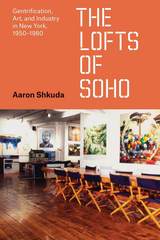
The Lofts of SoHo
Gentrification, Art, and Industry in New York, 1950–1980
Aaron Shkuda
University of Chicago Press, 2016
A groundbreaking look at the transformation of SoHo.
American cities entered a new phase when, beginning in the 1950s, artists and developers looked upon a decaying industrial zone in Lower Manhattan and saw, not blight, but opportunity: cheap rents, lax regulation, and wide open spaces. Thus, SoHo was born. From 1960 to 1980, residents transformed the industrial neighborhood into an artist district, creating the conditions under which it evolved into an upper-income, gentrified area. Introducing the idea—still potent in city planning today—that art could be harnessed to drive municipal prosperity, SoHo was the forerunner of gentrified districts in cities nationwide, spawning the notion of the creative class.
In The Lofts of SoHo, Aaron Shkuda studies the transition of the district from industrial space to artists’ enclave to affluent residential area, focusing on the legacy of urban renewal in and around SoHo and the growth of artist-led redevelopment. Shkuda explores conflicts between residents and property owners and analyzes the city’s embrace of the once-illegal loft conversion as an urban development strategy. As Shkuda explains, artists eventually lost control of SoHo’s development, but over several decades they nonetheless forced scholars, policymakers, and the general public to take them seriously as critical actors in the twentieth-century American city.
American cities entered a new phase when, beginning in the 1950s, artists and developers looked upon a decaying industrial zone in Lower Manhattan and saw, not blight, but opportunity: cheap rents, lax regulation, and wide open spaces. Thus, SoHo was born. From 1960 to 1980, residents transformed the industrial neighborhood into an artist district, creating the conditions under which it evolved into an upper-income, gentrified area. Introducing the idea—still potent in city planning today—that art could be harnessed to drive municipal prosperity, SoHo was the forerunner of gentrified districts in cities nationwide, spawning the notion of the creative class.
In The Lofts of SoHo, Aaron Shkuda studies the transition of the district from industrial space to artists’ enclave to affluent residential area, focusing on the legacy of urban renewal in and around SoHo and the growth of artist-led redevelopment. Shkuda explores conflicts between residents and property owners and analyzes the city’s embrace of the once-illegal loft conversion as an urban development strategy. As Shkuda explains, artists eventually lost control of SoHo’s development, but over several decades they nonetheless forced scholars, policymakers, and the general public to take them seriously as critical actors in the twentieth-century American city.
[more]
READERS
Browse our collection.
PUBLISHERS
See BiblioVault's publisher services.
STUDENT SERVICES
Files for college accessibility offices.
RECENTLY PUBLISHED




UChicago Accessibility Resources
home | accessibility | search | about | contact us
BiblioVault ® 2001 - 2025
The University of Chicago Press