
 A SCHOLARLY BOOK REPOSITORY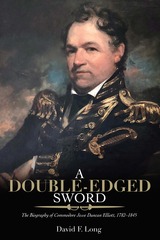
An overdue reassessment of one of the US Navy’s most decorated—and divisive—early commanders, whose legacy remains teetering between heroism and scandalous.
A Double-Edged Sword: The Biography of Commodore Jesse Duncan Elliott, 1782–1845 is a comprehensive and long-overdue portrait of one of the most polarizing figures in early US naval history. Written over the course of a decade and completed shortly before the author’s death, this meticulously researched biography revisits the career of a man once hailed for his military exploits—and later condemned for a myriad of personal controversies—including his perceived missteps while in command.
David F. Long traces Elliott’s rise from promising young officer to commodore, chronicling his leadership during key moments such as the capture of the brig Caledonia, the defense of Fort Erie, and his central—but contested—role in the Battle of Lake Erie. Despite notable contributions to the Navy’s early successes, including his diplomatic work and restoration of the USS Constitution, Elliott’s legacy was clouded by scandal: accusations of cowardice, a notorious duel, a contentious command style, and a drawn-out court-martial that ended his career in disgrace.
Serving as both biography and reflective historical analysis, Long paints a vivid picture of the early US Navy—its rivalries, growing pains, and evolving institutional identity. His balanced account of Elliott’s life, neither excusing his faults nor downplaying his achievements, places the commodore’s story in direct conversation with the challenges and ambitions of a rapidly expanding American maritime power. This is a must read for scholars of naval and military history, early American politics, or anyone interested in the brazen albeit controversial legacy of a forgotten national hero.

Uncover the untold story of America’s 19th-century adventurers and their quest for empire.
The first two decades of the 19th century found many Americans eager to move away from the crowded eastern seaboard and into new areas where their goals of landownership might be realized. Such movement was encouraged by Presidents Jefferson, Madison, and Monroe—collectively known as the Jeffersonians—who believed that the country's destiny was to have total control over the entire North American continent. Migration patterns during this time changed the country considerably and included the roots of the slavery controversy that ultimately led to the Civil War. By the end of the period, although expansionists had not succeeded in moving into British Canada, they had obtained command of large areas from the Spanish South and Southwest, including acreage previously controlled by Native Americans.
Utilizing memoirs, diaries, biographies, newspapers, and vast amounts of both foreign and domestic correspondence, Frank Lawrence Owsley Jr. and Gene A. Smith reveal an insider’s view of the filibusters and expansionists, the colorful—if not sometimes nefarious—characters on the front line of the United States’s land grab. Owsley and Smith describe in detail the actions and characters involving both the successful and the unsuccessful efforts to expand the United States during this period—as well as the outspoken opposition to expansion, found primarily among the Federalists in the Northeast.
Winner of The Society for Military History's 2025 Distinguished Book Award
A multidisciplinary examination of the role of military forts in the Caribbean during the age of European colonial expansion
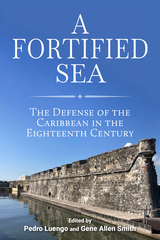
A Fortified Sea illuminates the key role of military forts in the greater Caribbean during the long eighteenth century. The historical Caribbean, with its multiple contested boundaries at the periphery of European western expansion, typically has been analyzed as part of an empire. European powers, including Spain, the Netherlands, England, and Denmark, carved up the Caribbean Sea into a cultural patchwork. These varied cultural contexts were especially evident during regional and national conflicts throughout the eighteenth century and prompted the construction of more fortifications to protect imperial interests. The emergence of Anglo-American colonies during the eighteenth century and later the United States gradually altered previous geopolitical balances, redefining the cultural and geopolitical boundaries of the region.
This collection of essays incorporates several historiographical traditions—from Spanish to American—all portraying the borderland as a breakthrough contested cultural, social, economic, and military boundary. A multinational roster of contributors approaches topics through a war studies lens as well as architecturally and historically, enriching a usually monothematic view. As well, discussion of cultural management of the historical remains of forts shows local communities trying to preserve and interpret the role of forts in society.
Part I defines the training of military engineers in Spain. Part II engages with British defensive military plans and settlements in the Caribbean and shows how the British dealt with the rhetorical image of the empire. Part III clarifies the building processes of fortifications in Santiago de Cuba, Cartagena de Indias, Havana, and Veracruz, among other places. Copious period maps complement the prodigious research. The book will appeal to readers interested in the history of the Caribbean, military history, and European imperial expansion.
CONTRIBUTORS
Mónica Cejudo Collera / Pedro Cruz Freire / María Mercedes Fernández Martín / Aaron Graham / Manuel Gámez Casado / Francisco Javier Herrera García / Nuria Hinarejos Martín / Pedro Luengo / Ignacio J. López-Hernández / José Miguel Morales Folguera / Alfredo J. Morales / Juan Miguel Muñoz Corbalán / Jesús Maria Ruiz Carrasco / Germán Segura García / Gene Allen Smith / Christopher K. Waters
READERS
Browse our collection.
PUBLISHERS
See BiblioVault's publisher services.
STUDENT SERVICES
Files for college accessibility offices.
RECENTLY PUBLISHED



UChicago Accessibility Resources
home | accessibility | search | about | contact us
BiblioVault ® 2001 - 2026
The University of Chicago Press