
 A SCHOLARLY BOOK REPOSITORY
Results by Title
3 books about Scodel, Ruth
3 books about Scodel, Ruth

A Companion to Apollonius of Rhodes
Ruth Scodel
University of Michigan Press, 2025
This volume presents a companion text to ancient Greek poet Apollonius of Rhodes, author of the epic poem Argonautica, which stands on a level of importance with other major ancient epics like the Aeneid or the Odyssey. Ruth Scodel and her contributors examine Apollonius’ work from three points of view—his literary influences and impact on contemporary writers, the actual work of Apollonius, and his later reception in Latin. This companion volume seeks to help readers with varied reasons to be interested in Apollonius—whether they are interested in Latin poets whom he influenced, or in patronage, or narrative method.
A Companion to Apollonius of Rhodes aims to help contemporary readers appreciate what is most characteristic of Apollonius’ epic—its fascination with ritual and myth, gods who act without the direction of Zeus, frequent distanced narration, the portrayal of characters in situations where there are no good choices. It includes thorough analyses of the poem’s relationship to contemporary art with illustrations and treats familiar topics, such as Jason’s leadership, with nuance. Contributors include Benjamin Acosta-Hughes, Annemarie Ambühl, Anja Bettenworth, Keyne Cheshire, Christopher Chinn, James Clauss, Adele Teresa Cozzoli, Kristopher Fletcher, Alexander Hollmann, Regina Höschele, Niklas Holzberg, Alison Keith, Adolf Köhnken†, Anatole Mori, William H. Race, Norman Sandridge, Selina Stewart, Stefanie Stürner, and Graham Zanker.
A Companion to Apollonius of Rhodes aims to help contemporary readers appreciate what is most characteristic of Apollonius’ epic—its fascination with ritual and myth, gods who act without the direction of Zeus, frequent distanced narration, the portrayal of characters in situations where there are no good choices. It includes thorough analyses of the poem’s relationship to contemporary art with illustrations and treats familiar topics, such as Jason’s leadership, with nuance. Contributors include Benjamin Acosta-Hughes, Annemarie Ambühl, Anja Bettenworth, Keyne Cheshire, Christopher Chinn, James Clauss, Adele Teresa Cozzoli, Kristopher Fletcher, Alexander Hollmann, Regina Höschele, Niklas Holzberg, Alison Keith, Adolf Köhnken†, Anatole Mori, William H. Race, Norman Sandridge, Selina Stewart, Stefanie Stürner, and Graham Zanker.
[more]
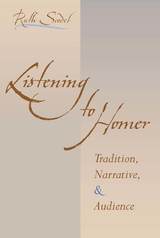
Listening to Homer
Tradition, Narrative, and Audience
Ruth Scodel
University of Michigan Press, 2002
The Homeric poems were not intended for readers, but for a listening audience. Traditional in their basic elements, the stories were learned by oral poets from earlier poets and recreated at every performance. Individual nuances, tailored to the audience, could creep into the stories of the Greek heroes on each and every occasion when a bard recited the epics.
For a particular audience at a particular moment, "tradition" is what it believes it has inherited from the past--and it may not be particularly old. The boundaries between the traditional and the innovative may become blurry and indistinct. By rethinking tradition, we can see Homer's methods and concerns in a new light. The Homeric poet is not naive. He must convince his audience that the story is true. He must therefore seem disinterested, unconcerned with promoting anyone's interests. The poet speaks as if everything he says is merely the repetition of old tales. Yet he carefully ensures that even someone who knows only a minimal amount about the ancient heroes can follow and enjoy the performance, while someone who knows many stories will not remember inappropriate ones. Pretending that every detail is already familiar, the poet heightens suspense and implies that ordinary people are the real judges of great heroes.
Listening to Homer transcends present controversies about Homeric tradition and invention by rethinking how tradition functions. Focusing on reception rather than on composition, Ruth Scodel argues that an audience would only rarely succeed in identifying narrative innovation. Homeric narrative relies on a traditionalizing, inclusive rhetoric that denies the innovation of the oral performance while providing enough information to make the epics intelligible to audiences for whom much of the material is new.
Listening to Homer will be of interest to general classicists, as well as to those specializing in Greek epic and narrative performance. Its wide breadth and scope will also appeal to those non-classicists interested in the nature of oral performance.
Ruth Scodel is Professor of Greek and Latin, University of Michigan, and former president of the American Philological Association.
"Ruth Scodel's Listening to Homer proves it is still possible to explore the workings of epic without recourse to a battery of jargon or technicalities. This is not a 'one big idea' book but a rich . . . set of reflections; it makes refreshing reading . . . ."
---Greece & Rome
---Greece & Rome
"This is an important book, putting the receiving rather than the sending side of the performance of the Homeric epics center stage. The many observations on narrative technique are often new and worthwhile."
---Irene J.F. de Jong, Gnomon
---Irene J.F. de Jong, Gnomon
[more]
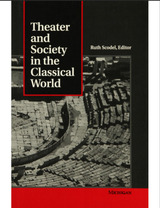
Theater and Society in the Classical World
Ruth Scodel, Editor
University of Michigan Press, 1993
Powerful and evocative, persuasive, frightening, and inspiring—the comedies and tragedies written in classical antiquity are all of these. In recent years the study of ancient drama has become ever more exciting and controversial. The social context of Greek drama especially has drawn attention, and a new understanding of Roman comedy has arisen.Theater and Society in the Classical World draws together the work of numerous international scholars. Both collectively and individually these works illustrate the continuing power and voice of ancient drama, and they help reveal some of the reasons why these plays still speak to us today.Among the essays are several that investigate the important relations between Greek drama and ritual. A second group examines the value of dramatic texts as sources for social history, while a third looks at the ways in which Roman authors creatively transformed their sources.This volume presents papers delivered at a conference at the University of Michigan, held under the joint auspices of the Institute for the Humanities and the Department of Classical Studies.
[more]
READERS
Browse our collection.
PUBLISHERS
See BiblioVault's publisher services.
STUDENT SERVICES
Files for college accessibility offices.
RECENTLY PUBLISHED






UChicago Accessibility Resources
home | accessibility | search | about | contact us
BiblioVault ® 2001 - 2026
The University of Chicago Press