
 A SCHOLARLY BOOK REPOSITORY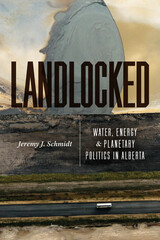
A study of oil-rich Alberta reveals the entwined relationships among geoscience, governance, and power.
The Canadian province of Alberta holds the world’s fourth-largest reserve of fossil fuels, with oil sands famous for bitumen, a viscous form of petroleum. A clearinghouse for international environmental ideas and energy policies, Alberta pioneered state-led efforts to understand, extract, and sell bitumen. Without natural access to ocean ports, Alberta is reliant on pipelines to global markets, which are often hampered by neighboring provinces and nations alike. But Alberta is also landlocked in another sense: it is caught in an extractive relationship with oil-rich earth.
In Landlocked, Jeremy J. Schmidt focuses on Alberta’s energy industry, particularly its use of water and oil, to argue for a new way to understand how political authority is forged and maintained through the environment. Schmidt details how water and oil were enrolled in early state-making projects, such as irrigation, before tracing the reverberating consequences, including a series of events in 2013 that released 4.2 million barrels of bitumen into underground environments. By uncovering the ways that geosciences supported activities—from land settlement to the dispossession of Indigenous peoples—that produced particular environmental policies and approaches to management and governance, he shows that geosciences aren’t merely instruments of state power, but central to Alberta’s political identity and legitimacy.
These diverse efforts are the subject of the latest volume in the Worldwatch Institute’s highly regarded State of the World series. The 2014 edition, marking the Institute’s 40th anniversary, examines both barriers to responsible political and economic governance as well as gridlock-shattering new ideas. The authors analyze a variety of trends and proposals, including regional and local climate initiatives, the rise of benefit corporations and worker-owned firms, the need for energy democracy, the Internet’s impact on sustainability, and the importance of eco-literacy. A consistent thread throughout the book is that informed and engaged citizens are key to better governance.
The book is a clear-eyed yet ultimately optimistic assessment of citizens’ ability to govern for sustainability. By highlighting both obstacles and opportunities, State of the World 2014 shows how to effect change within and beyond the halls of government. This volume will be especially useful for policymakers, environmental nonprofits, students of environmental studies, sustainability, or economics—and citizens looking to jumpstart significant change around the world.
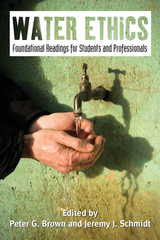
According to the editors of this collection of foundational essays, questions surrounding water are inherently ethical. Peter Brown and Jeremy Schmidt contend that all approaches to managing water, no matter how grounded in empirical data, involve value judgments and cultural assumptions. Each of the six sections of the book discuses a different approach to thinking about the relationship between water and humanity, from utilitarianism to eco-feminism to religious beliefs, including Islam, Hinduism, and Christianity. Contributors range from Bartholemew, Ecumenical Patriarch of the Orthodox Church to Nobel Laureate economist Elinor Ostrom and water policy expert Sandra Postel. Each section is framed by an original introductory essay written by the editors.
Water Ethics will help readers understand how various moral perspectives, even when unstated, have guided and will continue to guide water policy around the globe.
READERS
Browse our collection.
PUBLISHERS
See BiblioVault's publisher services.
STUDENT SERVICES
Files for college accessibility offices.
RECENTLY PUBLISHED



UChicago Accessibility Resources
home | accessibility | search | about | contact us
BiblioVault ® 2001 - 2026
The University of Chicago Press