
 A SCHOLARLY BOOK REPOSITORY
Through essays that critically engage with fan participation within consumer, material, and brand cultures, Acquiring Fan Lifestyles explores how fandom is increasingly imagined by brand owners and consumers as a lifestyle. The authors highlight a range of often overlooked fan practices and sites of engagement, including home decor, health and wellness, sustainable fashion, luxury goods, and other lifestyle categories, looking to brands such as Target and Ruggable as well as fandoms such as Twin Peaks and LEGO. They examine how individuals who claim the identity of “fan” engage in acquisition practices that are intended to demonstrate said fandom, as well as how individuals come to discover their fandoms through acquisition. In so doing, they seek to complicate the ways people participate in fandoms via acquisition; practices that are neither inauthentic nor co-opted, but rather blur the boundaries between fandom as subculture and fandom as lifestyle. Acquiring Fan Lifestyles takes seriously what acquisition and lifestyle affords fandoms and fan agency, decision making, and labor without dismissing the possibility of fan activity being constrained by and reshaped within market and class-based ideologies.
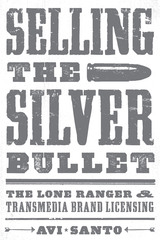
Originating as a radio series in 1933, the Lone Ranger is a cross-media star who has appeared in comic strips, comic books, adult and juvenile novels, feature films and serials, clothing, games, toys, home furnishings, and many other consumer products. In his prime, he rivaled Mickey Mouse as one of the most successfully licensed and merchandised children’s properties in the United States, while in more recent decades, the Lone Ranger has struggled to resonate with consumers, leading to efforts to rebrand the property. The Lone Ranger’s eighty-year history as a lifestyle brand thus offers a perfect case study of how the fields of licensing, merchandizing, and brand management have operated within shifting industrial and sociohistorical conditions that continue to redefine how the business of entertainment functions.
Deciphering how iconic characters gain and retain their status as cultural commodities, Selling the Silver Bullet focuses on the work done by peripheral consumer product and licensing divisions in selectively extending the characters’ reach and in cultivating investment in these characters among potential stakeholders. Tracing the Lone Ranger’s decades-long career as intellectual property allows Avi Santo to analyze the mechanisms that drive contemporary character licensing and entertainment brand management practices, while at the same time situating the licensing field’s development within particular sociohistorical and industrial contexts. He also offers a nuanced assessment of the ways that character licensing firms and consumer product divisions have responded to changing cultural and economic conditions over the past eighty years, which will alter perceptions about the creative and managerial authority these ancillary units wield.
READERS
Browse our collection.
PUBLISHERS
See BiblioVault's publisher services.
STUDENT SERVICES
Files for college accessibility offices.
RECENTLY PUBLISHED





UChicago Accessibility Resources
home | accessibility | search | about | contact us
BiblioVault ® 2001 - 2026
The University of Chicago Press