logo for Seagull Books
Safe Space
Finding Safety in Solidarity and Self-Determination
Raphaëlle Red
Seagull Books, 2026

An urgent and intimate meditation on what it means to feel—and to be—safe. 

In Safe Space, Raphaëlle Red traces the physiological toll of insecurity on marginalized lives across literature, film, music, and political discourse. In conversation with artists and thinkers such as James Baldwin, Nina Simone, June Jordan, Ja’Tovia Gary, and Leslie Feinberg, she maps the genealogy of “safe spaces,” from their radical origins to their contested place in today’s public debates. Rather than dismissing or defending the concept, Red asks what we might recover if we redefined safety not as fragility or withdrawal, but as self-determination, collective defense, and the right to opacity. She explores the tension between feeling and reality, protection and powerlessness, the language of safety, and the politics it sustains. Along the way, she grounds her reflections in personal narrative, European and North American contexts, and contemporary movements of resistance. At once theoretical and deeply personal, Safe Space refuses easy answers. Instead, it imagines safe space as temporary, regenerative, and insurgent—a practice of care and solidarity that unsettles hierarchies rather than reproducing them. A book for anyone wrestling with fear, vulnerability, and the fragile promise of collective liberation.


[more]

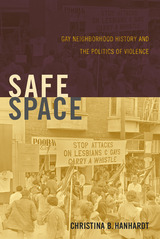
front cover of Safe Space
Safe Space
Gay Neighborhood History and the Politics of Violence
Christina B. Hanhardt
Duke University Press, 2013
Winner, 2014 Lambda Literary Award in LGBT Studies

Since the 1970s, a key goal of lesbian and gay activists has been protection against street violence, especially in gay neighborhoods. During the same time, policymakers and private developers declared the containment of urban violence to be a top priority. In this important book, Christina B. Hanhardt examines how LGBT calls for "safe space" have been shaped by broader public safety initiatives that have sought solutions in policing and privatization and have had devastating effects along race and class lines.

Drawing on extensive archival and ethnographic research in New York City and San Francisco, Hanhardt traces the entwined histories of LGBT activism, urban development, and U.S. policy in relation to poverty and crime over the past fifty years. She highlights the formation of a mainstream LGBT movement, as well as the very different trajectories followed by radical LGBT and queer grassroots organizations. Placing LGBT activism in the context of shifting liberal and neoliberal policies, Safe Space is a groundbreaking exploration of the contradictory legacies of the LGBT struggle for safety in the city.

[more]


Send via email Share on Facebook Share on Twitter