
front cover of Burn Me Back
Burn Me Back
Peggy Robles-Alvarado
Four Way Books, 2025
“My Spanglish,” Peggy Robles-Alvarado declares, “drops the -s and makes it ma’ o meno’,” replaces accent marks with side-eye, “has a Tía sin papeles,” and recognizes that “there is no other way to say— / Cónchole papi, you look good!” Igniting across tongues, cultures, and countries, the incendiary poems in Burn Me Back harness the incantatory power of language through hybrid forms, preserving a beloved father’s memory, enshrining the legacy of the Latino immigrant community in Washington Heights and the Bronx, reimagining the world we share, and speaking toward a hopeful multiplicity of possible futures. At the cross section of Puerto Rican and Dominican diasporas, rooted in ancestral narratives and infused with generational dislocation, this speaker refuses to abandon what resists translation, makes the space she needs, and transforms objects as she names them: “My Spanglish knows a fire escape is also a terrace.” Yes, the language here is a feat of engineering — a design shaped by the conditions of emergency, an architecture of survival, deliverance to open air. Like isolating the notes in a thunderous chord, Robles-Alvarado dexterously teases out each word’s many meanings, listening for the individual strains that created her as she archives family lore and fleshes out her personal history, writing against patriarchy while codifying working-class wisdom. She reconstructs a whole genealogy in “What They Mean by Papers,” reciting a negative litany of “papeles.” “Not the Daily News or El Diario La Prensa, / or the kind my mother read to me on Sunday / mornings,” her “throat full of / pelitos de mango,” “Not the kind Tía Weltina used to roll her tobacco with,” “conjuring / Taíno spirits she exhaled … as she tried to memorize the national anthem,” but the kind “Uncle Rito forged” while he “learned to curl the R in his name / as if writing sacred geometry,” “the kind that convinced four of my aunts to marry older / naturalized men in exchange for an acre of my grandfather’s campo” — the kind that required the rest of their lives as payment, “their bodies, / all their milk and honey, all their amber and caña dulce / sacrificed to the lust of viejos verdes, old bastards / who soured early on too much tabaco y ron and wanted to plant / their moldy seeds in supple girls who had never seen snow.” Robles-Alvarado orchestrates the fullness of her song by refusing to leave anyone out, by making room for a term’s contradictory definitions and playing through discordant combinations until the dissonance resolves. What began as an elegy composed by a daughter lost in mourning becomes an expansive arrangement sounding rupture and repair. This music travels between loss and recovery, addiction and sobriety, the cooling embers of lost childhood and the heat of the present, this very moment in which you could reach out to the people around you and ask them to be here with you for every scalding second, the warmth of your skin against theirs posing a burning question — an invitation to burn you back. 
[more]

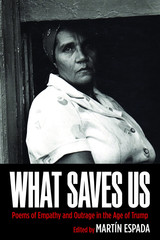
front cover of What Saves Us
What Saves Us
Poems of Empathy and Outrage in the Age of Trump
Edited by Martín Espada
Northwestern University Press, 2019

This is an anthology of poems in the Age of Trump—and much more than Trump. These are poems that either embody or express a sense of empathy or outrage, both prior to and following his election, since it is empathy the president lacks and outrage he provokes.

There is an extraordinary diversity of voices here. The ninety-three poets featured include Elizabeth Alexander, Julia Alvarez, Richard Blanco, Carolyn Forché, Aracelis Girmay, Donald Hall, Juan Felipe Herrera, Yusef Komunyakaa, Naomi Shihab Nye, Marge Piercy, Robert Pinsky, Danez Smith, Patricia Smith, Brian Turner, Ocean Vuong, Bruce Weigl, and Eleanor Wilner. They speak of persecuted and scapegoated immigrants. They bear witness to violence: police brutality against African Americans, mass shootings in a school or synagogue, the rage inflicted on women everywhere. They testify to poverty: the waitress surviving on leftovers at the restaurant, the battles of a teacher in a shelter for homeless mothers, the emergency-room doctor listening to the heartbeats of his patients. There are voices of labor, in the factory and the fields. There are prophetic voices, imploring us to imagine the world we will leave behind in ruins lest we speak and act.

However, this is not merely a collection of grievances. The poets build bridges. One poet steps up to translate in Arabic at the airport; another walks through the city and sees her immigrant past in the immigrant present; another declaims a musical manifesto after the hurricane that devastated his island; another evokes a demonstration in the street, shouting in an ecstasy of defiance. The poets take back the language, resisting the demagogic corruption of words themselves. They assert our common humanity in the face of dehumanization.

[more]


Send via email Share on Facebook Share on Twitter