
front cover of A Theory of System Justification
A Theory of System Justification
John T. Jost
Harvard University Press, 2020

A leading psychologist explains why nearly all of us—including many of those who are persecuted and powerless—so often defend the social systems that cause misery and injustice.

Why do we so often defend the very social systems that are responsible for injustice and exploitation? In A Theory of System Justification, John Jost argues that we are motivated to defend the status quo because doing so serves fundamental psychological needs for certainty, security, and social acceptance. We want to feel good not only about ourselves and the groups to which we belong, but also about the overarching social structure in which we live, even when it hurts others and ourselves.

Jost lays out the wide range of evidence for his groundbreaking theory and examines its implications for our communities and our democracy. Drawing on twenty-five years of research, he provides an accessible account of system justification theory and its insights. System justification helps to explain deep contradictions, including the feeling among some women that they don’t deserve the same salaries as men and the tendency of some poor people to vote for policies that increase economic inequality.

The theory illuminates the most pressing social and political issues of our time—why has it been so hard to combat anthropogenic climate change?—as well as some of the most intimate—why do some black children prefer white dolls to black ones and why do some people stay in bad relationships? Jost’s theory has far-reaching implications, and he offers numerous insights that political activists and social justice advocates can use to promote change.
[more]

front cover of To Exist is to Resist
To Exist is to Resist
Black Feminism in Europe
Edited by Akwugo Emejulu and Francesca Sobande
Pluto Press, 2019
This book brings together activists, artists and scholars of colour to show how Black feminism and Afrofeminism are being practiced in Europe today, exploring their differing social positions in various countries, and how they organise and mobilise to imagine a Black feminist Europe.

Deeply aware that they are constructed as 'Others' living in a racialised and hierarchical continent, the contibutors explore gender, class, sexuality and legal status to show that they are both invisible - presumed to be absent from and irrelevant to European societies - and hyper-visible - assumed to be passive and sexualised, angry and irrational.

Through imagining a future outside the neocolonial frames and practices of contemporary Europe, this book explores a variety of critical spaces including motherhood and the home, friendships and intimate relationships, activism and community, and literature, dance and film.
[more]

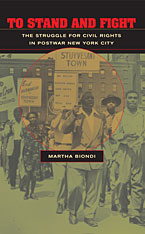
front cover of To Stand and Fight
To Stand and Fight
The Struggle for Civil Rights in Postwar New York City
Martha Biondi
Harvard University Press, 2006

The story of the Civil Rights Movement typically begins with the Montgomery bus boycott of 1955 and culminates with the 1965 voting rights struggle in Selma. But as Martha Biondi shows, a grassroots struggle for racial equality in the urban North began a full ten years before the rise of the movement in the South. This story is an essential first chapter, not only to the southern movement that followed, but to the riots that erupted in northern and western cities just as the Civil Rights Movement was achieving major victories.

Biondi tells the story of African Americans who mobilized to make the war against fascism a launching pad for a postwar struggle against white supremacy at home. Rather than seeking integration in the abstract, Black New Yorkers demanded first-class citizenship—jobs for all, affordable housing, protection from police violence, access to higher education, and political representation. This powerful local push for economic and political equality met broad resistance, yet managed to win several landmark laws barring discrimination and segregation.

To Stand and Fight demonstrates how Black New Yorkers launched the modern civil rights struggle and left a rich legacy.

[more]

front cover of To Wake the Nations
To Wake the Nations
Race in the Making of American Literature
Eric J. Sundquist
Harvard University Press, 1993

This powerful book argues that white culture in America does not exist apart from black culture. The revolution of the rights of man that established this country collided long ago with the system of slavery, and we have been trying to reestablish a steady course for ourselves ever since. To Wake the Nations is urgent and rousing: we have integrated our buses, schools, and factories, but not the canon of American literature. That is the task Eric Sundquist has assumed in a book that ranges from politics to literature, from Uncle Remus to African American spirituals. But the hallmark of this volume is a sweeping reevaluation of the glory years of American literature—from 1830 to 1930—that shows how white literature and black literature form a single interwoven tradition.

By examining African America’s contested relation to the intellectual and literary forms of white culture, Sundquist reconstructs the main lines of American literary tradition from the decades before the Civil War through the early twentieth century. An opening discussion of Nat Turner’s “Confessions,” recorded by a white man, Thomas Gray, establishes a paradigm for the complexity of meanings that Sundquist uncovers in American literary texts. Focusing on Frederick Douglass’s autobiographical books, Herman Melville’s Benito Cereno, Martin Delany’s novel Blake; or the Huts of America, Mark Twain’s Pudd’nhead Wilson, Charles Chesnutt’s fiction, and W. E. B. Du Bois’s The Souls of Black Folk and Darkwater, Sundquist considers each text against a rich background of history, law, literature, politics, religion, folklore, music, and dance. These readings lead to insights into components of the culture at large: slavery as it intersected with postcolonial revolutionary ideology; literary representations of the legal and political foundations of segregation; and the transformation of elements of African and antebellum folk consciousness into the public forms of American literature.

[more]

front cover of Town and Country
Town and Country
Race Relations in an Urban-Rural Context, Arkansas, 1865–1905
John Graves
University of Arkansas Press, 1990

A thoroughly researched and extensively documented look at race relations in Arkansas druing the forty years after the Civil War, Town and Country focuses on the gradual adjustment of black and white Arkansans to the new status of the freedman, in both society and law, after generations of practicing the racial etiquette of slavery.

John Graves examines the influences of the established agrarian culture on the developing racial practices of the urban centers, where many blacks living in the towns were able to gain prominence as doctors, lawyers, successful entrepreneurs, and political leaders. Despite the tension, conflict, and disputes within and between the voice of the government and the voice of the people in an arduous journey toward compromise, Arkansas was one of the most progressive states during Reconstruction in desegregating its people.

Town and Country makes a significant contribution to the history of the postwar South and its complex engagement with the race issue.

[more]

front cover of Transnational Marriage and Partner Migration
Transnational Marriage and Partner Migration
Constellations of Security, Citizenship, and Rights
Anne-Marie D'Aoust
Rutgers University Press, 2022
This multidisciplinary collection investigates the ways in which marriage and partner migration processes have become the object of state scrutiny, and the site of sustained political interventions in several states around the world. Covering cases as varied as the United States, Canada, Japan, Iran, France, Belgium or the Netherlands, among others, contributors reveal how marriage and partner migration have become battlegrounds for political participation, control, and exclusion. Which forms of attachments (towards the family, the nation, or specific individuals) have become framed as risks to be managed? How do such preoccupations translate into policies? With what consequences for those affected by them, in terms of rights and access to citizenship? The book answers these questions by analyzing the interplay between issues of security, citizenship and rights from the perspectives of migrants and policymakers, but also from actors who negotiate encounters with the state, such as lawyers, non-governmental organizations, and translators. 
[more]

front cover of Traveling Freely
Traveling Freely
Essays
Roberto Carlos Garcia
Northwestern University Press, 2025

A poet’s debut essay collection exploring American faults through the eyes of a Dominican American

In Traveling Freely: Essays, Roberto Carlos Garcia explores intersecting topics such as race, identity, American socioeconomic inequality, police violence, our inability to partake in our culture as innocents, and our complicity as Americans in all that’s wrong with the United States from the author’s specific vantage point as a Black Dominican American man. The voice in these essays is both clear and nuanced, and as readers move through the collection, the various themes cohere into a multilayered investigation of institutional racism and the inherent exploitations of capitalism.

In essays that are uniquely straightforward and accessible, Garcia insists that in order to resist state-sanctioned violence against marginalized bodies and populations, we must understand our shared history of oppression—so that we can rise against it effectively and find new paths forward.

[more]

front cover of Traveling without Moving
Traveling without Moving
Essays from a Black Woman Trying to Survive in America
Taiyon J. Coleman
University of Minnesota Press, 2024

A stunning lyrical commentary on the constructions of race, gender, and class in the fraught nexus of a Black woman’s personal experience and cultural history


The Fair Housing Act passed in 1968, and more than fifty years later, yours seems to be the only Black family on your block in Minneapolis. You and your Black African husband, both college graduates, make less money than some White people with a felony record and no high school diploma. You’re the only Black student in your graduate program. You just aren’t working hard enough. You’re too sensitive. Sandra Bland? George Floyd? Don't take everything so personally. Amid the White smiles of Minnesota Nice and the Minnesota Paradox—the insidious racism of an ostensibly inclusive place to live—what do you do? If you’re Taiyon J. Coleman, you write.


In Traveling without Moving, Coleman shares intimate essays from her life: her childhood in Chicago—growing up in poverty with four siblings and a single mother—and the empowering decision to leave her first marriage. She writes about being the only Black student in a prestigious and predominantly White creative writing program, about institutional racism and implicit bias in writing instruction, about the violent legacies of racism in the U.S. housing market, about the maternal health disparities seen across the country and their implication in her own miscarriage. She explores what it means to write her story and that of her family—an act at once a responsibility and a privilege—bringing forth the inherent contradictions between American ideals and Black reality.


Using a powerful blend of perspectives that move between a first-person lens of lived experience and a wider-ranging critique of U.S. culture, policy, and academia, Coleman’s writing evinces how a Black woman in America is always on the run, always Harriet Tubman, traveling with her babies in tow, seeking safety, desperate to survive, thrive, and finally find freedom.


Retail e-book files for this title are screen-reader friendly.

[more]

front cover of Trial by Treatment
Trial by Treatment
Punishing Illness in an Age of Criminal Legal Reform
Mary Ellen Stitt
University of Chicago Press, 2025

A troubling account of the unexpected impacts of treatment-based alternatives to criminal punishment.

Every year, courts send hundreds of thousands of people to treatment-based programs as alternatives to traditional punishment. These alternatives—known as ‘diversion programs’—are widely celebrated as reforms that reduce the punishment of the mentally ill. But in Trial by Treatment, Mary Ellen Stitt shows that they have, in fact, expanded the reach of the criminal legal system and its power over the lives of the most vulnerable.

The inner workings of diversion programs are obscure, partially by design, and data on outcomes is hard to come by. Stitt draws on two years of fieldwork in criminal courtrooms and court-mandated treatment sessions, as well as an original national dataset, in-depth interviews, and experimental survey data, to document the hidden impacts of diversion. She shows that placing mental healthcare under the control of the courts has helped to legitimize the criminalization of illness, warped treatment environments, and amplified inequalities in punishment. In vivid and humanizing detail, Trial by Treatment shows how reforms that keep power and discretion in the same hands can entrench the very problems they promised to solve.

[more]

front cover of Trial by Treatment
Trial by Treatment
Punishing Illness in an Age of Criminal Legal Reform
Mary Ellen Stitt
University of Chicago Press, 2025

This is an auto-narrated audiobook version of this book.

A troubling account of the unexpected impacts of treatment-based alternatives to criminal punishment.

Every year, courts send hundreds of thousands of people to treatment-based programs as alternatives to traditional punishment. These alternatives—known as ‘diversion programs’—are widely celebrated as reforms that reduce the punishment of the mentally ill. But in Trial by Treatment, Mary Ellen Stitt shows that they have, in fact, expanded the reach of the criminal legal system and its power over the lives of the most vulnerable.

The inner workings of diversion programs are obscure, partially by design, and data on outcomes is hard to come by. Stitt draws on two years of fieldwork in criminal courtrooms and court-mandated treatment sessions, as well as an original national dataset, in-depth interviews, and experimental survey data, to document the hidden impacts of diversion. She shows that placing mental healthcare under the control of the courts has helped to legitimize the criminalization of illness, warped treatment environments, and amplified inequalities in punishment. In vivid and humanizing detail, Trial by Treatment shows how reforms that keep power and discretion in the same hands can entrench the very problems they promised to solve.

[more]

front cover of Trouble the Water
Trouble the Water
Melvin Dixon
University of Alabama Press, 1989

A haunting and poetic journey of memory, identity, and reconciliation in the heart of the Black South.

Winner of the Excellence in Minority Fiction Award

Trouble the Water moves among finely woven layers of time and place as it takes on a new and controversial theme in contemporary black writing, the search for family reconciliation. Twenty years after running away from home in Pee Dee, North Carolina, Jordan Henry believed he had found success, as a young college professor of history, a married man, and a resident of New England, whose colonial past he knew so well. When Jordan finds his career stymied by local prejudices, his world crumbles. Word of his grandmother's death reaches him, and he returns home to claim the ambiguous legacy of her farmland and face the consequences of his long absence.

Jordan's estranged father also returns to Pee Dee on a quest of his own restoring his good name in a community which blames him for Chloe Henry's death in childbirth. Chloe was Jordan's mother and his grandmother's only child. Unresolved hostility in the family and in the community breaks out, making Jordan the unsuspecting pawn in a plot of revenge against his father. Jordan may be the only one who can free his family from the past and the equally troubled present.

Trouble the Water gains resonance from its unflinching confrontation with dualities common in the Afro-American experience: reality and myth, folklore and sophistication, North and South, rural and cosmopolitan. While sacrificing none of its complexities for the sake of simplicity, it has the relentless movement of a fairy tale that reaches deep into the unconscious roots of behavior. It is intensely lyrical and dense in realism. Trouble the Water is magical in the way it reveals the Afro-American psyche and symbolizes fundamental truths about American life.

[more]

front cover of The Turkishness Contract
The Turkishness Contract
Baris Ünlü
Temple University Press, 2025
The Turkishness Contract places Critical Race Theory in conversation with literature on Turkey and nation-state making via a historical study enriched by in-depth interviews. In this new English-language edition, Barış Ünlü makes a number of comprehensive changes to his widely read and much discussed 2018 Turkish book, including a new preface and a new sweeping and theoretical introduction.

Ünlü uses Critical Race Theory to present a historical–sociological model to examine not only the historical constitution and contemporary functioning of the Turkish nation-state, but also the affective and bodily modalities of being Turkish. He also develops a framework for rethinking the complex relations between the socio-genesis of the Turkish nation and state and the psycho-genesis of the Turkish people, their cognitive habits and emotional orientations, and the structural privileges and unconsciousness strategies of Turkishness.

The Turkishness Contract addresses broader theoretical concerns including histories of colonialism, ethnic/racial social contracts, privilege, Armenian Genocide and the Kurdish question, as well as the unraveling of Turkey’s social contract at a moment of contemporary right-wing authoritarianism. 

In the series Critical Race, Indigeneity, and Relationality
[more]

front cover of The Two Princes of Calabar
The Two Princes of Calabar
An Eighteenth-Century Atlantic Odyssey
Randy J. Sparks
Harvard University Press, 2009

In 1767, two “princes” of a ruling family in the port of Old Calabar, on the slave coast of Africa, were ambushed and captured by English slavers. The princes, Little Ephraim Robin John and Ancona Robin Robin John, were themselves slave traders who were betrayed by African competitors—and so began their own extraordinary odyssey of enslavement. Their story, written in their own hand, survives as a rare firsthand account of the Atlantic slave experience.

Randy J. Sparks made the remarkable discovery of the princes’ correspondence and has managed to reconstruct their adventures from it. They were transported from the coast of Africa to Dominica, where they were sold to a French physician. By employing their considerable language and interpersonal skills, they cleverly negotiated several escapes that took them from the Caribbean to Virginia, and to England, but always ended in their being enslaved again. Finally, in England, they sued for, and remarkably won, their freedom. Eventually, they found their way back to Old Calabar and, evidence suggests, resumed their business of slave trading.

The Two Princes of Calabar offers a rare glimpse into the eighteenth-century Atlantic World and slave trade from an African perspective. It brings us into the trading communities along the coast of Africa and follows the regular movement of goods, people, and ideas across and around the Atlantic. It is an extraordinary tale of slaves’ relentless quest for freedom and their important role in the creation of the modern Atlantic World.

[more]


Send via email Share on Facebook Share on Twitter