front cover of Queer, Women of Color, and Critical Approaches to Feminist Mentorship and Pedagogy
Queer, Women of Color, and Critical Approaches to Feminist Mentorship and Pedagogy
Edited by Leandra H. Hernández, Stevie M. Munz, and Jessica Pauly
University of Illinois Press, 2025
Feminist mentorship remains in short supply within communication studies and feminist and gender studies. A diverse group of contributors from the undergraduate level to senior scholars use Black feminist, Chicana feminist, and queer lenses to explore feminist mentorship examples in both pedagogical and relationship-building contexts.

The first section draws upon the contributors’ unique and situated experiences of mentorship in academia. Essays explore their past and current experiences with feminist mentorship in relationships that take many forms: faculty members with fellow faculty members; faculty members with undergraduate and graduate students; and faculty members who feel as if they have become family with their mentors and mentees. In the second section, the contributors deeply interrogate the practices of feminist mentoring by problematizing practices and offering new ways, places, and formats that make space and consider new possibilities. A conclusion reflects on the future of feminist mentorship amidst contemporary debates and concerns in higher education.

Enriching and hopeful, Queer, Women of Color, and Critical Approaches to Feminist Mentorship and Pedagogy is a much-needed challenge to traditional forms of mentorship.

[more]

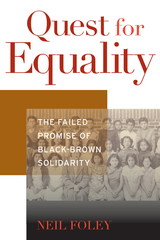
front cover of Quest for Equality
Quest for Equality
The Failed Promise of Black-Brown Solidarity
Neil Foley
Harvard University Press, 2010

As the United States championed principles of freedom and equality during World War II, it denied fundamental rights to many non-white citizens. In the wake of President Franklin Roosevelt’s “Good Neighbor” policy with Latin America, African American and Mexican American civil rights leaders sought ways to make that policy of respect and mutual obligations apply at home as well as abroad. They argued that a whites-only democracy not only denied constitutional protection to every citizen but also threatened the war effort and FDR’s aims.

Neil Foley examines the complex interplay among regional, national, and international politics that plagued the efforts of Mexican Americans and African Americans to find common ground in ending employment discrimination in the defense industries and school segregation in the war years and beyond. Underlying differences in organizational strength, political affiliation, class position, and level of assimilation complicated efforts by Mexican and black Americans to forge strategic alliances in their fight for economic and educational equality. The prospect of interracial cooperation foundered as Mexican American civil rights leaders saw little to gain and much to lose in joining hands with African Americans.

Over a half century later, African American and Latino civil rights organizations continue to seek solutions to relevant issues, including the persistence of de facto segregation in our public schools and the widening gap in wealth and income in America. Yet they continue to grapple with the difficulty of forging solidarity across lines of cultural, class, and racial-ethnic difference, a struggle that remains central to contemporary American life.


[more]

front cover of Quiet Methodologies
Quiet Methodologies
Humility in the Humanities
Suzanne Bost
University of Minnesota Press, 2025

Reimagining humanities scholarship with humility and inclusive attention

How might foregrounding the writings of colonized peoples transform the ways we work in the humanities? In an era dominated by loud political rhetoric, Suzanne Bost advocates for quieter modes of scholarship: intellectual humility rather than ego, collaboration and conversation rather than singular argumentation, continual reflection and revision rather than defensiveness, and a willingness to believe in different ways of being and knowing rather than adhering to academic norms. With Quiet Methodologies, she demonstrates practical decolonial scholarship and proposes alternative approaches for fostering meaningful engagement.

Turning to feminist, queer, and decolonial writings from Gloria Anzaldúa, Alexis Pauline Gumbs, Audre Lorde, and many others, Bost reflects on what we do when we work with literature, culture, and ideas. She weaves together multiple voices, methods of writing, and culturally diverse epistemologies and uses creative devices such as collage, her own original poetry, revision, lists, images, and conversation to disengage academic thought and writing from colonial theories and archives that have passed as neutral. Eschewing conventional monograph formats, her work embraces a reciprocal and heterogeneous learning process with profound ethical implications.

Part of a movement of reimagining research and education through care, Quiet Methodologies is a powerful exploration of the possibilities of criticism during crises. It encourages readers to be visionary and pragmatic, challenging current conditions and offering alternative ideas for the future of the humanities.

Retail e-book files for this title are screen-reader friendly with images accompanied by short alt text and/or extended descriptions.

[more]


Send via email Share on Facebook Share on Twitter