
 A SCHOLARLY BOOK REPOSITORY
12 start with P start with P
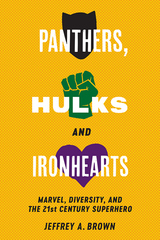
Panthers, Hulks, and Ironhearts offers the first comprehensive study of how Marvel has reimagined what a superhero might look like in the twenty-first century. It examines how they have revitalized older characters like Black Panther and Luke Cage, while creating new ones like Latina superhero Miss America. Furthermore, it considers the mixed fan responses to Marvel’s recasting of certain “legacy heroes,” including a Pakistani-American Ms. Marvel, a Korean-American Hulk, and a whole rainbow of multiverse Spidermen.
If the superhero comic is a quintessentially American creation, then how might the increasing diversification of Marvel’s superhero lineup reveal a fundamental shift in our understanding of American identity? This timely study answers those questions and considers what Marvel’s comics, TV series, and films might teach us about stereotyping, Orientalism, repatriation, whitewashing, and identification.
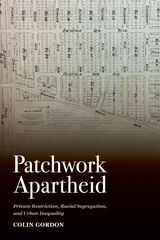
Gordon also explores the role of other policies and practices in sustaining segregation. Enforcement of private racial restrictions was held unconstitutional in 1948, and such agreements were prohibited outright in 1968. But their premises and assumptions, and the segregation they had accomplished, were accommodated by local zoning and federal housing policies. Explicit racial restrictions were replaced by the deceptive business practices of real estate agents and developers, who characterized certain neighborhoods as white and desirable and others as black and undesirable, thereby hiding segregation behind the promotion of sound property investments, safe neighborhoods, and good schools. These practices were in turn replaced by local zoning, which systematically protected white neighborhoods while targeting “blighted” black neighborhoods for commercial and industrial redevelopment, and by a tangle of federal policies that reliably deferred to local and private interests with deep investments in local segregation. Private race restriction was thus a key element in the original segregation of American cities and a source of durable inequalities in housing wealth, housing opportunity, and economic mobility.
Patchwork Apartheid exhaustively documents the history of private restriction in urban settings and demonstrates its crucial role in the ideas and assumptions that have sustained racial segregation in the United States into the twenty-first century.

Pulitzer Prize–winning novelist Toni Morrison brings the genius of a master writer to this personal inquiry into the significance of African-Americans in the American literary imagination. Her goal, she states at the outset, is to “put forth an argument for extending the study of American literature…draw a map, so to speak, of a critical geography and use that map to open as much space for discovery, intellectual adventure, and close exploration as did the original charting of the New World—without the mandate for conquest.”
Author of Beloved, The Bluest Eye, Song of Solomon, and other vivid portrayals of black American experience, Morrison ponders the effect that living in a historically racialized society has had on American writing in the nineteenth and twentieth centuries. She argues that race has become a metaphor, a way of referring to forces, events, and forms of social decay, economic division, and human panic. Her compelling point is that the central characteristics of American literature individualism, masculinity, the insistence upon innocence coupled to an obsession with figurations of death and hell—are responses to a dark and abiding Africanist presence.
Through her investigation of black characters, narrative strategies, and idiom in the fiction of white American writers, Morrison provides a daring perspective that is sure to alter conventional notions about American literature. She considers Willa Cather and the impact of race on concept and plot; turns to Poe, Hawthorne, and Melville to examine the black force that figures so significantly in the literature of early America; and discusses the implications of the Africanist presence at the heart of Huckleberry Finn. A final chapter on Ernest Hemingway is a brilliant exposition of the racial subtext that glimmers beneath the surface plots of his fiction.
Written with the artistic vision that has earned her a preeminent place in modern letters, Playing in the Dark will be avidly read by Morrison admirers as well as by students, critics, and scholars of American literature.
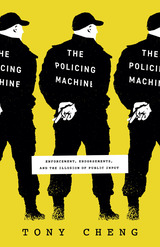
The past few years have seen Americans express passionate demands for police transformation. But even as discussion of no-knock warrants, chokeholds, and body cameras has exploded, any changes to police procedures have only led to the same outcomes. Despite calls for increased accountability, police departments have successfully stonewalled change.
In The Policing Machine, Tony Cheng reveals the stages of that resistance, offering a close look at the deep engagement strategies that NYPD precincts have developed with only subsets of the community in order to counter any truly meaningful, democratic oversight. Cheng spent nearly two years in an unprecedented effort to understand the who and how of police-community relationship building in New York City, documenting the many ways the police strategically distributed power and privilege within the community to increase their own public legitimacy without sacrificing their organizational independence. By setting up community councils that are conveniently run by police allies, handing out favors to local churches that will promote the police to their parishioners, and offering additional support to institutions friendly to the police, the NYPD, like police departments all over the country, cultivates political capital through a strategic politics that involves distributing public resources, offering regulatory leniency, and deploying coercive force. The fundamental challenge with police-community relationships, Cheng shows, is not to build them. It is that they already exist and are motivated by a machinery designed to stymie reform.
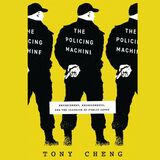
A revelatory look at how the NYPD has resisted change through strategic and selective community engagement.
The past few years have seen Americans express passionate demands for police transformation. But even as discussion of no-knock warrants, chokeholds, and body cameras has exploded, any changes to police procedures have only led to the same outcomes. Despite calls for increased accountability, police departments have successfully stonewalled change.
In The Policing Machine, Tony Cheng reveals the stages of that resistance, offering a close look at the deep engagement strategies that NYPD precincts have developed with only subsets of the community in order to counter any truly meaningful, democratic oversight. Cheng spent nearly two years in an unprecedented effort to understand the who and how of police-community relationship building in New York City, documenting the many ways the police strategically distributed power and privilege within the community to increase their own public legitimacy without sacrificing their organizational independence. By setting up community councils that are conveniently run by police allies, handing out favors to local churches that will promote the police to their parishioners, and offering additional support to institutions friendly to the police, the NYPD, like police departments all over the country, cultivates political capital through a strategic politics that involves distributing public resources, offering regulatory leniency, and deploying coercive force. The fundamental challenge with police-community relationships, Cheng shows, is not to build them. It is that they already exist and are motivated by a machinery designed to stymie reform.
While college initiates a major transition in all students’ lives, low-income and first-generation students attending elite schools are often entering entirely new worlds. Amid the financial and academic challenges of adapting to college, their emotional lives, too, undergo a transformation. Surrounded by peers from different classes and cultural backgrounds, they are faced with an impossible choice: turn away from their former lives to blend in or stay true to themselves and remain on the outside.
An ethnography that draws on in-depth interviews with one hundred and fifty first-generation and low-income students across eighteen elite institutions, Polished uncovers the hidden consequences of the promise of social mobility in today’s educational landscape. Sociologist Melissa Osborne reveals how the very support designed to propel first-generation students forward can unexpectedly reshape their identities, often putting them at odds with their peers and families. Without direct institutional support, this emotional journey can lead to alienation, mental health challenges, poor academic outcomes, and difficult choices between upward mobility or maintaining authenticity and community. Whether you're an educator, advocate, or student, Polished provides a powerful perspective on the uncharted challenges of social mobility and personal identity during college.
This book presents a sociological study of how and why racial prejudice against members of a minority group comes to shape what happens to important political claims and aspirations of the group. Lawrence Bobo and Mia Tuan explore a lengthy controversy surrounding the fishing, hunting, and gathering rights of the Chippewa Indians in Wisconsin. The controversy started in 1974, when two Chippewa Indians were arrested for off-reservation fishing, and persisted into the 1990s. It involved the efforts of the Chippewa to assert their traditional spearfishing rights, which met with angry, racially charged responses from whites.
Bobo and Tuan develop a "group position" perspective on racial attitudes that takes account of the complex interplay of racial stereotypes and negative group feelings as well as the vested interests, collective privileges, and political threats that form the basis of racialized political disputes. They explore whether theories that explain race politics in the case of black-white relations are applicable to understanding Indian-white relations. The book uses a carefully designed survey of public opinion to explore the dynamics of prejudice and political contestation, and to further our understanding of how and why racial prejudice enters into politics in the United States.
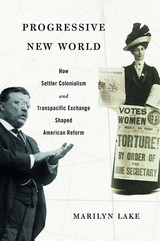
The paradox of progressivism continues to fascinate more than one hundred years on. Democratic but elitist, emancipatory but coercive, advanced and assimilationist, Progressivism was defined by its contradictions. In a bold new argument, Marilyn Lake points to the significance of turn-of-the-twentieth-century exchanges between American and Australasian reformers who shared racial sensibilities, along with a commitment to forging an ideal social order. Progressive New World demonstrates that race and reform were mutually supportive as Progressivism became the political logic of settler colonialism.
White settlers in the United States, who saw themselves as path-breakers and pioneers, were inspired by the state experiments of Australia and New Zealand that helped shape their commitment to an active state, women’s and workers’ rights, mothers’ pensions, and child welfare. Both settler societies defined themselves as New World, against Old World feudal and aristocratic societies and Indigenous peoples deemed backward and primitive.
In conversations, conferences, correspondence, and collaboration, transpacific networks were animated by a sense of racial kinship and investment in social justice. While “Asiatics” and “Blacks” would be excluded, segregated, or deported, Indians and Aborigines would be assimilated or absorbed. The political mobilizations of Indigenous progressives—in the Society of American Indians and the Australian Aborigines’ Progressive Association—testified to the power of Progressive thought but also to its repressive underpinnings. Burdened by the legacies of dispossession and displacement, Indigenous reformers sought recognition and redress in differently imagined new worlds and thus redefined the meaning of Progressivism itself.
When inclusion into the fold of citizenship is conditioned by a social group’s conceit to ritual violence, humiliation, and exploitation, what can anti-citizenship offer us?
The Promise of Youth Anti-citizenship argues that Black youth and youth of color have been cast as anti-citizens, disenfranchised from the social, political, and economic mainstream of American life. Instead of asking youth to conform to a larger societal structure undergirded by racial capitalism and antiblackness, the volume’s contributors propose that the collective practice of anti-citizenship opens up a liberatory space for youth to challenge the social order.
The chapters cover an array of topics, including Black youth in the charter school experiment in post-Katrina New Orleans; racial capitalism, the queering of ethnicity, and the 1980s Salvadoran migration to South Central Los Angeles; the notion of decolonizing classrooms through Palestinian liberation narratives; and more. Through a range of methodological approaches and conceptual interventions, this collection illuminates how youth negotiate and exercise anti-citizenship as forms of either resistance or refusal in response to coercive patriotism, cultural imperialism, and predatory capitalism.
Contributors: Karlyn Adams-Wiggins, Portland State U; Ariana Brazier; Julio Cammarota, U of Arizona; Michael Davis, U of Wisconsin–Madison; Damaris C. Dunn, U of Georgia; Diana Gamez, U of California, Irvine; Rachel F. Gómez, Virginia Commonwealth U; Luma Hasan; Gabriel Rodriguez, Iowa State U; Christopher R. Rogers, U of Pennsylvania; Damien M. Sojoyner, U of California, Irvine.
READERS
Browse our collection.
PUBLISHERS
See BiblioVault's publisher services.
STUDENT SERVICES
Files for college accessibility offices.
RECENTLY PUBLISHED



UChicago Accessibility Resources
home | accessibility | search | about | contact us
BiblioVault ® 2001 - 2024
The University of Chicago Press