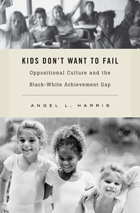
front cover of Kids Don't Want to Fail
Kids Don't Want to Fail
Oppositional Culture and the Black-White Achievement Gap
Angel L. Harris
Harvard University Press, 2011

Understanding the causes of the racial achievement gap in American education—and then addressing it with effective programs—is one of the most urgent problems communities and educators face.

For many years, the most popular explanation for the achievement gap has been the “oppositional culture theory”: the idea that black students underperform in secondary schools because of a group culture that devalues learning and sees academic effort as “acting white.” Despite lack of evidence for this belief, classroom teachers accept it, with predictable self-fulfilling results. In a careful quantitative assessment of the oppositional culture hypothesis, Angel L. Harris tested its empirical implications systematically and broadened his analysis to include data from British schools. From every conceivable angle of examination, the oppositional culture theory fell flat.

Despite achieving less in school, black students value schooling more than their white counterparts do. Black kids perform badly in high school not because they don’t want to succeed but because they enter without the necessary skills. Harris finds that the achievement gap starts to open up in preadolescence—when cumulating socioeconomic and health disadvantages inhibit skills development and when students start to feel the impact of lowered teacher expectations.

Kids Don’t Want to Fail is must reading for teachers, academics, policy makers, and anyone interested in understanding the intersection of race and education.

[more]

front cover of Kill the Overseer!
Kill the Overseer!
The Gamification of Slave Resistance
Sarah Juliet Lauro
University of Minnesota Press, 2020

Explores the representation of slave revolt in video games—and the trouble with making history playable

Kill the Overseer! profiles and problematizes digital games that depict Atlantic slavery and “gamify” slave resistance. In videogames emphasizing plantation labor, the player may choose to commit small acts of resistance like tool-breaking or working slowly. Others dramatically stage the slave’s choice to flee enslavement and journey northward, and some depict outright violent revolt against the master and his apparatus. In this work, Sarah Juliet Lauro questions whether the reduction of a historical enslaved person to a digital commodity in games such as Mission US, Assassin’s Creed, and Freedom Cry ought to trouble us as a further commodification of slavery’s victims, or whether these interactive experiences offer an empowering commemoration of the history of slave resistance. 

Forerunners is a thought-in-process series of breakthrough digital works. Written between fresh ideas and finished books, Forerunners draws on scholarly work initiated in notable blogs, social media, conference plenaries, journal articles, and the synergy of academic exchange. This is gray literature publishing: where intense thinking, change, and speculation take place in scholarship.


[more]

front cover of The Killing of Jane McCrea
The Killing of Jane McCrea
An American Tragedy on the Revolutionary Frontier
Paul Staiti
Westholme Publishing, 2025
The killing of Jane McCrea on July 26, 1777, on the outskirts of a village in the northern Hudson Valley, would unexpectedly rupture the British advance from Canada that was meant to crush the American Revolution in one knockout blow. On that day, twenty-five-year-old McCrea, an unremarkable person preparing for an impending marriage, was assaulted, scalped, and killed by a group of Native Americans in the employ of British general John Burgoyne. Though the murder was but one of many civilian deaths in a fierce war zone, McCrea’s killing had far-reaching consequences for each of the three major parties involved in the Northern Campaign of 1777. In America, she became the great cause célèbre of the Revolution, the sympathetic female victim of the war symbolizing the righteousness of The Cause. In Britain, she was a human-rights tragedy that tarnished the polished surface of British honor and galvanized Whig politicians who shouted out her name in Parliament as an example of how low the nation had fallen. For Native peoples, recruited by both the British and the Americans, and caught in the middle of a war staged on ancestral grounds, McCrea’s killing was the opening salvo in a vicious chain of bloody retribution that led to the disintegration of the venerable Iroquois Confederacy and the obliteration of Native homelands. After the war, the nightmarish image of a young Jane McCrea slaughtered on the New York frontier would obsess white Americans who came to fear Native peoples as irredeemable savages. Her murder would help justify the expulsion of Indigenous tribes and open the doors for an expansionary United States that was fully intent on transforming the American continent into its own image.
            The Killing of Jane McCrea: An American Tragedy on the Revolutionary Frontier by distinguished historian Paul Staiti undertakes for the first time a comprehensive investigation into McCrea’s life, death, and especially her long and strange afterlife. Using both visual arts and written records, the author reassembles the scattered fragments to illuminate a historical terrain long since shrouded in misinformation, mired in controversy, and relegated to mythology. Coming into view is a major portrait of the persons, cultures, actions, and motives that fatally converged on that hot July morning in 1777.
[more]


Send via email Share on Facebook Share on Twitter