
 A SCHOLARLY BOOK REPOSITORY
6 start with H start with H
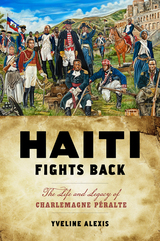
Haiti Fights Back: The Life and Legacy of Charlemagne Péralte is the first US scholarly examination of the politician and caco leader (guerrilla fighter) who fought against the US military occupation of Haiti. The occupation lasted close to two decades, from 1915-1934. Alexis argues for the importance of documenting resistance while exploring the occupation’s mechanics and its imperialism. She takes us to Haiti, exploring the sites of what she labels as resistance zones, including Péralte’s hometown of Hinche and the nation’s large port areas--Port-au-Prince and Cap-Haïtien. Alexis offers a new reading of U.S. military archival sources that record Haitian protests as banditry. Haiti Fights Back illuminates how Péralte launched a political movement, and meticulously captures how Haitian women and men resisted occupation through silence, military battles, and writings. She locates and assembles rare, multilingual primary sources from traditional repositories, living archives (oral stories), and artistic representations in Haiti and the United States. The interdisciplinary work draws on legislation, cacos’ letters, newspapers, and murals, offering a unique examination of Péralte’s life (1885-1919) and the significance of his legacy through the twenty-first century. Haiti Fights Back offers a new approach to the study of the U.S. invasion of the Americas by chronicling how Caribbean people fought back.
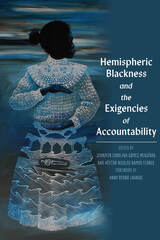
Hemispheric Blackness and the Exigencies of Accountability examines the way Afrodescendant and Black communities use the land on which they live, the rule of law, and their bodies to assert their historical, ontological, and physical presence across South, Central, and North America. Their demand for the recognition of ancestral lands, responsive policies, and human rights sheds new light on their permanent yet tenuous presence throughout the region. The authors argue that by deploying a discourse of transcontinental historical continuity, Black communities assert their presence in local, national, and international political spheres. This conceptualization of hemispheric Blackness is the driving force confronting the historical loss, dismissal, and disparagement of Black lives across the Américas. Through twelve case studies that cover a wide range of locations, their work examines contemporary manifestations of sovereignty of Black body and mind, Black-Indigenous nexuses, and national revisions that challenge more than a quincentennial of denial and state unaccountability in the hemisphere.
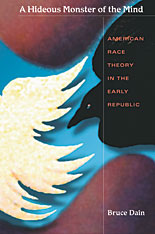
The intellectual history of race, one of the most pernicious and enduring ideas in American history, has remained segregated into studies of black or white traditions. Bruce Dain breaks this separatist pattern with an integrated account of the emergence of modern racial consciousness in the United States from the Revolution to the Civil War. A Hideous Monster of the Mind reveals that ideas on race crossed racial boundaries in a process that produced not only well-known theories of biological racism but also countertheories that were early expressions of cultural relativism, cultural pluralism, and latter-day Afrocentrism.
From 1800 to 1830 in particular, race took on a new reality as Americans, black and white, reacted to postrevolutionary disillusionment, the events of the Haitian Revolution, the rise of cotton culture, and the entrenchment of slavery. Dain examines not only major white figures like Thomas Jefferson and Samuel Stanhope Smith, but also the first self-consciously "black" African-American writers. These various thinkers transformed late-eighteenth-century European environmentalist "natural history" into race theories that combined culture and biology and set the terms for later controversies over slavery and abolition. In those debates, the ethnology of Samuel George Morton and Josiah Nott intertwined conceptually with important writing by black authors who have been largely forgotten, like Hosea Easton and James McCune Smith. Scientific racism and the idea of races as cultural constructions were thus interrelated aspects of the same effort to explain human differences.
In retrieving neglected African-American thinkers, reestablishing the European intellectual background to American racial theory, and demonstrating the deep confusion "race" caused for thinkers black and white, A Hideous Monster of the Mind offers an engaging and enlightening new perspective on modern American racial thought.

The brutality and racial hatred exhibited by Japan’s military during the Pacific War piqued outrage in the West and fanned resentments throughout Asia. Public understanding of Japan’s wartime atrocities, however, often fails to differentiate the racial agendas of its military and government elites from the racial values held by the Japanese people. While not denying brutalities committed by the Japanese military, Honored and Dishonored Guests overturns these standard narratives and demonstrates rather that Japan’s racial attitudes during wartime are more accurately discerned in the treatment of Western civilians living in Japan than the experiences of enemy POWs.
The book chronicles Western communities in wartime Japan, using this body of experiences to reconsider allegations of Japanese racism and racial hatred. Its bold thesis is borne out by a broad mosaic of stories from dozens of foreign families and individuals who variously endured police harassment, suspicion, relocation, starvation, denaturalization, internment, and torture, as well as extraordinary acts of charity. The book’s account of stranded Westerners—from Tokyo, Yokohama, and Kobe to the mountain resorts of Karuizawa and Hakone—yields a unique interpretation of race relations and wartime life in Japan.
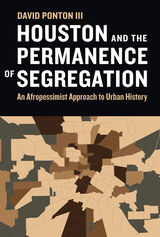
A history of racism and segregation in twentieth-century Houston and beyond.
Through the 1950s and beyond, the Supreme Court issued decisions that appeared to provide immediate civil rights protections to racial minorities as it relegated Jim Crow to the past. For black Houstonians who had been hoping and actively fighting for what they called a “raceless democracy,” these postwar decades were often seen as decades of promise. In Houston and the Permanence of Segregation, David Ponton argues that these were instead “decades of capture”: times in which people were captured and constrained by gender and race, by faith in the law, by antiblack violence, and even by the narrative structures of conventional histories. Bringing the insights of Black studies and Afropessimism to the field of urban history, Ponton explores how gender roles constrained thought in black freedom movements, how the “rule of law” compelled black Houstonians to view injustice as a sign of progress, and how antiblack terror undermined Houston’s narrative of itself as a “heavenly” place.
Today, Houston is one of the most racially diverse cities in the United States, and at the same time it remains one of the most starkly segregated. Ponton’s study demonstrates how and why segregation has become a permanent feature in our cities and offers powerful tools for imagining the world otherwise.
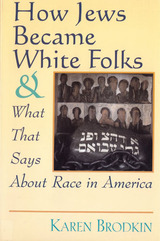
The history of Jews in the United States is one of racial change that provides useful insights on race in America. Prevailing classifications have sometimes assigned Jews to the white race and at other times have created an off-white racial designation for them. Those changes in racial assignment have shaped the ways American Jews of different eras have constructed their ethnoracial identities. Brodkin illustrates these changes through an analysis of her own family's multi-generational experience. She shows how Jews experience a kind of double vision that comes from racial middleness: on the one hand, marginality with regard to whiteness; on the other, whiteness and belonging with regard to blackness.
Class and gender are key elements of race-making in American history. Brodkin suggests that this country's racial assignment of individuals and groupsconstitutes an institutionalized system of occupational and residential segregation, is a key element in misguided public policy, and serves as a pernicious foundational principle in the construction of nationhood. Alternatives available to non-white and alien "others" have been either to whiten or to be consigned to an inferior underclass unworthy of full citizenship. The American ethnoracial map-who is assigned to each of these poles-is continually changing, although the binary of black and white is not. As a result, the structure within which Americans form their ethnoracial, gender, and class identities is distressingly stable. Brodkin questions the means by which Americans construct their political identities and what is required to weaken the hold of this governing myth.
READERS
Browse our collection.
PUBLISHERS
See BiblioVault's publisher services.
STUDENT SERVICES
Files for college accessibility offices.
RECENTLY PUBLISHED




UChicago Accessibility Resources
home | accessibility | search | about | contact us
BiblioVault ® 2001 - 2024
The University of Chicago Press