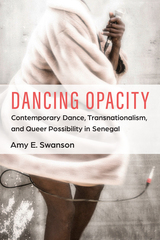
Dancing Opacity
Contemporary Dance, Transnationalism, and Queer Possibility in Senegal
Amy E. Swanson
University of Michigan Press, 2025
Amy Swanson’s Dancing Opacity chronicles the ways in which contemporary dancers in Senegal navigate the global contemporary dance circuit while challenging heteropatriarchal ideologies at home. A longstanding hub of African performing arts, Senegal was at the forefront of the explosion of contemporary dance across the continent at the turn of the twenty-first century. Drawing on ethnographic and historical research, Swanson demonstrates how Senegalese choreographers and dancers contend with entrenched racialized prejudices about Africa outside the continent, while pushing back against repressive regulations of gender and sexuality within Senegal. Swanson employs the concept of opacity, defined as a refusal to adhere to the colonial logic of transparency for dominant gazes and argues that artists create work with multiple layers of meaning that are not meant to be immediately transparent to all viewers. By doing so, these artists evade cultural norms that govern gender and sexual expression in Senegal, while challenging their international audiences to expand their perceptions of African dance. Dancing Opacity highlights the artists’ accounts of their pedagogies, performances, aesthetics, and lived realities, as well as Africanist conceptions of gender, sexuality, and queerness that have yet to be applied to contemporary dance.
[more]