
front cover of The Philosopher in Plato's Statesman
The Philosopher in Plato's Statesman
Mitchell Miller
Parmenides Publishing, 2004
In the Statesman, Plato brings together--only to challenge and displace--his own crowning contributions to philosophical method, political theory, and drama. In his 1980 study, reprinted here, Mitchell Miller employs literary theory and conceptual analysis to expose the philosophical, political, and pedagogical conflict that is the underlying context of the dialogue, revealing that its chaotic variety of movements is actually a carefully harmonized act of realizing the mean. The original study left one question outstanding: what specifically, in the metaphysical order of things, motivated the nameless Visitor from Elea to abandon bifurcation for his consummating non-bifurcatory division of fifteen kinds at the end of the dialogue? Miller addressed in a separate essay, first published in 1999 and reprinted here. In it, he opens the horizon of interpretation to include the new metaphysics of the Parmenides, the Philebus, and the "unwritten teachings."

"This study demonstrates how the Statesman is the culminating expression of Plato''s lifelong effort, both in Athens and in the Academy, to bring metaphysical insight to the unending political crisis of his times."The Philosopher in Plato's Statesman a trail-blazing work. While not every reader will agree with the lessons Miller himself draws from this approach, none should fail to be impressed by its interpretive power. All this is exciting stuff. The interpretive pathway on which Miller has embarked has the potential for changing the face of scholarship on the late Platonic dialogues. Parmenides [Publishing] is to be commended for making these two important contributions available under a single cover." --Kenneth Sayre, Professor of Philosophy, University of Notre Dame

"Miller casts considerable light on virtually every aspect of the dialogue. . . . All in all, this book is an outstanding contribution to our understanding of the Statesman." --Stanley Rosen, Borden Parker Bowne Professor of Philosophy, Boston University


MITCHELL MILLER is Professor of Philosophy at Vassar College. He is the author of Plato's Parmenides.
[more]

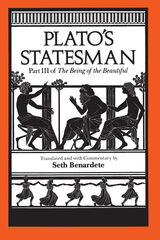
front cover of Plato's Statesman
Plato's Statesman
Part III of The Being of the Beautiful
Plato
University of Chicago Press, 1986
Three classic Platonic dialogues in the most authoritative translation available

Theaetetus is the first of a trilogy of Platonic dialogues that show Socrates formulating his conception of philosophy as he prepares the defense for his trial. This translation is particularly faithful to the original Greek, and it is accompanied by an introduction, extensive notes, and comprehensive commentary that puts the dialogue in context with Plato's thought and its influence over the centuries.

Seth Benardete (1930-2001) was professor of classics at New York University. 
[more]

front cover of A Stranger's Knowledge
A Stranger's Knowledge
Statesmanship, Philosophy, and Law in Plato's Statesman
Xavier Márquez
Parmenides Publishing, 2012
The Statesman is a difficult and puzzling Platonic dialogue. In A Stranger's Knowledge Marquez argues that Plato abandons here the classic idea, prominent in the Republic, that the philosopher, qua philosopher, is qualified to rule. Instead, the dialogue presents the statesman as different from the philosopher, the possessor of a specialist expertise that cannot be reduced to philosophy. The expertise is of how to make a city resilient against internal and external conflict in light of the imperfect sociality of human beings and the poverty of their reason. This expertise, however, cannot be produced on demand: one cannot train statesmen like one might train carpenters. Worse, it cannot be made acceptable to the citizens, or operate in ways that are not deeply destructive to the city’s stability. Even as the political community requires his knowledge for its preservation, the genuine statesman must remain a stranger to the city.

Marquez shows how this impasse is the key to understanding the ambiguous reevaluation of the rule of law that is the most striking feature of the political philosophy of the Statesman. The law appears here as a mere approximation of the expertise of the inevitably absent statesman, dim images and static snapshots of the clear and dynamic expertise required to steer the ship of state across the storms of the political world. Yet such laws, even when they are not created by genuine statesmen, can often provide the city with a limited form of cognitive capital that enables it to preserve itself in the long run, so long as citizens, and especially leaders, retain a “philosophical” attitude towards them. It is only when rulers know that they do not know better than the laws what is just or good (and yet want to know what is just and good) that the city can be preserved. The dialogue is thus, in a sense, the vindication of the philosopher-king in the absence of genuine political knowledge. 

 
[more]


Send via email Share on Facebook Share on Twitter