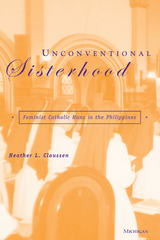
front cover of Unconventional Sisterhood
Unconventional Sisterhood
Feminist Catholic Nuns in the Philippines
Heather L. Claussen
University of Michigan Press, 2001
Unconventional Sisterhood is an ethnographic exploration of the ways in which Filipina Missionary Benedictine Sisters are renegotiating traditional understandings of gender, religious responsibility, and national identity in the context of a rapidly globalizing nation. Unlike the popular stereotypes of staid sisters cloaked in rigid religious dogmatism, they are doing so by telling jokes, engaging in eclectic religious rituals, maintaining connections with a local nationalist cult, and committing themselves to a radical and feminist politics.
This work represents an important addition to scholarship on Philippine feminism. It is one of few ethnographies that focuses on female monasticism--of particular cultural importance in the Christian Philippines, where nuns enjoy relatively high social status and freedom from many of the traditional constraints delineating Filipina lives. It is noteworthy as well for its focus on metropolitan Manila--a socially complex, dynamic, diverse, and understudied environment.
Heather L. Claussen is an anthropologist currently living in Santa Cruz, California.

[more]

logo for University of Michigan Press
Unconventional Sisterhood
Feminist Catholic Nuns in the Philippines
Heather L. Claussen
University of Michigan Press
Unconventional Sisterhood is an ethnographic exploration of the ways in which Filipina Missionary Benedictine Sisters are renegotiating traditional understandings of gender, religious responsibility, and national identity in the context of a rapidly globalizing nation. Unlike the popular stereotypes of staid sisters cloaked in rigid religious dogmatism, they are doing so by telling jokes, engaging in eclectic religious rituals, maintaining connections with a local nationalist cult, and committing themselves to a radical and feminist politics.
This work represents an important addition to scholarship on Philippine feminism. It is one of few ethnographies that focuses on female monasticism--of particular cultural importance in the Christian Philippines, where nuns enjoy relatively high social status and freedom from many of the traditional constraints delineating Filipina lives. It is noteworthy as well for its focus on metropolitan Manila--a socially complex, dynamic, diverse, and understudied environment.
Heather L. Claussen is an anthropologist currently living in Santa Cruz, California.

[more]

front cover of Unmaking Botany
Unmaking Botany
Science and Vernacular Knowledge in the Colonial Philippines
Kathleen Cruz Gutierrez
Duke University Press, 2025
In Anglo-European botany, it is customary to think of the vernacular as that which is not a Latin or Latinized scientific plant name. In Unmaking Botany, Kathleen Cruz Gutierrez traces a history of botany in the Philippines during the last decades of Spanish rule and the first decades of US colonization. Through this history, she redefines the vernacular, expanding it to include embodied, cosmological, artistic, and varied taxonomic practices. From the culinary textures of rice and the lyrics crooned to honor a flower to the touch of a skirt woven from banana fiber, she illuminates how vernaculars of plant knowing in the Philippines exposed the philosophical and practical limits of botany. Such vernaculars remained as sovereign forms of knowledge production. Yet, at the same time, they fueled botany’s dominance over other ways of knowing plants. Revealing this tension allows Gutierrez to theorize “sovereign vernaculars,” or insight into plants that made and unmade the science, which serves as a methodological provocation to examine the interplay of different knowledge systems and to study the history of science from multiple vantage points.
[more]


Send via email Share on Facebook Share on Twitter