 A SCHOLARLY BOOK REPOSITORY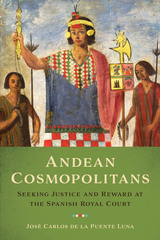
Winner, Premio Flora Tristán Al Mejor Libro, Peru Section, Latin American Studies Association, 2019
After the Spanish victories over the Inca claimed Tawantinsuyu for Charles V in the 1530s, native Andeans undertook a series of perilous trips from Peru to the royal court in Spain. Ranging from an indigenous commoner entrusted with delivering birds of prey for courtly entertainment to an Inca prince who spent his days amid titles, pensions, and other royal favors, these sojourners were both exceptional and paradigmatic. Together, they shared a conviction that the sovereign’s absolute authority would guarantee that justice would be done and service would receive its due reward. As they negotiated their claims with imperial officials, Amerindian peoples helped forge the connections that sustained the expanding Habsburg realm’s imaginary and gave the modern global age its defining character.
Andean Cosmopolitans recovers these travelers’ dramatic experiences, while simultaneously highlighting their profound influences on the making and remaking of the colonial world. While Spain’s American possessions became Spanish in many ways, the Andean travelers (in their cosmopolitan lives and journeys) also helped to shape Spain in the image and likeness of Peru. De la Puente brings remarkable insights to a narrative showing how previously unknown peoples and ideas created new power structures and institutions, as well as novel ways of being urban, Indian, elite, and subject. As indigenous people articulated and defended their own views regarding the legal and political character of the “Republic of the Indians,” they became state-builders of a special kind, cocreating the colonial order.
Examining the vivid, often apocalyptic church murals of Peru from the early colonial period through the nineteenth century, Heaven, Hell, and Everything in Between explores the sociopolitical situation represented by the artists who generated these murals for rural parishes. Arguing that the murals were embedded in complex networks of trade, commerce, and the exchange of ideas between the Andes and Europe, Ananda Cohen-Aponte also considers the ways in which artists and viewers worked through difficult questions of envisioning sacredness.
This study brings to light the fact that, unlike the murals of New Spain, the murals of the Andes possess few direct visual connections to a pre-Columbian painting tradition; the Incas’ preference for abstracted motifs created a problem for visually translating Catholic doctrine to indigenous congregations, as the Spaniards were unable to read Inca visual culture. Nevertheless, as Cohen Suarez demonstrates, colonial murals of the Andes can be seen as a reformulation of a long-standing artistic practice of adorning architectural spaces with images that command power and contemplation. Drawing on extensive secondary and archival sources, including account books from the churches, as well as on colonial Spanish texts, Cohen Suarez urges us to see the murals not merely as decoration or as tools of missionaries but as visual archives of the complex negotiations among empire, communities, and individuals.

What becomes clear throughout Missionary Scientists is that early missionaries were adept in adapting to local practices, in order to both understand the scientific foundations of these techniques and ingratiate themselves to the native communities.
Spanning the disciplines of history, religion, and Latin American studies, Missionary Scientists reshapes our understanding of the importance of the Jesuit missions in establishing early scientific traditions in the New World.
READERS
Browse our collection.
PUBLISHERS
See BiblioVault's publisher services.
STUDENT SERVICES
Files for college accessibility offices.
RECENTLY PUBLISHED




UChicago Accessibility Resources
home | accessibility | search | about | contact us
BiblioVault ® 2001 - 2026
The University of Chicago Press