
 A SCHOLARLY BOOK REPOSITORY

Explanation and Power was first published in 1988. Minnesota Archive Editions uses digital technology to make long-unavailable books once again accessible, and are published unaltered from the original University of Minnesota Press editions.
The meaning of any utterance or any sign is the response to that utterance or sign: this is the fundamental proposition behind Morse Peckham's Explanation and Power. Published in 1979 and now available in paperback for the first time, Explanation and Power grew out of Peckham's efforts, as a scholar of Victorian literature, to understand the nature of Romanticism. His search ultimately led back to—and built upon—the tradition of signs developed by the American Pragmatists. Since, in Peckham's view, meaning is not inherent in word or sign, only in response, human behavior itself must depend upon interaction, which in turn relies upon the stability of verbal and nonverbal signs. In the end, meaning can be stabilized only by explanation, and when explanation fails, by force. Peckham's semiotic account of human behavior, radical in its time, contends with the same issues that animate today's debates in critical theory — how culture is produced, how meaning is arrived at, the relation of knowledge to power and of society to its institutions. Readers across a wide range of disciplines, in the humanities and social sciences, will welcome its reappearance.

The bombing of the federal building in Oklahoma City, the emergence of militias and skinheads, the rise of the religious right, the attacks on Planned Parenthood clinics, the backlash against equal rights movements, the increase in poverty...these, according to Bob Altemeyer, are all versions of one story--the authoritarian personality in action. But aren't authoritarians Nazi types, kooks, the Klan? These are just the extreme examples, he argues. The Authoritarian Specter shows that many ordinary people today are psychologically disposed to embrace antidemocratic, fascist policies.
The book presents the latest results from a prize-winning research program on the authoritarian personality--a victory for the scientific method in the struggle to understand the worst aspects of ourselves. It connects for the first time the many ways authoritarianism undermines democracy. Many of our biggest problems, seemingly unrelated, have authoritarian roots. The scientific studies demonstrating this are extensive and thorough; their powerful findings are presented in a conversational, clear manner that engages readers from all backgrounds.
This is an important, timely work. It explains a growing movement to submit to a "man on horseback," to attack those who are different, to march in lockstep. Altemeyer reveals that these sentiments are strongly held even by many American lawmakers. These discoveries deserve careful attention in a presidential election year.

The present book aims to respond to this need by addressing the consonance and individuality in human nature, and the ways in which ordering in personality and psychology are
not inhibiting, but potentially liberating and influential. Francisco Insa draws from his medical and theological background, which includes both clinical and pastoral experience, to address all those responsible for the formation of others––including parents, teachers, priests, spiritual directors––and enables them to confront their roles as formators with greater insight and confidence. Insa's guidance through the human personality and its various expressions, the education of the character, growth in maturity, the particularity of each stage of the life cycle, sexuality and celibacy, chastity in the context of post-modern life, and mental illnesses is a landmark presentation of scientific rigor matched with practical application. As often as one says, "My situation is unique,"; the author here responds: "Yes, but special even more than you can express"; Insa is forthright about what can never be lost in human beings, but only recovered when the head and heart are aligned and formed properly.
For as much as this book may help the reader understand himself, it will also render him better understood by others. The Christian approach to the formation of affectivity, as Insa shows, is indispensable to deep and enduring human development, and it is often the only way to identify and mediate interior dissonance and confusion.
How is something as broad and complex as a personality organized? What makes up a satisfactory theory of personality? In this ambitious book, Jaan Valsiner argues for a theoretical integration of two long-standing approaches: the individualistic tradition of personalistic psychology, typified by the work of William Stern and Gordon Allport, and the semiotic tradition of cultural-historical psychology, typified by the work of L. S. Vygotsky. The two are brought together in Valsiner's theory, which highlights the sign-constructing and sign-using nature of all distinctively human psychological processes.
Arguing that the individualistic and the cultural traditions differ largely in emphasis, Valsiner unites them by focusing on the intricate relations between personality and its social context, and their interplay in personality development. The semiotic devices internalized from the social environment shape an individual's development, and the flow of thinking, feeling, and acting. Valsiner uses this theoretical approach to illuminate two remarkable, and remarkably different, phenomena: letters from the mother of Allport's college roommate, a key empirical case in Allport's theory, and the ritual movements of a Hindu temple dancer. Valsiner shows how both exemplify basic human tendencies for the cultural construction of life courses.
The Guided Mind shows the fundamental unities in the vastly diverse phenomenon of human personality.
This volume reports on a study of 850 pairs of twins who were tested to determine the influence of heredity and environment on individual differences in personality, ability, and interests. It presents the background, research design, and procedures of the study, a complete tabulation of the test results, and the authors’ extensive analysis of their findings. Based on one of the largest studies of twin behavior conducted in the twentieth century, the book challenges a number of traditional beliefs about genetic and environmental contributions to personality development.
The subjects were chosen from participants in the National Merit Scholarship Qualifying Test of 1962 and were mailed a battery of personality and interest questionnaires. In addition, parents of the twins were sent questionnaires asking about the twins’ early experiences. A similar sample of nontwin students who had taken the merit exam provided a comparison group. The questions investigated included how twins are similar to or different from nontwins, how identical twins are similar to or different from fraternal twins, how the personalities and interests of twins reflect genetic factors, how the personalities and interests of twins reflect early environmental factors, and what implications these questions have for the general issue of how heredity and environment influence the development of psychological characteristics. In attempting to answer these questions, the authors shed light on the importance of both genes and environment and form the basis for different approaches in behavior genetic research.
A leading expert on twins delves into the stories behind her research to reveal the profound joys and real-life traumas of twelve remarkable sets of twins, triplets, and quadruplets.
Indivisible by Two introduces us to an assortment of memorable characters, from the “Fireman Twins”—brothers who, though reared separately, are astonishingly similar in personality and behavioral traits—to the twin sisters who overcame one twin’s infertility by having the other serve as her surrogate mother. We meet one of the few identical brother–sister pairs in the world after one of two sisters was surgically transformed into a man, and identical triplet brothers, only one of whom is gay while the others are straight. We see uniquely blended families—identical twin brothers marrying identical twin sisters, and Chinese twins adopted by different Canadian families yet raised as sisters.
Being a twin can also render the experience of historical tragedy uniquely painful. We meet Stepha and Annetta, survivors of Josef Mengele’s heinous experiments in Auschwitz, and untangle the troubled lifelong tie between Jack and Oskar, born in the 1930s to a Jewish father and a German Gentile mother, one raised as a Jew in Trinidad and the other as a Catholic and a member of the Hitler Youth in Nazi Germany.
Nancy Segal unravels these stories and others with an eye for the challenges that life as a twin (or triplet or quadruplet) can pose to parents, friends, and spouses, as well as the twins themselves. These moving stories remind us how incompletely any theory explains real life—twin or not.
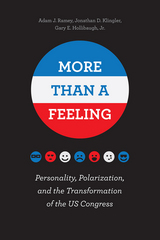
With More Than a Feeling, Adam J. Ramey, Jonathan D. Klingler, and Gary E. Hollibaugh, Jr. have developed an innovative framework incorporating what are known as the Big Five dimensions of personality—openness to experience, conscientiousness, extraversion, agreeableness, and neuroticism—to improve our understanding of political behavior among members of Congress. To determine how strongly individuals display these traits, the authors identified correlates across a wealth of data, including speeches, campaign contributions and expenditures, committee involvement, willingness to filibuster, and even Twitter feeds. They then show how we might expect to see the influence of these traits across all aspects of Congress members’ political behavior—from the type and quantity of legislation they sponsor and their style of communication to whether they decide to run again or seek a higher office. They also argue convincingly that the types of personalities that have come to dominate Capitol Hill in recent years may be contributing to a lot of the gridlock and frustration plaguing the American political system.
Israel's founders sought to create a nation of new Jews who would never again go meekly to the death camps. Yet Israel's strength has become synonymous with an oppression of the Palestinians that provokes anger throughout the Muslim world and beyond. How are Israelis able to see themselves as victims while victimizing others? What does Israeli Jewish identity mean today?
Arthur Neslen explores the dynamics, distortions and incredible diversity of Israeli society. From the mouths of soldiers, settlers, sex workers and the victims of suicide attacks, Occupied Minds is the story of a national psyche that has become scarred by mental security barriers, emotional checkpoints and displaced outposts of self-righteousness and aggression.
From vignettes to in-depth interviews, more than fifty Israelis offer their accounts. What they reveal is in turn powerful, haunting, subtle and disturbing. Illustrated throughout with photographs, this unique book offers an unrivalled insight into Israeli consciousness, private and public.
It charts the evolution of a communal self-image based on cultural and religious values towards one formed around a single militaristic imperative: national security.
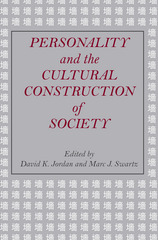
Pyschological anthropology is a vital area of contemporary social science, and one of the field's most important and innovative thinkers is Melford E. Spiro. This volume brings together sixteen essays that review Spiro's theoretical insights and extend them into new areas. The essays center on several general problems: In what ways is it meaningful to speak of a social act as having "functions"? What elements and processes of human personality are universal, and why? What is the relationship between religion and personality? Why? What are the pyschological underpinnings of social manipulation?
This book presents penetrating observations by six authorities on the personality development of children for the enlightenment of parents, teachers, and others who have a vital interest in children.
In the first paper, the late Harold E. Jones, a professor of psychology and the director of the Institute of Human Development at the University of California, examines the development of personality over a long period of time. He discusses the child-rearing practices used with a number of babies, then follows through with observations made several years later to see the effects of these practices.
In another paper, John E. Anderson, a professor of psychology at the University of Minnesota and the former director of the Institute of Child Development and Welfare there, supports the theory that valid predictions of future personality adjustment can be made through an assessment of the present status of an individual.
Anderson’s findings are based on the results of tests administered to children of Nobles County, Minnesota, during the period 1950–1957, and on teacher-community-pupil ratings of these children.
Still other papers offer a variety of ideas. Dr. Milton J. E. Senn, Sterling Professor of Pediatrics and Psychiatry and the director of the Child Study Center at Yale University, suggests that there be greater harmony and more exchange of thought among people working toward a proper understanding of human nature. To a degree this entire book follows his suggestion.
Among several noteworthy observations made by Stanford University Professor of Psychology Robert R. Sears is the point that the development of conscience depends largely upon whether a child is loved or rejected by his or her parents.
John W. M. Whiting, professor of education and director of the Laboratory for Human Development at Harvard University, discusses, among other problems, the question of why children like to play grown-up roles and what happens when they are not permitted to do so. Orville Brim, a sociologist at the Russell Sage Foundation of New York City, explains personality in terms of demands, holding that one’s personality changes from situation to situation and from person to person.
This work by a highly respected senior psychologist is an effort to answer these questions. Irving E. Alexander presents a case for considering the personal narrative of a human life as the most compelling aspect of that life to be decoded and understood. In part a critique of an exclusive reliance on general theories about the development of personality and ways of knowing based primarily on comparison with others, Personology is illustrated with material drawn from the lives, personal writings, and theories of Freud, Jung, and Sullivan. Alexander develops new insights into the lives of these men and offers methods and guidelines for investigating and teaching personology and psychobiography.

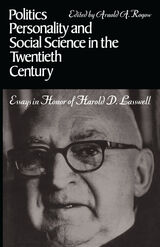
This collection of essays is the first full-scale effort to deal with the voluminous writings of Lasswell and explore his at once charming and baffling personality which is perhaps inseparable from the inventiveness, unconventionality, and unusual scope of his work.
The authors of these essays, many of whom are former students or collaborators, view their subject from a variety of perspectives. What emerges is a full assessment of Lasswell's many-faceted contribution to the social scholarship of his time.
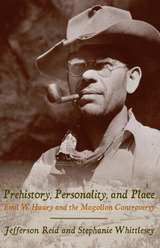
Reid and Whittlesey present the arguments and actions surrounding the Mogollon discovery, definition, and debate. Drawing on extensive interviews conducted with Haury before his death in 1992, they explore facets of the debate that scholars pursued at various times and places and how ultimately the New Archaeology shifted attention from the research questions of cultural affiliation and antiquity that had been at the heart of the controversy. In gathering the facts and anecdotes surrounding the debate, Reid and Whittlesey offer a compelling picture of an academician who was committed to understanding the unwritten past, who believed wholeheartedly in the techniques of scientific archaeology, and who used his influence to assist scholarship rather than to advance his own career.
Prehistory, Personality, and Place depicts a real archaeologist practicing real archaeology, one that fashioned from potsherds and pit houses a true understanding of prehistoric peoples. But more than the chronicle of a controversy, it is a book about places and personalities: the role of place in shaping archaeologists’ intellect and personalities, as well as the unusual intersections of people and places that produced resolutions of some intractable problems in Southwest history.

A political leader's decisions can determine the fate of a nation, but what determines how and why that leader makes certain choices? William H. Chafe, a distinguished historian of twentieth century America, examines eight of the most significant political leaders of the modern era in order to explore the relationship between their personal patterns of behavior and their political decision-making process. The result is a fascinating look at how personal lives and political fortunes have intersected to shape America over the past fifty years.
One might expect our leaders to be healthy, wealthy, genteel, and happy. In fact, most of these individuals--from Franklin Delano Roosevelt to Martin Luther King, Jr., from John F. Kennedy to Bill Clinton--came from dysfunctional families, including three children of alcoholics; half grew up in poor or only marginally secure homes; most experienced discord in their marriages; and at least two displayed signs of mental instability. What links this extraordinarily diverse group is an intense ambition to succeed, and the drive to overcome adversity. Indeed, adversity offered a vehicle to develop the personal attributes that would define their careers and shape the way they exercised power.
Chafe probes the influences that forged these men's lives, and profiles the distinctive personalities that molded their exercise of power in times of danger and strife. The history of the United States from the Depression into the new century cannot be understood without exploring the dynamic and critical relationship between personal history and political leadership that these eight life stories so poignantly reveal.
Five chapters show how differing psychobiographical approaches can illuminate the lives of Richard Nixon, Nathaniel Hawthorne, Eleanor Marx (Karl Marx’s youngest daughter), author and feminist Vera Brittain, psychologist Henry Murray, and Sigmund Freud (whose peculiar relationship to Leonardo da Vinci shaped and distorted the first psychobiography every written). Two chapters concentrate on the analysis of life histories collected from contemporary American adults at mid-life crises, and the remaining three chapters provide bold new conceptual and methodological perspectives from which to view the study of individual lives and life stories.
This landmark volume promises to make a major contribution to the growing literature on biography and personality.
Contributors. Irving E. Alexander, James William Anderson, Leslie A. Carlson, Rae Carlson, Alan C. Elms, Carol Franz, Lynne Layton, Dan P. McAdams, Richard L. Ochberg, George C. Rosenwald, William McKinley Runyan, Abigail G. Stewart, Jacquelyn Wiersma, David G. Winter
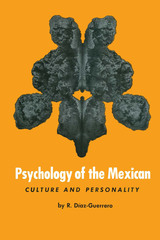
In his quest to understand and describe the behavior of the Mexican, the distinguished Mexican psychologist R. Díaz-Guerrero combines a strong theoretical interest in the relationship of culture to personality with a pragmatic concern for methodology. This collection of essays is rooted both in studies of Mexican psychology as an independent phenomenon and in cross-cultural comparisons of Mexicans, Mexican-Americans, and Anglo-Americans.
Dr. Díaz-Guerrero discusses Mexican attitudes toward sex roles and the family, motivations of the Mexican worker, and other topics. He compares Mexican and American concepts of respect and analyzes the relation between neurosis and the Mexican family structure. He attempts to determine the degree of mental, personal, and social health of urban Mexicans. The importance of basic sociocultural premises, such as "The mother is the dearest person in existence," and "The stricter the parents are, the better the children turn out," is explored. In one essay, Díaz-Guerrero notes the differences in typical reactions to stress in Mexico and the United States, concluding that the American pattern involves active response to stress, whereas the Mexican response tends to be more passive.
Psychology of the Mexican deals with a variety of historical, psychological, biological, social, economic, and anthropological variables, attempting to treat them in a scientific way through the use of carefully constructed questionnaires, with detailed statistical analyses of the results. On the basis of data obtained in this way, the author formulates broad conceptual schemes with immediate application to the understanding of human behavior in real situations. He is particularly intrigued by the way the individual relates to the significant people in his environment. For the Mexican, he says, such interpersonal relationships are the most important part of life; in contrast to the American insistence on liberty and equality, Mexican culture emphasizes affiliation and love.
"Rarely does a volume present contributions on a controversial topic from such distinguished clinicians and experimentalists . . . . There is something of interest in this volume for almost anyone involved in experimental cognitive psychology and psychiatry."—Carroll E. Izard, Contemporary Psychology
"The concept of repression is the cornerstone of psychoanalytic theory. . . . This is a delightful book, unusually well-written. . . . Recommended."—Choice
"Readable, thorough, wide ranging and consistently interesting. . . . A testament to the continuing power of psychodynamic ideas when faced with individual psychopathology."—Sue Llewelyn, Psychologist
"Singer has brought together some of the best empirical research in the areas of unconscious mental activity and repression—that is at once interdisciplinary and scholarly."—Howard D. Lerner, International Review of Psycho-analysis
"A rich reference, replete with summaries and citations, covering a variety of topics related to the psychology of repression and dissociation. . . . A thoughtful, detailed and eclectic discussion of the scientific and theoretical basis of repression and dissociation."—Steven Lazrove, M.D., American Journal of Psychiatry
In 1843, the Victorian philosopher John Stuart Mill called for the establishment of a new science, “the science of the formation of character.” Although Mill’s proposal failed as scientific practice, S. Pearl Brilmyer maintains that it found its true home in realist fiction of the period, which employed the literary figure of character to investigate the nature of embodied experience. Bringing to life Mill’s unrealized dream of a science of character, novelists such as George Eliot, Thomas Hardy, and Olive Schreiner turned to narrative to explore how traits and behaviors in organisms emerge and develop, and how aesthetic features—shapes, colors, and gestures—come to take on cultural meaning through certain categories, such as race and sex. Engaged with materialist science and philosophy, these authors transformed character from the liberal notion of the inner truth of an individual into a materially determined figuration produced through shifts in the boundaries between the body’s inside and outside. In their hands, Brilmyer argues, literature became a science, not in the sense that its claims were falsifiable or even systematically articulated, but in its commitment to uncovering, through a fictional staging of realistic events, the laws governing physical and affective life. The Science of Character redraws late Victorian literary history to show how women and feminist novelists pushed realism to its aesthetic and philosophical limits in the crucial span between 1870 and 1920.
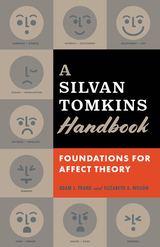
An accessible guide to the work of American psychologist and affect theorist Silvan Tomkins
The brilliant and complex theories of psychologist Silvan Tomkins (1911–1991) have inspired the turn to affect in the humanities, social sciences, and elsewhere. Nevertheless, these theories are not well understood. A Silvan Tomkins Handbook makes his theories portable across a range of interdisciplinary contexts and accessible to a wide variety of contemporary scholars and students of affect.
A Silvan Tomkins Handbook provides readers with a clear outline of Tomkins’s affect theory as he developed it in his four-volume masterwork Affect Imagery Consciousness. It shows how his key terms and conceptual innovations can be used to build robust frameworks for theorizing affect and emotion. In addition to clarifying his affect theory, the Handbook emphasizes Tomkins’s other significant contributions, from his broad theories of imagery and consciousness to more focused concepts of scenes and scripts. With their extensive experience engaging and teaching Tomkins’s work, Adam J. Frank and Elizabeth A. Wilson provide a user-friendly guide for readers who want to know more about the foundations of affect studies.
READERS
Browse our collection.
PUBLISHERS
See BiblioVault's publisher services.
STUDENT SERVICES
Files for college accessibility offices.
RECENTLY PUBLISHED


UChicago Accessibility Resources
home | accessibility | search | about | contact us
BiblioVault ® 2001 - 2024
The University of Chicago Press