
 A SCHOLARLY BOOK REPOSITORY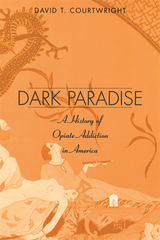
In a newly enlarged edition of this eye-opening book, David T. Courtwright offers an original interpretation of a puzzling chapter in American social and medical history: the dramatic change in the pattern of opiate addiction--from respectable upper-class matrons to lower-class urban males, often with a criminal record. Challenging the prevailing view that the shift resulted from harsh new laws, Courtwright shows that the crucial role was played by the medical rather than the legal profession.
Dark Paradise tells the story not only from the standpoint of legal and medical sources, but also from the perspective of addicts themselves. With the addition of a new introduction and two new chapters on heroin addiction and treatment since 1940, Courtwright has updated this compelling work of social history for the present crisis of the Drug War.

Afghanistan is the world's largest producer of opium and heroin. This book explores the devastating impact that the drugs trade has had on the Afghan people.
Author David Macdonald has worked as a drugs advisor to the UN. Based on his extensive experience, this book breaks down the myths surrounding the cultivation and consumption of drugs, providing a detailed analysis of the history of drug use within the country. He examines the impact of over 25 years of continuous conflict, and shows how poverty and instability has led to an increase in drugs consumption. He also considers the recent rise in the use of pharmaceutical drugs, resulting in dangerous chemical cocktails and analyses the effect of Afghanistan's drug trade on neighbouring countries.
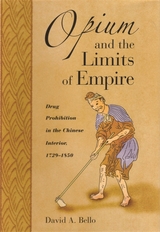
The British opium trade along China's seacoast has come to symbolize China's century-long descent into political and social chaos. In the standard historical narrative, opium is the primary medium through which China encountered the economic, social, and political institutions of the West. Opium, however, was not a Sino-British problem confined to southeastern China. It was, rather, an empire-wide crisis, and its spread among an ethnically diverse populace created regionally and culturally distinct problems of control for the Qing state.
This book examines the crisis from the perspective of Qing prohibition efforts. The author argues that opium prohibition, and not the opium wars, was genuinely imperial in scale and is hence much more representative of the actual drug problem faced by Qing administrators. The study of prohibition also permits a more comprehensive and accurate observation of the economics and criminology of opium. The Qing drug traffic involved the domestic production, distribution, and consumption of opium. A balanced examination of the opium market and state anti-drug policy in terms of prohibition reveals the importance of the empire's landlocked western frontier regions, which were the domestic production centers, in what has previously been considered an essentially coastal problem.

Macedonian raw opium was a highly sought-after pharmaceutical raw material. This book focuses on its cultivation and production, and the trafficking of opium-based narcotics. Vladan Jovanović offers fresh insight into a neglected and marginalized subject, tracing and contextualizing both the licit and the illicit processing and trade of opium alkaloids from the Western Balkans through Turkey, and on to the rest of the world between the two World Wars.
His approach is to explore the subject both from the top down, involving the League of Nations and politicians and diplomats, as well as from the bottom up, through the analysis of the activities of smugglers, police, and ordinary people who participated in the production and distribution of opium. The author describes the process of relocating the illegal processing industry from Turkey and Bulgaria to Yugoslavia. He insightfully shows the implicit continuity of relations between the former Ottoman Empire and the newly constituted Yugoslav state in the form of bilateral political agreements.
He pays special attention to the illegal activities within the legal pharmaceutical industry and also exposes the role of criminal networks, which he situates in the appropriate political and social context. The exploration of this sensitive historical subject extends to other Balkan countries, along with Turkey, Western Europe, and the United States.
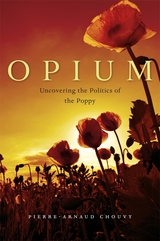
Known to the Greeks as opos or opion, as afiun in Persian and Arabic, and fuyung in Chinese, opium is at once a palliative and a poison. Its exotic origins, its literary associations, and the properties that are, often erroneously, attributed to it have ensured an ongoing air of mystery.
Pierre-Arnaud Chouvy reveals the long and fascinating history of a powerful and addictive drug and explores the changing fortunes of the modern-day illicit opium trade, especially in the remote regions of Asia. He answers key questions: Why have anti-drug policies failed despite four decades of increasing effort? And what are the shortcomings and limitations of forced eradication, alternative development, "silver bullets," and other quick fixes? In answering these questions, Chouvy draws upon geography, anthropology, politics, and development studies. He shows that the history of opium production is unexpectedly linked to the history of Afghanistan.
A compelling account of a narcotic as old as humanity, Opium offers powerful insights into the complex politics and economics of the poppy in the world today.
READERS
Browse our collection.
PUBLISHERS
See BiblioVault's publisher services.
STUDENT SERVICES
Files for college accessibility offices.
RECENTLY PUBLISHED




UChicago Accessibility Resources
home | accessibility | search | about | contact us
BiblioVault ® 2001 - 2025
The University of Chicago Press