
 A SCHOLARLY BOOK REPOSITORY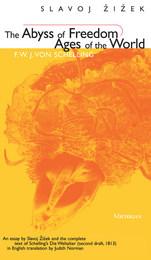
Zizek argues that Schelling's most profound thoughts are found in the series of three consecutive attempts he made to formulate the "ages of the world/Weltalter," the stages of the self-development of the Absolute. Of the three versions, claims Zizek, it is the second that is the most eloquent and definitive encompassing of Schelling's lyrical thought. It centers on the problem of how the Absolute (God) himself, in order to become actual, to exist effectively, has to accomplish a radically contingent move of acquiring material, bodily existence. Never before available in English, this version finally renders accessible one of the key texts of modern philosophy, a text that is widely debated in philosophical circles today.
The Abyss of Freedom is Zizek's own reading of Schelling based upon Lacanian psychoanalytic theory. It focuses on the notion that Lacan's theory--which claims that the symbolic universe emerged from presymbolic drives--is prefigured in Schelling's idea of logos as given birth to from the vortex of primordial drives, or from what "in God is not yet God." For Zizek, this connection is monumental, showing that Schelling's ideas forcefully presage the post-modern "deconstruction" of logocentrism.
Slavoj Zizek is not a philosopher who stoops to conquer objects but a radical voice who believes that philosophy is nothing if it is not embodied, nothing if it is only abstract. For him, true philosophy always speaks of something rather than nothing. Those interested in the genesis of contemporary thought and the fate of reason in our "age of anxiety" will find this coupling of texts not only philosophically relevant, but vitally important.
Slavoj Zizek is the author of The Sublime Object of Ideology, Tarrying with the Negative: Kant, Hegel and the Critique of Ideology, and most recently, The Indivisible Remainder: An Essay on Schelling and Related Matters. Currently he is a Senior Researcher at the Institute for Social Sciences, University of Ljubljana. Judith Norman is Assistant Professor of Philosophy at Trinity University in San Antonio, Texas.
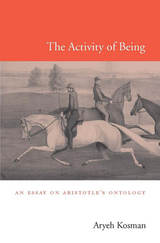
Understanding “what something is” is a project that has long occupied philosophers. Perhaps no thinker in the Western tradition has had more influence on how we approach this question than Aristotle, whose Metaphysics remains the locus classicus of rigorous examinations into the nature of being. Now, in an elegantly argued new study, Aryeh Kosman reinterprets Aristotle’s ontology and compels us to reexamine some of our most basic assumptions about the great philosopher’s thought.
For Aristotle, to ask “what something is” is to inquire into a specific mode of its being, something ordinarily regarded as its “substance.” But to understand substance, we need the concept of energeia—a Greek term usually translated as “actuality.” In a move of far-reaching consequence, Kosman explains that the correct translation of energeia is not “actuality” but “activity.” We have subtly misunderstood the Metaphysics on this crucial point, says Kosman. Aristotle conceives of substance as a kind of dynamic activity, not some inert quality. Substance is something actively being what it is.
Kosman demonstrates how this insight significantly alters our understanding of a number of important concepts in Aristotelian thought, from accounts of motion, consciousness, and essence to explanations of the nature of animal and divine being. Whether it is approached as an in-depth introduction to Aristotle’s metaphysics or as a highly original reassessment sure to spark debate, there can be no argument that The Activity of Being is a major contribution to our understanding of one of philosophy’s most important thinkers.
In After Life, Eugene Thacker clears the ground for a new philosophy of life by recovering the twists and turns in its philosophical history. Beginning with Aristotle’s originary formulation of a philosophy of life, Thacker examines the influence of Aristotle’s ideas in medieval and early modern thought, leading him to the work of Immanuel Kant, who notes the inherently contradictory nature of “life in itself.” Along the way, Thacker shows how early modern philosophy’s engagement with the problem of life affects thinkers such as Gilles Deleuze, Georges Bataille, and Alain Badiou, as well as contemporary developments in the “speculative turn” in philosophy.
At a time when life is categorized, measured, and exploited in a variety of ways, After Life invites us to delve deeper into the contours and contradictions of the age-old question, “what is life?”
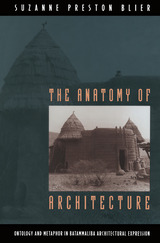
"A splendid analysis of the centrality of architecture in the daily lives of the Batammaliba and its integral role in articulating social values....The story is beautifully told in the best of anthropological traditions."—Judith R. Blau, Contemporary Society
"A remarkable study....Blier's volume carries the study of African architecture to a qualitatively new level of scholarship. It introduces a new dimension whereby the architectural medium can be used to illuminate much of the entire belief system of any culture."—Labelle Prussin, African Arts
"In this excellent book Blier provides a richly detailed and searching account of what architecture means to the Batammaliba of northern Togo and Benin....The finest account I have yet read of the relations between systems of beliefs, ritual practices, and African aesthetics and plastic arts....The ethnography and basic insight should be the envy of any social anthropologist."—T.O. Beidelman, Man
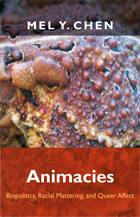
Chen's book is the first to bring the concept of animacy together with queer of color scholarship, critical animal studies, and disability theory. Through analyses of dehumanizing insults, the meanings of queerness, animal protagonists in recent Asian/American art and film, the lead in toys panic in 2007, and the social lives of environmental illness, Animacies illuminates a hierarchical politics infused by race, sexuality, and ability. In this groundbreaking book, Chen rethinks the criteria governing agency and receptivity, health and toxicity, productivity and stillness—and demonstrates how attention to the affective charge of matter challenges commonsense orderings of the world.
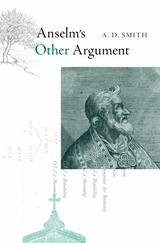
Anselm of Canterbury (1033–1109 CE), in his work Proslogion, originated the “ontological argument” for God’s existence, famously arguing that “something than which nothing greater can be conceived,” which he identifies with God, must actually exist, for otherwise something greater could indeed be conceived. Some commentators have claimed that although Anselm may not have been conscious of the fact, the Proslogion as well as his Reply to Gaunilo contains passages that constitute a second independent proof: a “modal ontological argument” that concerns the supposed logical necessity of God’s existence. Other commentators disagree, countering that the alleged second argument does not stand on its own but presupposes the conclusion of the first.
Anselm’s Other Argument stakes an original claim in this debate, and takes it further. There is a second a priori argument in Anselm (specifically in the Reply), A. D. Smith contends, but it is not the modal argument past scholars have identified. This second argument surfaces in a number of forms, though always turning on certain deep, interrelated metaphysical issues. It is this form of argument that in fact underlies several of the passages which have been misconstrued as statements of the modal argument. In a book that combines historical research with rigorous philosophical analysis, Smith discusses this argument in detail, finally defending a modification of it that is implicit in Anselm. This “other argument” bears a striking resemblance to one that Duns Scotus would later employ.
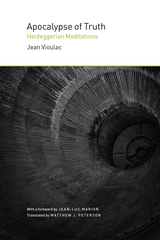
In his first book to be translated into English, Vioulac radicalizes Heidegger’s understanding of truth as disclosure through the notion of truth as apocalypse. This “apocalypse of truth” works as an unveiling that reveals both the finitude and mystery of truth, allowing a full confrontation with truth-as-absence. Engaging with Heidegger, Marx, and St. Paul, as well as contemporary figures including Giorgio Agamben, Alain Badiou, and Slavoj Žižek, Vioulac’s book presents a subtle, masterful exposition of his analysis before culminating in a powerful vision of “the abyss of the deity.” Here, Vioulac articulates a portrait of Christianity as a religion of mourning, waiting for a god who has already passed by, a form of ever-present eschatology whose end has always already taken place. With a preface by Jean-Luc Marion, Apocalypse of Truth presents a major contemporary French thinker to English-speaking audiences for the first time.
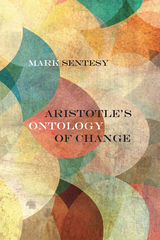
Aristotle may be the only thinker to propose a noncircular definition of change. With his landmark argument that change did, in fact, exist, Aristotle challenged established assumptions about what it is and developed a set of conceptual frameworks that continue to provide insight into the nature of reality. This groundbreaking work on change, however, has long been interpreted through a Platonist view of change as unreal. By offering a comprehensive reexamination of Aristotle’s pivotal arguments, and establishing his positive ontological conception of change, Sentesy makes a significant contribution to scholarship on Aristotle, ancient philosophy, the history and philosophy of science, and metaphysics.
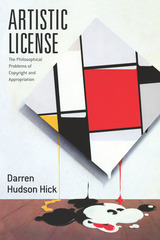
Engaging with long-standing debates about the nature of originality, authorship, and artists’ rights, Hick examines the philosophical challenges presented by the role of intellectual property in the artworld and vice versa. Using real-life examples of artists who have incorporated copyrighted works into their art, he explores issues of artistic creation and the nature of infringement as they are informed by analytical aesthetics and legal and critical theory. Ultimately, Artistic License provides a critical and systematic analysis of the key philosophical issues that underlie copyright policy, rethinking the relationship between artist, artwork, and the law.
The Rousseauian tradition begins, for Velkley, with Rousseau's criticism of modern political philosophy. Although the German Idealists such as Schelling accepted much of Rousseau's critique, they believed, unlike Rousseau, that human wholeness could be attained at the level of society and history. Heidegger and Nietzsche questioned this claim, but followed both Rousseau and the Idealists in their vision of the philosopher-poet striving to recover an original wholeness that the history of reason has distorted.
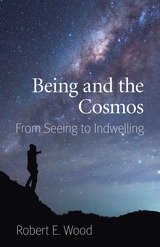
In Being and the Cosmos<\i>, the tack against both is to make explicit the character of the mind that sees and thinks, that actively takes up commitment to the truth available in the disciplines involved. The basic ground of this position rests upon the functioning of the notion of Being that opens up the question of the character of the Whole and the human being’s place in it. Thus position the treatment of the notion of Being as foundation and as orientation toward the Whole between the attack on reductionism and on deconstruction and anti-foundationalism. Wood concludes with a multidimensional sketch of an evolutionary view of the cosmos whose initial phases contain the potentialities for life, sensibility, and intellect as cosmic telos. The holism of contemporary physics has to be reconfigured in terms of this observation. Both reductionists and dualists should know that matter itself has to be re-minded and that mind itself matters.
“The translations are masterpieces of literalness. . . . They are honest, accurate, and give the reader a wonderful sense of the Greek.”—Drew A. Hyland, Review of Metaphysics

The Body Multiple juxtaposes two distinct texts. Alongside Mol’s analysis of her ethnographic material—interviews with doctors and patients and observations of medical examinations, consultations, and operations—runs a parallel text in which she reflects on the relevant literature. Mol draws on medical anthropology, sociology, feminist theory, philosophy, and science and technology studies to reframe such issues as the disease-illness distinction, subject-object relations, boundaries, difference, situatedness, and ontology. In dialogue with one another, Mol’s two texts meditate on the multiplicity of reality-in-practice.
Presenting philosophical reflections on the body and medical practice through vivid storytelling, The Body Multiple will be important to those in medical anthropology, philosophy, and the social study of science, technology, and medicine.

From one end of his philosophical work to the other, Gilles Deleuze consistently described his position as a transcendental empiricism. But just what is transcendental about Deleuze's transcendental empiricism? And how does his position fit with the traditional empiricism articulated by Hume? In Difference and Givenness, Levi Bryant addresses these long-neglected questions so critical to an understanding of Deleuze's thinking. Through a close examination of Deleuze's independent work--focusing especially on Difference and Repetition--as well as his engagement with thinkers such as Kant, Maimon, Bergson, and Simondon, Bryant sets out to unearth Deleuze's transcendental empiricism and to show how it differs from transcendental idealism, absolute idealism, and traditional empiricism. What emerges from these efforts is a metaphysics that strives to articulate the conditions for real existence, capable of accounting for the individual itself without falling into conceptual or essentialist abstraction. In Bryant's analysis, Deleuze's metaphysics articulates an account of being as process or creative individuation based on difference, as well as a challenging critique--and explanation--of essentialist substance ontologies. A clear and powerful discussion of how Deleuze's project relates to two of the most influential strains in the history of philosophy, this book will prove essential to anyone seeking to understand Deleuze's thought and its specific contribution to metaphysics and epistemology.
In 1962 Zubiri had published Sobre la esencia (On essence), a work of metaphysics that was praised by critics with one qualification: its treatment of reality was too static. The 1968 course was devised as a response to those critics. Dynamic Structure of Reality retraces the road Hegel traveled concerning the creation of a self and how that self is realized by an interplay between spirit and nature.
Like his great predecessor José Ortega y Gasset, and like his great Jewish contemporary Emmanuel Levinas, Zubiri takes religion in all seriousness and locates its questions within the questions of modern philosophy. In harmony with science, he advances a new idea of becoming. Reality, not being, becomes. As reality’s traits are revealed, in different degrees, reality resembles God, the universal self-giver. Zubiri systematically touches on many disciplines to show the varieties of self-giving--throughout the universe--of structural dynamism.
Epidemic Subjects—Radical Ontology brings together a renowned team of contributors, including Levi Bryant, Angela Melitopoulos, and Susan Stryker, who together forge a radically inclusive definition of subjectivity. Drawing on Gilles Deleuze and Félix Guattari’s concept of the “girl” as a heuristic device for examining modern society and its foundations, they tie together recent trends in philosophy and offer a concrete way forward from the conception of the “thing” or “object” privileged by new materialism, speculative realism, and other theories of subjectivity.
In this brief book one of the most distinguished living American philosophers takes up the question of whether ethical judgments can properly be considered objective—a question that has vexed philosophers over the past century. Looking at the efforts of philosophers from the Enlightenment through the twentieth century, Hilary Putnam traces the ways in which ethical problems arise in a historical context.
Putnam’s central concern is ontology—indeed, the very idea of ontology as the division of philosophy concerned with what (ultimately) exists. Reviewing what he deems the disastrous consequences of ontology’s influence on analytic philosophy—in particular, the contortions it imposes upon debates about the objective of ethical judgments—Putnam proposes abandoning the very idea of ontology. He argues persuasively that the attempt to provide an ontological explanation of the objectivity of either mathematics or ethics is, in fact, an attempt to provide justifications that are extraneous to mathematics and ethics—and is thus deeply misguided.
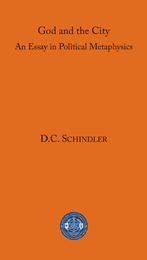
political theory or other, nor on the legitimacy of political action or the distinctiveness of particular regimes, but on the nature of political order as such, and how this order implicates the
fundamental questions of existence, those concerning man, being, and God.
Aristotle, and Aquinas after him, identified metaphysics and politics as “architectonic” sciences, since each concerns in some respect the whole of reality, of which the particular
sciences study a part. Chapter one of this book argues that, just as metaphysics, in studying being as a whole, cannot but address the question of God in some respect, so too does politics, the ordering of human life as a whole, necessarily implicate the existence of God. In this regard, the modern liberal project has deluded itself in attempting to render religion a private, rather than a genuinely political, matter. We cannot organize human existence without making some claim, whether implicitly or explicitly, about the nature of God and God’s relation to the world.
The second chapter approaches this theme from the anthropological dimension. As Plato affirmed, the “city is the soul writ large”: if man is religious by nature, he cannot be properly
understood, and the human good cannot be properly secured and fostered, if the “God question” is “bracketed out” of the properly political order. Moreover, if we fail to recognize the
essentially political dimension of relation to God, we will be unable properly to grasp the presence of God in the (ecclesial and sacramental) Body of Christ: God cannot be real in the
Church as Church unless he is also real in the city as city (and vice versa).
In his De regno, Aquinas famously affirms that “the king is to be in the kingdom what the soul is in the body and what God is in the world.” Chapter three offers a careful study of the
body-soul relationship in order to illuminate, on the one hand, the nature of political authority, and, on the other, the precise way that God is present in human community.
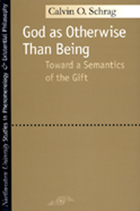
Schrag draws with grace, ease, and precision upon the history of Western metaphysics, from Plato and Aristotle through Nietzsche and Heidegger. Most important to his central question of God as "otherwise than Being," however, are such influential post-Heideggerian thinkers as Jean-Luc Marion, Jacques Derrida, and Emmanuel Levinas. Schrag's inquiry engages these thinkers at a serious level and also expands recent discussions by relating them to the work of figures hitherto overlooked or underplayed, most notably Paul Tillich.
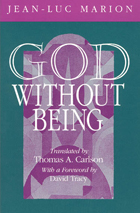
This volume, the first translation into English of the work of this leading Catholic philosopher, offers a contemporary perspective on the nature of God.
"An immensely thoughtful book. . . . It promises a rich harvest. Marion's highly original treatment of the idol and the icon, the Eucharist, boredom and vanity, conversion and prayer takes theological and philosophical discussions to a new level."—Norman Wirzba, Christian Century
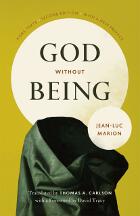
Jean-Luc Marion is one of the world’s foremost philosophers of religion as well as one of the leading Catholic thinkers of modern times. In God Without Being, Marion challenges a fundamental premise of traditional philosophy, theology, and metaphysics: that God, before all else, must be. Taking a characteristically postmodern stance and engaging in passionate dialogue with Heidegger, he locates a “God without Being” in the realm of agape, or Christian charity and love. If God is love, Marion contends, then God loves before he actually is.
The contributions to this volume, written by leading scholars in the field of Heidegger research, address many of these questions in close readings of Heidegger’s texts and thus provide sound orientation in the field of contemporary Heidegger research. They show how the different trajectories of Heidegger’s thought—his early interest in the meaning of Being and in Dasein, his discussion of, and involvement with, politics, his understanding of art, poetry, and technology, his concept of truth and the idea of a history of Being—all converge at one point: the question of Being. It thus becomes clear that, all differences notwithstanding, Heidegger followed one very consistent path of thinking.
Kekes considers how we might deal with these predicaments by comparing how others in different times and cultures have approached them. He examines what is good, bad, instructive, and dangerous in the sexually charged politics of the Shilluk, the Hindu caste system, Balinese role-morality, the religious passion of Cortes and Simone Weil, the fate of Colonel Hiromichi Yahara during and after the battle for Okinawa, the ritual human sacrifices of the Aztecs, and the tragedies to which innocence may lead. In doing so, he shakes us out of our deep-seated ways of thinking, enlarging our understanding of the possibilities available to us as we struggle with the problems that stand in the way of how we want to live. The result is a highly interesting journey through time and space that illuminates and helps us cope with some of the most basic predicaments we all face as human beings.
Institution and Passivity is based on course notes for classes taught at the Bibliothèque Nationale de Paris. Philosophically, this collection connects the issue of passive constitution of meaning with the dimension of history, furthering discussions and completing arguments started in The Visible and the Invisible and Signs (both published by Northwestern). Leonard Lawlor and Heath Massey’s translation makes available to an English-speaking readership a critical transitional text in the history of phenomenology.
Livingston's formal and phenomenological analysis articulates and defends a realist position about being, time, and their relationship that understands that all of these are structured and constituted in a way that does not depend on the human mind, consciousness, or subjectivity. This approach provides a basis for new logically and phenomenologically based accounts of the structure of linguistic truth in relation to the appearance of objects and of the formal structure of time as given.
Livingston draws on philosophers from Plato and Aristotle to Davidson and Heidegger in this exploration. In it, readers and scholars will discover innovative connections between continental and analytic philosophy.
Merleau-Ponty's Developmental Ontology shows how the philosophy of Maurice Merleau-Ponty, from its very beginnings, seeks to find sense or meaning within nature, and how this quest calls for and develops into a radically new ontology.
David Morris first gives an illuminating analysis of sense, showing how it requires understanding nature as engendering new norms. He then presents innovative studies of Merleau-Ponty's The Structure of Behavior and Phenomenology of Perception, revealing how these early works are oriented by the problem of sense and already lead to difficulties about nature, temporality, and ontology that preoccupy Merleau-Ponty's later work. Morris shows how resolving these difficulties requires seeking sense through its appearance in nature, prior to experience—ultimately leading to radically new concepts of nature, time, and philosophy.
Merleau-Ponty's Developmental Ontology makes key issues in Merleau-Ponty's philosophy clear and accessible to a broad audience while also advancing original philosophical conclusions.
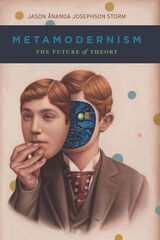
Metamodernism works through the postmodern critiques and uncovers the mechanisms that produce and maintain concepts and social categories. In so doing, Storm provides a new, radical account of society’s ever-changing nature—what he calls a “Process Social Ontology”—and its materialization in temporary zones of stability or “social kinds.” Storm then formulates a fresh approach to philosophy of language by looking beyond the typical theorizing that focuses solely on human language production, showing us instead how our own sign-making is actually on a continuum with animal and plant communication.
Storm also considers fundamental issues of the relationship between knowledge and value, promoting a turn toward humble, emancipatory knowledge that recognizes the existence of multiple modes of the real. Metamodernism is a revolutionary manifesto for research in the human sciences that offers a new way through postmodern skepticism to envision a more inclusive future of theory in which new forms of both progress and knowledge can be realized.
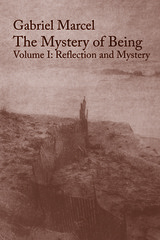
These volumes deal with almost all of the major themes of Marcel's thought: the nature of philosophy, our broken world, man's deep ontological need for being, i.e., for permanent eternal values, our incarnate bodily existence, primary and secondary reflection, participation, being in situation, the identity of the human self, intersubjectivity, mystery and problem, faith, hope, and the reality of God, and immortality.
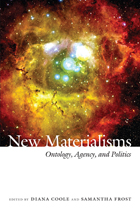
Coole and Frost argue that contemporary economic, environmental, geopolitical, and technological developments demand new accounts of nature, agency, and social and political relationships; modes of inquiry that privilege consciousness and subjectivity are not adequate to the task. New materialist philosophies are needed to do justice to the complexities of twenty-first-century biopolitics and political economy, because they raise fundamental questions about the place of embodied humans in a material world and the ways that we produce, reproduce, and consume our material environment.
Contributors
Sara Ahmed
Jane Bennett
Rosi Braidotti
Pheng Cheah
Rey Chow
William E. Connolly
Diana Coole
Jason Edwards
Samantha Frost
Elizabeth Grosz
Sonia Kruks
Melissa A. Orlie
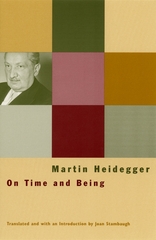
"This collection may well vie with Vom Wesen des Grundes and Identität and Differenz as definitive statements of Heidegger's ontology."—Library Journal
"The title of the English translation is that of the lead essay, the highly celebrated lecture which Heidegger gave in 1962 and which bears the same title as the never published 'third division' of the 'first half' of Being and Time. This lecture is perhaps the most significant document to be added to the Heideggerian corpus since the Letter of Humanism. . . . Stambaugh's translation is superb."—Stanley O. Hoerr and staff, The Review of Metaphysics
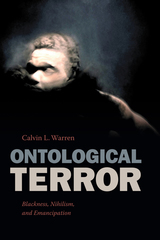
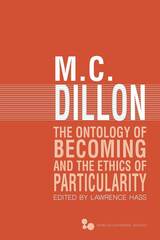
M. C. Dillon (1938–2005) was widely regarded as a world-leading Merleau-Ponty scholar. His book Merleau-Ponty’s Ontology (1988) is recognized as a classic text that revolutionized the philosophical conversation about the great French phenomenologist. Dillon followed that book with two others: Semiological Reductionism, a critique of early-1990s linguistic reductionism, and Beyond Romance, a richly developed theory of love. At the time of his death, Dillon had nearly completed two further books to which he was passionately committed. The first one offers a highly original interpretation of Nietzsche’s ontology of becoming. The second offers a detailed ethical theory based on Merleau-Ponty’s account of carnal intersubjectivity. The Ontology of Becoming and the Ethics of Particularity collects these two manuscripts written by a distinguished philosopher at the peak of his powers—manuscripts that, taken together, offer a distinctive and powerful view of human life and ethical relations.
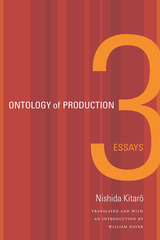
Agreeing with Marx that ontology is production and production is ontology, Nishida in these three essays—"Expressive Activity" (1925), "The Standpoint of Active Intuition" (1935), and "Human Being" (1938)—addresses sense and reason, language and thought, intuition and appropriation, ultimately arguing that in this concept of production, ideality and materiality are neither mutually exclusive nor oppositional but, rather, coimmanent. Nishida's forceful articulation of the radical nature of Marx's theory of production is, Haver contends, particularly timely in today's speculation-driven global economy. Nishida's reading of Marx, which points to the inseparability of immaterial intellectual labor and material manual labor, provokes a reconsideration of Marxism's utility for making sense of—and resisting—the logic of contemporary capitalism.

Ingarden elaborates upon the conception of concretization which he present in The Literary Work of Art and applies it to music and visual art. He also employs the concept of aspect to clarify the ontic structure of these art works and the distinction between the concretization of the work and the work itself. The distinction between the work’s concretization — effectuated in the mental experiences of the listener or viewer — and the work itself serves to help Ingarden confirm and account for the work’s intersubjective identity.
The problem of aesthetic value, Ingarden maintains, can be fruitfully treated only after the ontic structure of art work has been clarified. His primary concern in Ontology of the Work of Art is to ascertain and describe that structure and the mode of existence of works of art. In addition, he offers several discussions of aesthetic value, showing in the m the connections between questions of aesthetic value and the structure of the work of art.
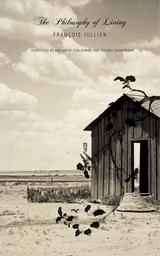
Living holds us between two places. It expresses what is most elementary—to be alive—and the absoluteness of our aspiration—finally living! But could we desire anything other than to live? In The Philosophy of Living, François Jullien meditates on Far Eastern thought and philosophy to analyze concepts that can be folded into a complete philosophy of living, including the idea of the moment, the ambiguity of the in-between, and what he calls the “transparency of morning.” Jullien here develops a strategy of living that goes beyond morality and dwells in the space between health and spirituality.
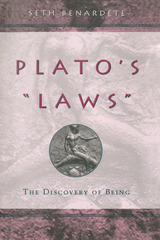
An insightful commentary on Plato’s Laws, his complex final work.
The Laws was Plato’s last work, his longest, and one of his most difficult. In contrast to the Republic, which presents an abstract ideal, the Laws appears to provide practical guidelines for the establishment and maintenance of political order in the real world. Classicist Seth Benardete offers a rich analysis of each of the twelve books of the Laws, which illuminates Plato’s major themes and arguments concerning theology, the soul, justice, and education.
Most importantly, Benardete shows how music in a broad sense, including drama, epic poetry, and even puppetry, mediates between reason and the city in Plato’s philosophy of law. Benardete also uncovers the work’s concealed ontological dimension, explaining why it is hidden and how it can be brought to light. In establishing the coherence and underlying organization of Plato’s last dialogue, Benardete makes a significant contribution to Platonic studies.
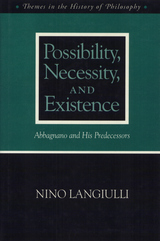
In this systematic historical analysis, Nino Langiulli focuses on a key philosophical issue, possibility, as it is refracted through the thought of the Italian philosopher Nicola Abbagnano. Langiulli examines Abbagnano's attempt to raise possibility to a level of prime importance and investigates his understanding of existence. In so doing, the author offers a sustained exposition of and argument with the account of possibility in the major thinkers of the Western tradition—Plato, Aristotle, Kant, and Kierkegaard. He also makes pertinent comments on such philosophers as Diodorus Cronus, William of Ockham, Spinoza, Hobbes, and Hegel, as well as such logicians as DeMorgan and Boole.
Nicola Abbagnano, who died in 1990, recently came to the attention of the general public as an influential teacher of author Umberto Eco. Creator of a dictionary of philosophy and author of a multiple-volume history of Western philosophy, Abbagnano was the only philosopher, according to Langiulli, to argue that "to be is to be possible."
Even though the concept of probability and the discipline of statistics are grounded in the concept of possibility, philosophers throughout history have grappled with the problem of defining it. Possibility has been viewed by some as an empty concept, devoid of reality, and by others as reducible to actuality or necessity—concepts which are opposite to it. Langiulli analyzes and debates Abbagnano's treatment of necessity as secondary to possibility, and he addresses the philosopher's conversation with his predecessors as well as his European and American contemporaries.
In the series Themes in the History of Philosophy, edited by Edith Wyschogrod.
This is a major phenomenological work in which real learning works in graceful tandem with genuine and important insight. Yet this is not a work of scholarship; it is a work of philosophy, a work that succeeds both in the careful, descriptive massing of detail and in the power of its analysis of the conditions that underlie the possibility of such things as description, interpretation, perception, and meaning.
Principles of Interpretation formulates answers to these questions: How does the interpretative process proceed? What are its fundamentals? What assurance have we that our interpretations are in principal faithful to that which is to be interpreted? What conclusions are indicated concerning the past phases of our history and its present tendencies?
In Processual Sociology, Abbott first examines the endurance of individuals and social groups through time and then goes on to consider the question of what this means for human nature. He looks at different approaches to the passing of social time and determination, all while examining the goal of social existence, weighing the concepts of individual outcome and social order. Abbott concludes by discussing core difficulties of the practice of social science as a moral activity, arguing that it is inescapably moral and therefore we must develop normative theories more sophisticated than our current naively political normativism. Ranging broadly across disciplines and methodologies, Processual Sociology breaks new ground in its search for conceptual foundations of a rigorously processual account of social life.
Science in the Forest, Science in the Past is a pioneering interdisciplinary exploration that will challenge the way readers interested in sciences, mathematics, humanities, social research, computer sciences, and education think about deeply held notions of what constitutes reality, how it is apprehended, and how to investigate it.
Responding to the ongoing “objectal turn” in contemporary humanities and social sciences, the essays in Subject Lessons present a sustained case for the continued importance— indeed, the indispensability—of the category of the subject for the future of materialist thought.
Approaching matters through the frame of Hegel and Lacan, the contributors to this volume, including the editors, as well as Andrew Cole, Mladen Dolar, Nathan Gorelick, Adrian Johnston, Todd McGowan, Borna Radnik, Molly Anne Rothenberg, Kathryn Van Wert, and Alenka Zupančič—many of whom stand at the forefront of contemporary Hegel and Lacan scholarship—agree with neovitalist thinkers that material reality is ontologically incomplete, in a state of perpetual becoming, yet they maintain that this is the case not in spite of but, rather, because of the subject.
Incorporating elements of philosophy, psychoanalysis, and literary and cultural studies, Subject Lessons contests the movement to dismiss the subject, arguing that there can be no truly robust materialism without accounting for the little piece of the Real that is the subject.

Opposing a long-standing orthodoxy of the Western philosophical tradition running from ancient Greek thought until the late nineteenth century, Frege argued that psychological laws of thought—those that explicate how we in fact think—must be distinguished from logical laws of thought—those that formulate and impose rational requirements on thinking. Logic does not describe how we actually think, but only how we should. Yet by thus sundering the logical from the psychological, Frege was unable to explain certain fundamental logical truths, most notably the psychological version of the law of non-contradiction—that one cannot think a thought and its negation simultaneously.
Irad Kimhi’s Thinking and Being marks a radical break with Frege’s legacy in analytic philosophy, exposing the flaws of his approach and outlining a novel conception of judgment as a two-way capacity. In closing the gap that Frege opened, Kimhi shows that the two principles of non-contradiction—the ontological principle and the psychological principle—are in fact aspects of the very same capacity, differently manifested in thinking and being.
As his argument progresses, Kimhi draws on the insights of historical figures such as Aristotle, Kant, and Wittgenstein to develop highly original accounts of topics that are of central importance to logic and philosophy more generally. Self-consciousness, language, and logic are revealed to be but different sides of the same reality. Ultimately, Kimhi’s work elucidates the essential sameness of thinking and being that has exercised Western philosophy since its inception.
Thoughts and Things posits what would appear to be an irreducible gap between our thoughts (the human subject) and things (the world). Bersani departs from his psychoanalytic convictions to speculate on the oneness of being—of our intrinsic connectedness to the other that is at once external and internal to us. He addresses the problem of formulating ways to consider the undivided mind, drawing on various sources, from Descartes to cosmology, Freud, and Genet and succeeds brilliantly in diagramming new forms as well as radical failures of connectedness. Ambitious, original, and eloquent, Thoughts and Things will be of interest to scholars in philosophy, film, literature, and beyond.
An award-winning philosopher bridges the continental-analytic divide with an important contribution to the debate on the meaning of realism.
Jocelyn Benoist argues for a philosophical point of view that prioritizes the concept of reality. The human mind’s attitudes toward reality, he posits, both depend on reality and must navigate within it.
Refusing the path of metaphysical realism, which would make reality an object of speculation in itself, independent of any reflection on our ways of approaching it or thinking about it, Benoist defends the idea of an intentionality placed in reality—contextualized. Intentionality is an essential part of any realist philosophical position; Benoist’s innovation is to insist on looking to context to develop a renewed realism that draws conclusions from contemporary philosophy of language and applies them methodically to issues in the fields of metaphysics and the philosophy of the mind. “What there is”—the traditional subject of metaphysics—can be determined only in context.
Benoist offers a sharp criticism of acontextual ontology and acontextual approaches to the mind and reality. At the same time, he opposes postmodern anti-realism and the semantic approach characteristic of classic analytic philosophy. Instead, Toward a Contextual Realism bridges the analytic-continental divide while providing the foundation for a radically contextualist philosophy of mind and metaphysics. “To be” is to be in a context.
The French philosopher Renaud Barbaras remarked that late in Maurice Merleau-Ponty’s career, “The phenomenology of perception fulfills itself as a philosophy of expression.” In Tracing Expression in Merleau-Ponty: Aesthetics, Philosophy of Biology, and Ontology, Véronique M. Fótiaddresses the guiding yet neglected theme of expression in Merleau-Ponty’s thought. She traces Merleau-Ponty’s ideas about how individuals express creative or artistic impulses through his three essays on aesthetics, his engagement with animality and the “new biology” in the second of his lecture courses on nature of 1957–58, and in his late ontology, articulated in 1964 in the fragmentary text of Le visible et l’invisible (The Visible and the Invisible). With the exception of a discussion of Merleau-Ponty’s 1945 essay “Cezanne’s Doubt,” Fóti engages with Merleau-Ponty’s late and final thought, with close attention to both his scientific and philosophical interlocutors, especially the continental rationalists. Expression shows itself, in Merleau-Ponty’s thought, to be primordial, and this innate and fundamental nature of expression has implications for his understanding of artistic creation, science, and philosophy.
We are so used to distinguishing between the possible and the real, between essence and existence that we do not realize that these distinctions, which seem so obvious to us, are the result of a long and laborious process that has led to the splitting of being—the “matter” of thought—into two fragments that are both conflicting and intimately intertwined.
This book argues that the ontological-political machine of the West is based on the splitting of this “matter,” without which neither science nor politics would be possible. Without the partition of reality into essence and existence and into possibility and actuality, neither scientific knowledge nor the ability to control human action—which characterizes the historical power of the West—would have been possible.
If we could not suspend the exclusive concentration of our attention on what immediately exists (as animals seem to do), to think and define its essence, Western science and technology would not have experienced the advances that characterize them. And if the dimension of possibility disappeared entirely, neither plans nor projects would be thinkable, and human actions could be neither directed nor controlled. The incomparable power of the West has one of its essential presuppositions in this ontological machine.
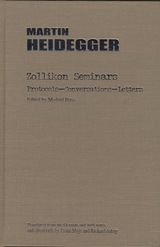
Boss approached Heidegger asking for help in reflective thinking on the nature of Heidegger's work. Soon they were holding annual two-week meetings in Boss's home in Zollikon, Switzerland. The protocols from these seminars, recorded by Boss and reviewed, corrected, and supplemented by Heidegger himself, make up one part of this volume. They are augmented by Boss's record of the conversations he had with Heidegger in the days between seminars and by excerpts from the hundreds of letters the philosopher wrote to Boss between 1947 and 1971.
READERS
Browse our collection.
PUBLISHERS
See BiblioVault's publisher services.
STUDENT SERVICES
Files for college accessibility offices.
RECENTLY PUBLISHED



UChicago Accessibility Resources
home | accessibility | search | about | contact us
BiblioVault ® 2001 - 2024
The University of Chicago Press