
 A SCHOLARLY BOOK REPOSITORY
Classicist Lowell Edmunds and folklorist Alan Dundes both note that “the Oedipus tale is not likely to ever fade from view in Western civilization, [as] the tale continues to pack a critical family drama into a timeless form.” Looking beyond the story related in Sophocles’ drama—the ancient Theban myth of the son who unknowingly kills his father and marries his mother—Oedipus: A Folklore Casebook examines variations of the tale from Africa and South America to Eastern Europe and the Pacific. Taking sociological, psychological, anthropological, and structuralist perspectives, the nineteen essays reveal the complexities and multiple meanings of this centuries-old tale.
In addition to the well-known interpretations of the Oedipus myth by Sigmund Freud and James Frazer, this casebook includes insightful selections by an international group of scholars. Essays on a Serbian Oedipus legend by Friedrich Krauss and on a Gypsy version by Mirella Karpati, for example, stress the psychological stages of atonement after the Oedipus figure learns the truth about his actions. Anthropologist Melford E. Spiro investigates the myth’s appearance in Burma and the significance of the mother’s identification with the dragon (the sphinx figure). Vladimir Propp’s essay, translated into English for the first time, and Lowell Edmunds’s theoretical review discuss the relation of the Oedipus story to the larger study of folklore. The result is a comprehensive and fascinating casebook for students of folklore, classical mythology, anthropology, and sociology.

Psychoanalysis, entering its second century, is a vital yet divided discipline. A confusing array of mutually contradictory theories compete for the loyalty of clinicians and for the attention of all those interested in understanding human experience.
In the classic Object Relations in Psychoanalytic Theory, Jay Greenberg and his coauthor Stephen Mitchell brought clarity to the confusion surrounding psychoanalytic disputes. They defined two competing models: the drive model, which addresses the private dimensions of experience; and the relational model, which reveals the relentlessly social aspect of our lives. Oedipus and Beyond builds on Greenberg’s earlier contribution. Beginning with a brilliant critique of the conceptual framework of psychoanalysis, he provides fresh insight into Freud’s theory, demonstrating how attempts to resolve some of its shortcomings have generated their own theoretical and clinical dilemmas. In the process he illuminates the roles of the Oedipus complex, the drives, the unconscious, and psychic structure in shaping the sensibilities of alternative psychoanalytic approaches.
Greenberg does not attempt to synthesize the two models, because he believes that diversity is essential if psychoanalysis is to remain strong. Instead, he proposes a compelling and practical clinical theory in which Freud’s insistence on the importance of inner motivation, psychic conflict, and personal agency effectively informs a relational emphasis on the fundamental influence of social living.
The book concludes with some apt illustrations of how the “representational model” can enrich clinical work. Greenberg rethinks the process of making the unconscious conscious, and arrives at new approaches to the analyst’s neutrality, to transference analysis, and to countertransference. The result reflects the author’s profound insight into the structure of psychoanalytic theory and his mastery of the contributions of diverse psychoanalytic schools. Perhaps most important, Greenberg’s argument never loses touch with his clinical experience; ultimately, this is the deeply personal statement of a skilled practitioner.
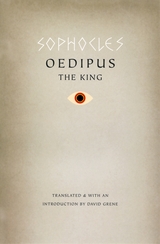
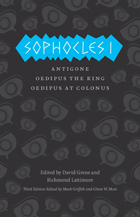
Available for the first time as an independent work, David Grene’s legendary translation of Oedipus the King renders Sophocles’ Greek into cogent, vivid, and poetic English for a new generation to savor. Over the years, Grene and Lattimore’s Complete Greek Tragedies have been the preferred choice of millions of readers—for personal libraries, individual study, and classroom use. This new, stand-alone edition of Sophocles’ searing tale of jealousy, rage, and revenge will continue the tradition of the University of Chicago Press’s classic series.
Praise for David Grene and Richmond Lattimore’s Complete Greek Tragedies
“This is it. No qualifications. Go out and buy it everybody.”—Kenneth Rexroth, Nation
“The translations deliberately avoid the highly wrought and affectedly poetic; their idiom is contemporary. . . . They have life and speed and suppleness of phrase.”—Times Education Supplement
READERS
Browse our collection.
PUBLISHERS
See BiblioVault's publisher services.
STUDENT SERVICES
Files for college accessibility offices.
RECENTLY PUBLISHED




UChicago Accessibility Resources
home | accessibility | search | about | contact us
BiblioVault ® 2001 - 2024
The University of Chicago Press