front cover of Being Jewish in the New Germany
Being Jewish in the New Germany
Being Jewish in the New Germany, First Paperback Edition
Jeffrey M. Peck
Rutgers University Press, 2007

Germany today boasts the fastest growing population of Jews in Europe. The streets of Berlin abound with signs of a revival of Jewish culture, ranging from bagel shops to the sight of worshipers leaving synagogue on Saturday. With the new energy infused by Jewish immigration from Russia and changes in immigration and naturalization laws in general, Jeffrey M. Peck argues that we must now begin considering how Jews live in Germany rather than merely asking why they would choose to do so.

In Being Jewish in the New Germany, Peck explores the diversity of contemporary Jewish life and the complex struggles within the community-and among Germans in general-over history, responsibility, culture, and identity. He provides a glimpse of an emerging, if conflicted, multicultural country and examines how the development of the European Community, globalization, and the post-9/11 political climate play out in this context. With sensitive, yet critical, insight into the nation's political and social life, chapters explore issues such as the shifting ethnic/national makeup of the population, changes in political leadership, and the renaissance of Jewish art and literature. Peck also explores new forms of anti-Semitism and relations between Jews and Turks-the country's other prominent minority population.

In this surprising description of the rebirth of a community, Peck argues that there is, indeed, a vibrant and significant future for Jews in Germany. Written in clear and compelling language, this book will be of interest to the general public and scholars alike.
 

[more]

front cover of Interrogating Integration
Interrogating Integration
Sport, Celebrity, and Scandal in the Making of New Germany
Kate Zambon
University of Michigan Press, 2025
Interrogating Integration explores how international sporting spectacles, media campaigns, and public debates construct racialized national identity in an era of rising right-wing nationalism. Across Europe, “integration” has emerged as a guiding concept to regulate cultural differences, particularly in Germany, where integration became a watchword after the introduction of birthright citizenship in 2000. The legal expansion of German citizenship threatened the homogeneous definition of the nation and spurred increased scrutiny of immigrants and Germans of color, primarily Muslim and Black Germans. This opened a new chapter in the long struggle over German identity. The celebrations, scandals, and debates analyzed here reveal how the admission of new citizens inspired an optimistic cosmopolitanism that claimed to differentiate the new Germany from its fascist past while simultaneously reinscribing racialized hierarchies and providing fuel for rising far-right politics.

Using touchstones of public memory, including events surrounding men’s World Cup soccer and the record-breaking success of a book blaming Muslims for Germany’s decline, Zambon examines persistent problems in European conceptions of race, where racializing projects take place under an “ideology of racelessness” and the atrocities of historical and transnational racisms are used to deny current local forms of racism.
 
[more]

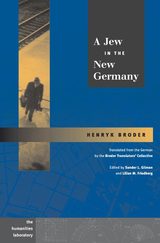
front cover of A Jew in the New Germany
A Jew in the New Germany
Henryk Broder
University of Illinois Press, 2003
Henryk Broder, one of the most controversial and engaging writers in Germany today, has been a thorn in the side of the Establishment for thirty years. The son of two Polish Holocaust survivors, Broder is not only a trenchant political critic and observant social essayist but an invaluable chronicler of the Jewish experience in late twentieth-century Germany. 
 
This volume collects eighteen of Broder's essays, translated for the first time into English. The first was written in 1979 and the most recent deals with the post-9/11 realities of the war on terrorism, and its effects on the countries of Europe. Other essays address the debate over the construction of a Holocaust memorial in Berlin, the German response to the 1991 Gulf War, the politics of German reunification, and the rise of the new German nationalism.
 
Broder charts the recent evolution of German Jewish relations, using his own outsider status to hold up a mirror to the German people and point out that things have not changed for German Jews as much as non-Jews might think.
 
[more]

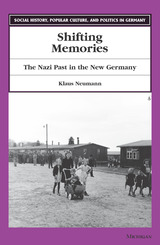
front cover of Shifting Memories
Shifting Memories
The Nazi Past in the New Germany
Klaus Neumann
University of Michigan Press, 2000
Shifting Memories explores the contours and genealogies of non-Jewish Germans' public memories of the Nazi past in the Federal Republic of Germany, asking how the crimes committed by Nazi Germany are reflected in the present. The study illuminates particular aspects of public remembering by focusing on case studies, telling a number of stories which at times appear parallel and at times intersect.
The case studies address, for example, the legacy of the so-called Celler Hasenjagd (the hunting down of concentration camp prisoners who survived an Allied air raid in April 1945 in a town in Lower Saxony); efforts by the City of Hildesheim to memorialize the Kristallnacht pogrom; attempts by Italian, Jewish, and Sinti survivors to commemorate their suffering in two West German towns; the posthumous reputation of a German communist imprisoned in Buchenwald and credited with having saved the lives of 159 Jewish children; and the public memories of the Ravensbrück and Buchenwald concentration camps in East Germany.
Directed at an audience curious about contemporary Germany, this book will appeal to those interested in issues of public and social memory, and in the legacy of Auschwitz.
Klaus Neumann is a historian who has taught in universities in Germany and Australia and written about social memories in the Pacific Islands, Australia, and Germany. Previous books include Not the Way It Really Was and Rabaul Yu Swit Moa Yet. He lives in Richmond, Australia.
[more]

front cover of That Was the Wild East
That Was the Wild East
Film Culture, Unification, and the "New" Germany
Leonie Naughton
University of Michigan Press, 2002
That Was the Wild East presents critical insight into popular film culture and art house cinema in Germany from 1990-1999. It examines box-office hits and cult films, such as the "Trabi comedies" and unification farces, which delighted local and international audiences, but which have been granted scarce critical attention up to this point. The first detailed account of the representation of German unification on film to appear, either in English or German, this work provides valuable and engaging source material otherwise inaccessible to non-German readers. In her focus on a range of "unification films," Leonie Naughton analyzes impressions of unification fostered in films from the East and West, along with the comic and tragic anxieties these films attribute to life in the "new" Germany. The ways in which German filmmakers represented unification throughout the 1990s are discussed with reference to a broad range of recent German films, and Naughton examines both divergent and convergent cinematic impressions of life in a recently unified Germany by 1990s filmmakers. Those interested in film studies and film history, German history and culture, as well as German unification and recent developments in German cinema, will find this book especially appealing.
[more]


Send via email Share on Facebook Share on Twitter