

logo for University of Chicago Press
The Economics of Place-Based Policies
Edited by Cecile Gaubert, Gordon H. Hanson, and David Neumark
University of Chicago Press, 2026

A wide-ranging collection of research examining the intricate economics of place-based policies.

After decades of skepticism about place-based policies, recent initiatives such as Opportunity Zones and elements of the Inflation Reduction Act signal renewed policy interest in targeting economically distressed areas. This volume surveys empirical findings from the US and Europe on the effectiveness of these policies, explores new theoretical rationales for geographic targeting, and examines the institutional contexts that shape policy design and implementation. The contributors evaluate major place-based initiatives and consider nontraditional approaches to supporting regional economies, including large-scale industrial interventions, public employment reallocation, and economic development on Native American reservations.

This collection is not limited to empirical policy impact evaluations as it takes a broader-ranging perspective. The contributors present evaluation evidence while also emphasizing the features, implementation processes, and institutional settings that shape policy effectiveness. They address critical questions such as: What new insights from economic theory can inform the design of place-based policies? What lessons from past policies are reflected—or ignored—in current approaches? How does US policymaking compare with European practices, and what takeaways can be derived from the comparison of the two?

The Economics of Place-Based Policies provides policymakers with evidence-based guidance on the design of effective interventions while offering researchers a comprehensive foundation for future study of how public policy can address geographic economic disparities.
[more]

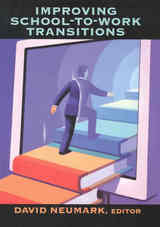
front cover of Improving School-to-Work Transitions
Improving School-to-Work Transitions
David Neumark
Russell Sage Foundation, 2007
As anxieties about America's economic competitiveness mounted in the 1980s, so too did concerns that the nation's schools were not adequately preparing young people for the modern workplace. Spurred by widespread joblessness and job instability among young adults, the federal government launched ambitious educational reforms in the 1990s to promote career development activities for students. In recent years, however, the federal government has shifted its focus to test-based reforms like No Child Left Behind that emphasize purely academic subjects. At this critical juncture in education reform, Improving School-To-Work Transitions, edited by David Neumark, weighs the successes and failures of the '90s-era school-to-work initiatives, and assesses how high schools, colleges, and government can help youths make a smoother transition into stable, well-paying employment. Drawing on evidence from national longitudinal studies, surveys, interviews, and case studies, the contributors to Improving School-To-Work Transitions offer thought-provoking perspectives on a variety of aspects of the school-to-work problem. Deborah Reed, Christopher Jepsen, and Laura Hill emphasize the importance of focusing school-to-work programs on the diverse needs of different demographic groups, particularly immigrants, who represent a growing proportion of the youth population. David Neumark and Donna Rothstein investigate the impact of school-to-work programs on the "forgotten half," students at the greatest risk of not attending college. Using data from the 1997 National Longitudinal Study of Youth, they find that participation by these students in programs like job shadowing, mentoring, and summer internships raise employment and college attendance rates among men and earnings among women. In a study of nine high schools with National Academy Foundation career academies, Terry Orr and her fellow researchers find that career academy participants are more engaged in school and are more likely to attend a four-year college than their peers. Nan Maxwell studies the skills demanded in entry-level jobs and finds that many supposedly "low-skilled" jobs actually demand extensive skills in reading, writing, and math, as well as the "new basic skills" of communication and problem-solving. Maxwell recommends that school districts collaborate with researchers to identify which skills are most in demand in their local labor markets. At a time when test-based educational reforms are making career development programs increasingly vulnerable, it is worth examining the possibilities and challenges of integrating career-related learning into the school environment. Written for educators, policymakers, researchers, and anyone concerned about how schools are shaping the economic opportunities of young people, Improving School-To-Work Transitions provides an authoritative guide to a crucial issue in education reform.
[more]


Send via email Share on Facebook Share on Twitter