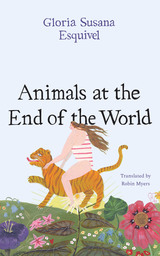
front cover of Animals at the End of the World
Animals at the End of the World
By Gloria Susana Esquivel, translated by Robin Myers
University of Texas Press, 2020

Animals at the End of the World begins with an explosion, which six-year-old Inés mistakes for the end of the world that she has long feared. In the midst of the chaos, she meets the maid’s granddaughter, Mariá, who becomes her best friend and with whom she navigates the adult world in her grandparents’ confined house. Together, they escape the house and confront the “animals” that populate Bogotá in the 1980s. But Inés soon realizes she cannot count on either María or her preoccupied and conflicted parents. Alone, she must learn to decipher her outer and inner worlds, confronting both armies of beasts and episodes of domestic chaos. In the process, she also learns what it means to test boundaries, break rules, and cope with the consequences.

The first novel by Colombian author Gloria Susana Esquivel, Animals at the End of the World is a poetic and moving coming-of-age story that lingers long after its final page.


[more]

front cover of Restless Dead
Restless Dead
Necrowriting and Disappropriation
Cristina Rivera Garza
Vanderbilt University Press, 2020
Based on comparative readings of contemporary books from Latin America, Spain, and the United States, the essays in this book present a radical critique against strategies of literary appropriation that were once thought of as neutral, and even concomitant, components of the writing process. Debunking the position of the author as the center of analysis, Cristina Rivera Garza argues for the communality—a term used by anthropologist Floriberto Díaz to describe modes of life of Indigenous peoples of Oaxaca based on notions of collaborative labor—permeating all writing processes.

Disappropriating is a political operation at the core of projects acknowledging, both at ethical and aesthetic levels, that writers always work with materials that are not their own. Writers borrow from the practitioners of a language, entering in a debt relationship that can only be covered by ushering the text back to the communities from which it grew. In a world rife with violence, where the experiences of many are erased by pillage and extraction, writing among and for the dead is a form of necrowriting that may well become a life-affirming act of decolonization and resistance.
[more]


Send via email Share on Facebook Share on Twitter