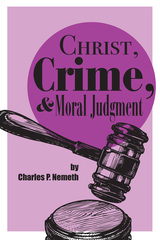
Christ, Crime, and Moral Judgment
Nemeth
St. Augustine's Press, 2025
After a career of teaching law, ethics, and the relationship between criminal activity and the moral imperative, Charles Nemeth wants to revisit the post-modern 'caricature' of the God who is so loving and merciful that one overlooks the urgency of the human requirement to be good at all times.
Nemeth traces the modern shift in considering God as judge to the God who just wants to wipe away tears. If we look in Scripture, there are harsh words for the person who dismisses moral action as less than a continual call to evaluation and conversion. One also sees the detrimental effect of granting political underpinnings to all interpretations of the Bible and its indications of what righteous action is. Nemeth asserts that not only is the measure of law worthless without a kind of hardness toward offenders, but charity itself has no backbone without justice. Restoration requires judgment, but the Judge who speaks harshly is the one who cultivates the desire for his softness. Post-modern scholars don't worry about receiving God's mercy, but they really ought to define the parameters of human responsibility. Any human attempt to define mercy and compassion on the part of God will always fall short, we ought to save our energies to live up to the moral life and take Christ as a perfect example and proof of the possibility.
[more]