
 A SCHOLARLY BOOK REPOSITORY
15 start with A start with A
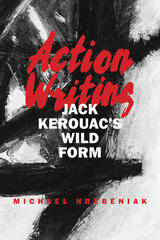
Action Writing: Jack Kerouac's Wild Form connects the personal and creative development of the Beat generation's famous icon with cultural changes in postwar America. Michael Hrebeniak asserts that Jack Kerouac's "wild form"—self-organizing narratives free of literary, grammatical, and syntactical conventions—moves within an experimental continuum across the arts to generate a Dionysian sense of writing as raw process. Action Writing highlights how Kerouac made concrete his 1952 intimation of "something beyond the novel" by assembling ideas from Beat America, modernist poetics, action painting, bebop, and subterranean oral traditions.
Geared to scholars and students of American literature, Beat studies, and creative writing, Action Writing places Kerouac's writing within the context of the American art scene at midcentury. Reframing the work of Kerouac and the Beat generation within the experimental modernist and postmodernist literary tradition, this probing inquiry offers a direct engagement with the social and cultural history at the foreground of Kerouac's career from the 1940s to the late 1960s.

On a December morning in 1925, a newspaper journalist reported receiving 25 different handbills in an hour's walk in downtown Tokyo, advertising everything from Western-style clothing and furniture to sweet shops, charity organizations, phonograph recordings, plays, and films. The activities of advertisers, and the new entertainment culture and patterns of consumption that they promoted, helped to define a new urban aesthetic emerging in the 1920s.
This book examines some of the responses of Japanese authors to the transformation of Tokyo in the early decades of the twentieth century. In particular, it explores the themes and formal strategies of the modernist literature that flourished in the 1920s, focusing on the work of Hagiwara Kyojiro (1899-1938) and Hayashi Fumiko (1903-1951). William Gardner shows how modernist works offer new constructions of individual subjectivity amid the social and technological changes that provided the ground for the appearance of "mass media." Hagiwara's conception of the poem and poet as an electric-radio "advertising tower" provides an emblem for the aesthetic tensions and multiple discourses of technology, media, urbanism, commerce, and propaganda that were circulating through the urban environment at the time; while Hayashi's work, with its references to popular songs, plays, and movies, suggests an understanding of "everyday life" as the interface between individual subjectivity and a highly mediated environment.
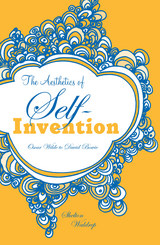
Traces the influence of Oscar Wilde as the precursor of twentieth-century artists of self-performance
By printing the title “Professor of Aesthetics” on his visiting cards, Oscar Wilde announced yet another transformation—and perhaps the most significant of his career, proclaiming his belief that he could redesign not just his image but his very self. Shelton Waldrep explores the cultural influences at play in Wilde’s life and work and his influence on the writing and performance of the twentieth century, particularly on the lives and careers of some of its most aestheticized performers: Truman Capote, Andy Warhol, David Hockney, and David Bowie. As Waldrep reveals, Wilde’s fusing of art with commerce foresaw the coming century’s cultural producers who would blend works of both “high art” and mass-market appeal.
Whether as a gay man or as a postmodern performance artist ahead of his time, Wilde ultimately emerges here as the embodiment of the twentieth-century media-savvy artist who is both subject and object of the aesthetic and economic systems in which he is enmeshed.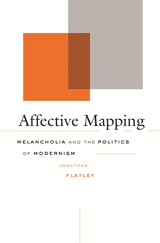
The surprising claim of this book is that dwelling on loss is not necessarily depressing. Instead, Jonathan Flatley argues, embracing melancholy can be a road back to contact with others and can lead people to productively remap their relationship to the world around them. Flatley demonstrates that a seemingly disparate set of modernist writers and thinkers showed how aesthetic activity can give us the means to comprehend and change our relation to loss.
The texts at the center of Flatley’s analysis—Henry James’s Turn of the Screw, W. E. B. Du Bois’s The Souls of Black Folk, and Andrei Platonov’s Chevengur—share with Freud an interest in understanding the depressing effects of difficult losses and with Walter Benjamin the hope that loss itself could become a means of connection and the basis for social transformation. For Du Bois, Platonov, and James, the focus on melancholy illuminates both the historical origins of subjective emotional life and a heretofore unarticulated community of melancholics. The affective maps they produce make possible the conversion of a depressive melancholia into a way to be interested in the world.
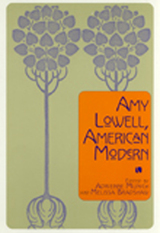
For decades, the work of one of America’s most influential poets, 1925 Pulitzer Prize–winner Amy Lowell (1874–1925), has been largely overlooked. This vigorous, courageous poet gave voice to an erotic, thoroughly American sensibility. Cigar-smoker, Boston Brahmin, lesbian, impresario, entrepreneur, and prolific poet, Lowell heralded the rush of an American poetic flowering. A best-selling poet as well as a wildly popular lecturer (autograph-seeking fans were sometimes so boisterous that she required a police escort), she was a respected authority on modern poetry, forging the path that led to the works of Allen Ginsberg, May Sarton, Sylvia Plath, and beyond. Yet, since her death, her work has suffered critical neglect.
This volume presents an essential revaluation of Lowell, and builds a solid critical basis for evaluating her poetry, criticism, politics, and influence. Essays explore the varied contributions of Lowell as a woman poet, a modernist, and a significant force of the literary debates of early twentieth-century poetics. In addition to placing Lowell in her proper historical context, contributors demonstrate her centrality to current critical and theoretical discussions: feminist, gay and lesbian, and postcolonial, in as well as in disability, American, and cultural studies. The book includes a transatlantic group of literary critics and scholars.
Amy Lowell, American Modern offers the most sustained examination of Lowell to date. It returns her to conversation and to literary history where she belongs.
The book traces this mode of thinking in linguistics, collaborative intellectual work in the arts and sciences, and interpretations of literary and sacred texts, concluding with a reading of the concept of Enlightenment in a comparison of Descartes and Foucault. The book examines the poststructuralism of Derrida; the collaborations of information theory and modern science as opposed to the individualism of Adam Smith and others, and analogical interpretations of Yeats, Dinesen, the Bible, Dreiser, and Mailer. Its overall aim is to present an interdisciplinary examination of a particular kind of understanding that responds to the experiences of our time.
Ronald Schleifer is Professor of English, University of Oklahoma. His books include Rhetoric and Death: The Language of Modernism and Postmodern Discourse Theory, Criticism and Culture; and Culture and Cognition: The Boundaries of Literary and Scientific Inquiry.
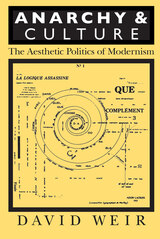
David Weir develops this thesis in several ways. He begins by considering the place of culture in the political thought of the classical anarchist thinkers William Godwin, Pierre-Joseph Proudhon, Mikhail Bakunin, and Peter Kropotkin. He then shows how the perceived "anarchy" of nineteenth-century society induced writers such as Matthew Arnold, Henry James, and Fyodor Dostoyevsky to turn away from politics and seek unity in the idea of a common culture.
Yet as other late-nineteenth-century writers and artists began to sympathize with anarchism, the prospect of a common culture became increasingly remote. In Weir's view, the affinity for anarchism that developed among members of the artistic avant-garde lies behind much of fin de siècle culture. Indeed, the emergence of modernism itself can be understood as the aesthetic realization of anarchist politics. In support of this contention, Weir shows that anarchism is the key aesthetic principle informing the work of a broad range of modernist figures, from Henrik Ibsen and James Joyce to dadaist Hugo Ball and surrealist Luis Buñuel.
Weir concludes by reevaluating the phenomenon of postmodernism as only the most recent case of the migration of politics into aesthetics, and by suggesting that anarchism is still very much with us as a cultural condition.
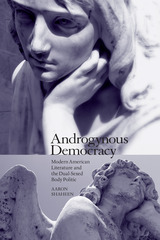
Androgynous Democracy examines how the notions of gender equality propounded by transcendentalists and other nineteenth-century writers were further developed and complicated by the rise of literary modernism. Aaron Shaheen specifically investigates the ways in which intellectual discussions of androgyny, once detached from earlier gonadal-based models, were used by various American authors to formulate their own paradigms of democratic national cohesion. Indeed, Henry James, Frank Norris, Charlotte Perkins Gilman, John Crowe Ransom, Grace Lumpkin, W. E. B. Du Bois, and Marita Bonner all expressed a deep fascination with androgyny—an interest that bore directly on their thoughts about some of the most prominent issues America confronted as it moved into the first decades of the twentieth century.
Shaheen not only considers the work of each of these seven writers individually, but he also reveals the interconnectedness of their ideas. He shows that Henry James used the concept of androgyny to make sense of the discord between the North and the South in the years immediately following the Civil War, while Norris and Gilman used it to formulate a new model of citizenship in the wake of America’s industrial ascendancy. The author next explores the uses Ransom and Lumpkin made of androgyny in assessing the threat of radicalism once the Great Depression had weakened the country’s faith in both capitalism and religious fundamentalism. Finally, he looks at how androgyny was instrumental in the discussions of racial uplift and urban migration generated by Du Bois and Bonner.
Thoroughly documented, this engrossing volume will be a valuable resource in the fields of American literary criticism, feminism and gender theory, queer theory, and politics and nationalism.
Aaron Shaheen is UC Foundation Assistant Professor of English at the University of Tennessee at Chattanooga. He has published articles in the Southern Literary Journal, American Literary Realism, and the Henry James Review.
Mia Spiro's Anti-Nazi Modernism marks a major step forward in the critical debates over the relationship between modernist art and politics. Spiro analyzes the antifascist, and particularly anti-Nazi, narrative methods used by key British and American fiction writers in the 1930s. Focusing on works by Djuna Barnes, Christopher Isherwood, and Virginia Woolf, Spiro illustrates how these writers use an "anti-Nazi aesthetic" to target and expose Nazism’s murderous discourse of exclusion. The three writers challenge the illusion of harmony and unity promoted by the Nazi spectacle in parades, film, rallies, and propaganda. Spiro illustrates how their writings, seldom read in this way, resonate with the psychological and social theories of the period and warn against Nazism’s suppression of individuality. Her approach also demonstrates how historical and cultural contexts complicate the works, often reinforcing the oppressive discourses they aim to attack. This book explores the textual ambivalences toward the "Others" in society—most prominently the Modern Woman, the homosexual, and the Jew. By doing so, Spiro uncovers important clues to the sexual and racial politics that were widespread in Europe and the United States in the years leading up to World War II.

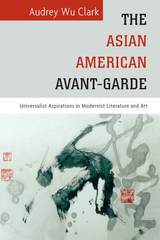
The Asian American Avant-Garde is the first book-length study that conceptualizes a long-neglected canon of early Asian American literature and art. Audrey Wu Clark traces a genealogy of counter-universalism in short fiction, poetry, novels, and art produced by writers and artists of Asian descent who were responding to their contemporary period of Asian exclusion in the United States, between the years 1882 and 1945.
Believing in the promise of an inclusive America, these avant-gardists critiqued racism as well as institutionalized art. Clark examines racial outsiders including Isamu Noguchi, Dong Kingman and Yun Gee to show how they engaged with modernist ideas, particularly cubism. She draws comparisons between writers such as Sui Sin Far and Carlos Bulosan with modernist luminaries like Stein, Eliot, Pound, and Proust.
Acknowledging the anachronism of the term “Asian American” with respect to these avant-gardists, Clark attempts to reconstruct it. The Asian American Avant-Garde explores the ways in which these artists and writers responded to their racialization and the Orientalism that took place in modernist writing.
READERS
Browse our collection.
PUBLISHERS
See BiblioVault's publisher services.
STUDENT SERVICES
Files for college accessibility offices.
RECENTLY PUBLISHED




UChicago Accessibility Resources
home | accessibility | search | about | contact us
BiblioVault ® 2001 - 2024
The University of Chicago Press