
 A SCHOLARLY BOOK REPOSITORY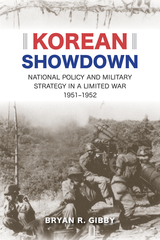
Winner of the 2023 Andrew F. Krepinevich Jr. Writing Award
Korean Showdown: National Policy and Military Strategy in a Limited War, 1951–1952 takes a holistic and integrative approach to strategy, operations, and tactics during the Korean War’s stalemate period and demonstrates how these matters shaped each other and influenced, or were influenced by, political and strategic policy decision-making. Bryan R. Gibby offers an analysis of the major political and military decisions affecting how the war was conducted operationally and diplomatically by examining American, Chinese, North Korean, and South Korean operations in the context of fighting a limited war with limited means, but for objectives that were not always limited in scope or ambition. The foundational political decision was Harry Truman’s voluntary repatriation policy, which extended the war by up to eighteen months. Its military counterpart was the American-led Operation Showdown, the last deliberate military offensive to coerce concessions at the negotiation table. Showdown’s failure (and the Communists’ own equally disappointing military efforts) opened up new avenues for solving the war short of a militarily imposed solution.
Gibby’s research draws on primary sources from American, Korean, and Chinese archives and publications. Many of these sources have not yet been mined in diplomatic and military histories of the Korean War. This innovative book also addresses a significant gap in the study of Korean military operations—the linkage between ground and air pressure campaigns, as well as the many Chinese and American operations conducted to establish negotiation positions. Gibby also explores many political and propagandist developments that assumed great importance in the summer of 1952, such as prisoner of war riots, the bombing of hydroelectric dams, and the South Korean constitutional crisis, which significantly influenced American and Chinese military decision-making.
Ultimately, this volume serves as a cautionary analysis of the limits of force, the necessity to understand an adversary, and the importance of strategic consensus. It also offers an effective case study on an underappreciated period of civil-military tension during the Cold War and on how civilian politicians and military leaders must collaborate to determine a realistic and effective strategy.

Military Strategy, Joint Operations, and Airpower will introduce readers to contemporary strategy and the operational level of war, particularly as it relates to airpower.
This intermediate textbook was developed as required reading for all US Air Force Academy cadets, and is designed to close the gap between military theory and military practice. It asks readers to reconceive of the military as a “profession of effects” rather than as a profession of arms because much of the military's work and impact no longer involves kinetic warfare.
The book covers strategic foundations; operational design and joint-service operations; the air, space, and cyber capabilities that make up modern airpower; and contemporary challenges in the application of strategy. The contributing authors include both military practitioners and scholars of security studies, political science, and history.
In addition to being required reading for Air Force Academy cadets, the book will provide an essential overview of strategy and practice for anyone interested in modern airpower and the joint operating environment.
An essential introduction to contemporary strategy at the operational level of war, now in its second edition
Military Strategy, Joint Operations, and Airpower introduces contemporary strategy at the operational level of war, particularly as it relates to airpower. Developed as foundational reading for all US Air Force Academy cadets, Air Force ROTC students, and Officer Training School candidates, this intermediate textbook is designed to close the gap between military theory and practice. It covers strategic foundations; operational design and joint-service operations; the air, space, and cyber capabilities that comprise modern airpower; and contemporary challenges in the application of strategy.
In this second edition, each chapter has been updated and revised, and several sections have been expanded. Part 2, “Military Forces and the Joint Fight,” now features separate chapters about each service. Similarly, operational design is expanded from one to four chapters to provide a more thorough step-by-step guide through the process. New chapters in this second edition include “Integrating the Instruments of Power,” “The Spectrum of Conflict and Range of Military Operations,” and “The Nuclear Weapons Triad and Missile Defense.”
Military Strategy, Joint Operations, and Airpower’s contributing authors and editors include both military practitioners and scholars of security studies, political science, and history. In addition to being required reading for US Air Force cadets, the book provides an essential overview of strategy and practice for anyone interested in modern airpower.
READERS
Browse our collection.
PUBLISHERS
See BiblioVault's publisher services.
STUDENT SERVICES
Files for college accessibility offices.
RECENTLY PUBLISHED





UChicago Accessibility Resources
home | accessibility | search | about | contact us
BiblioVault ® 2001 - 2026
The University of Chicago Press