
 A SCHOLARLY BOOK REPOSITORY
Results by Title
2 books about Memmi, Albert
2 books about Memmi, Albert
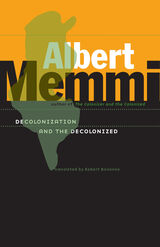
Decolonization and the Decolonized
Albert Memmi
University of Minnesota Press, 2006
In this time of global instability and widespread violence, Albert Memmi—author of the highly influential and groundbreaking work The Colonizer and the Colonized—turns his attention to the present-day situation of formerly colonized peoples. In Decolonization and the Decolonized, Memmi expands his intellectual engagement with the subject and examines the manifold causes of the failure of decolonization efforts throughout the world.As outspoken and controversial as ever, Memmi initiates a much-needed discussion of the ex-colonized and refuses to idealize those who are too often painted as hapless victims. He shows how, in light of a radically changed world, it would be problematic—and even irresponsible—to continue to deploy concepts that were useful and valid during the period of anticolonial struggle.Decolonization and the Decolonized contributes to the most current debates on Islamophobia in France, the “new” anti-Semitism, and the unrelenting poverty gripping the African continent. Memmi, who is Jewish, was born and raised in Tunis, and focuses primarily on what he calls the Arab-Muslim condition, while also incorporating comparisons with South America, Asia, Black Africa, and the United States. In Decolonization and the Decolonized, Memmi has written that rare book—a manifesto informed by intellect and animated by passion—that will propel public analysis of the most urgent global issues to a new level.Albert Memmi is professor emeritus of sociology at the University of Paris, Nanterre, and the author of Racism (Minnesota, 1997).Robert Bononno, a teacher and translator, lives in New York City.
[more]
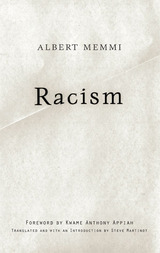
Racism
Albert Memmi
University of Minnesota Press, 1999
An eminent social analyst examines the way racism works-and how it can be overcome.
Racism: It is social, not “natural”; it is general, not “personal”; and it is tragically effective. In a remarkable meditation on a subject at the troubled center of American life, Albert Memmi investigates racism as social pathology-a cultural disease that prevails because it allows one segment of society to empower itself at the expense of another. By turns historical, sociological, and autobiographical, Racism moves beyond individual prejudice and taste to engage the broader questions of collective behavior and social responsibility.
The book comprises three sections-“Description,” “Definition,” and “Treatment”-in which Memmi delineates racism’s causes and hidden workings, examines its close affinity to colonialism, and considers its everyday manifestations over a period of centuries throughout the West.
For Memmi, the structure of racism has four “moments”: the insistence on difference; the negative valuation imposed on those who differ; the generalizing of this negative valuation to an entire group; and the use of generalization to legitimize hostility. Memmi shows how it is not racism’s content-which can change at will-but its form that gives it such power and tenacity.
Born in a poor section of Tunis, Tunisia, a Jew among Muslims, an Arab among Europeans, Memmi brings his own experience of the complex contours of prejudice to his analysis of a problem that divides societies the world over. Writing in the tradition of Frantz Fanon, Memmi redirects debates about racism-and offers a rare chance for progress against social prejudice.
Racism: It is social, not “natural”; it is general, not “personal”; and it is tragically effective. In a remarkable meditation on a subject at the troubled center of American life, Albert Memmi investigates racism as social pathology-a cultural disease that prevails because it allows one segment of society to empower itself at the expense of another. By turns historical, sociological, and autobiographical, Racism moves beyond individual prejudice and taste to engage the broader questions of collective behavior and social responsibility.
The book comprises three sections-“Description,” “Definition,” and “Treatment”-in which Memmi delineates racism’s causes and hidden workings, examines its close affinity to colonialism, and considers its everyday manifestations over a period of centuries throughout the West.
For Memmi, the structure of racism has four “moments”: the insistence on difference; the negative valuation imposed on those who differ; the generalizing of this negative valuation to an entire group; and the use of generalization to legitimize hostility. Memmi shows how it is not racism’s content-which can change at will-but its form that gives it such power and tenacity.
Born in a poor section of Tunis, Tunisia, a Jew among Muslims, an Arab among Europeans, Memmi brings his own experience of the complex contours of prejudice to his analysis of a problem that divides societies the world over. Writing in the tradition of Frantz Fanon, Memmi redirects debates about racism-and offers a rare chance for progress against social prejudice.
[more]
READERS
Browse our collection.
PUBLISHERS
See BiblioVault's publisher services.
STUDENT SERVICES
Files for college accessibility offices.
RECENTLY PUBLISHED






UChicago Accessibility Resources
home | accessibility | search | about | contact us
BiblioVault ® 2001 - 2026
The University of Chicago Press