
 A SCHOLARLY BOOK REPOSITORY
Results by Title
3 books about Medievalists
3 books about Medievalists

History Continues
Georges Duby
University of Chicago Press, 1994
In this engaging intellectual autobiography, Georges Duby looks back on a career that has led him to be called one of the most distinguished historians in the Western world.
Since its beginning in the 1940s, Duby's career has been rich and varied, encompassing economic history, social history, the history of mentalites, art history, microhistory, urban history, the history of women and sexuality, and, most recently, the Church's influence on feudal society. In retracing this singular career path, Duby candidly remembers his life's most formative influences, including the legendary historians Marc Bloch and Lucien Febvre, the Annales School so closely associated with them, and the College de France.
Duby also offers insights about the proper methods of gathering and using archival data and on constructing penetrating interpretations of the documents. Indeed, his discussion of how he chose his subjects, collected his materials, developed the arguments, erected the scaffolding and constructed his theses offers the best introduction to the craft available to aspiring historians.
Candid and charming, this book is both a memoir of one of this century's great scholars and a history of the French historical school since the mid-twentieth century. It will be required reading for anyone interested in the French academic milieu, medieval history, French history, or the recording of history in general.
Georges Duby, a member of the Academie francaise, for many years held the distinguished chair in medieval history at the College de France. His numerous books include The Age of Cathedrals; The Knight, the Lady, and the Priest; Love and Marriage in the Middle Ages; and The Three Orders—all published by the University of Chicago Press.
Since its beginning in the 1940s, Duby's career has been rich and varied, encompassing economic history, social history, the history of mentalites, art history, microhistory, urban history, the history of women and sexuality, and, most recently, the Church's influence on feudal society. In retracing this singular career path, Duby candidly remembers his life's most formative influences, including the legendary historians Marc Bloch and Lucien Febvre, the Annales School so closely associated with them, and the College de France.
Duby also offers insights about the proper methods of gathering and using archival data and on constructing penetrating interpretations of the documents. Indeed, his discussion of how he chose his subjects, collected his materials, developed the arguments, erected the scaffolding and constructed his theses offers the best introduction to the craft available to aspiring historians.
Candid and charming, this book is both a memoir of one of this century's great scholars and a history of the French historical school since the mid-twentieth century. It will be required reading for anyone interested in the French academic milieu, medieval history, French history, or the recording of history in general.
Georges Duby, a member of the Academie francaise, for many years held the distinguished chair in medieval history at the College de France. His numerous books include The Age of Cathedrals; The Knight, the Lady, and the Priest; Love and Marriage in the Middle Ages; and The Three Orders—all published by the University of Chicago Press.
[more]
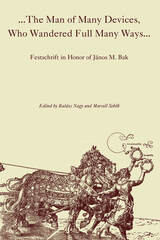
The Man of Many Devices, Who Wandered Full Many Ways
Festschrift in Honor of János M. Bak
Balázs Nagy
Central European University Press, 1999
More than sixty friends and colleagues pay tribute to the distinguished professor János Bak's 70th birthday. Notable contributors from many countries dedicate previously unpublished essays and articles in this celebratory Festschrift. Reflecting the intellectual calibre of János Bak, scholars not only of medieval history, but also from the fields of modern history, philosophy, linguistics, art history and political science provide a broad range of perspectives on a wide range of disciplinary areas thus allowing a wide readership audience.
[more]
Times of Upheaval
Four Medievalists in Twentieth-Century Central Europe. Conversations with Jerzy Kloczowski, János M. Bak, František Šmahel, and Herwig Wolfram
Pavlína Rychterová
Central European University Press, 2019
The volume unites conversations with four masters of Medieval Studies from east-central Europe: János Bak from Hungary, Jerzy Kloczowski from Poland, František Šmahel from the Czech Republic, and Herwig Wolfram from Austria. The interviews, made by younger colleagues, reveal engaging life stories, with numerous observations, anecdotes and experiences. The four scholars grew up before and during the war, under Nazi occupation, emerged as young scholars in the difficult post-war period, and, for most of their careers worked in the shadow of the Iron Curtain, two of them spending most of their lifetimes under communist regimes. The conversations focus on ways in which open-minded young intellectuals became medieval historians under difficult circumstances, how they experienced the long shadows of totalitarian regimes with their acute sensitivity for historical change, and how their perceptions of the world around them reflected back on their approach to medieval history. The histories of their nations were broken, most of them ceased to exist and then were re-established during their lifetimes, came under foreign domination, were split up, or had their territories shifted. These changes affected these scholars' identities and patriotic feelings, and their present was reflected in the distant mirror of the medieval past.
[more]
READERS
Browse our collection.
PUBLISHERS
See BiblioVault's publisher services.
STUDENT SERVICES
Files for college accessibility offices.
RECENTLY PUBLISHED





UChicago Accessibility Resources
home | accessibility | search | about | contact us
BiblioVault ® 2001 - 2026
The University of Chicago Press