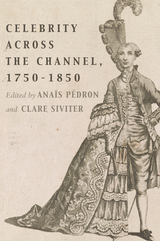
front cover of Celebrity Across the Channel, 1750–1850
Celebrity Across the Channel, 1750–1850
Anaïs Pédron
University of Delaware Press, 2021
Celebrity Across the Channel, 1750-1850 is the first book to study and compare the concept of celebrity in France and Britain from 1750 to 1850 as the two countries transformed into the states we recognize today. It offers a transnational perspective by placing in dialogue the growing fields of celebrity studies in the two countries, especially by engaging with Antoine Lilti’s seminal work, The Invention of Celebrity, translated into English in 2017. With contributions from a diverse range of scholarly cultures, the volume has a firmly interdisciplinary scope over the time period 1750 to 1850, which was an era marked by social, political, and cultural upheaval. Bringing together the fields of history, politics, literature, theater studies, and musicology, the volume employs a firmly interdisciplinary scope to explore an era marked by social, political, and cultural upheaval. The organization of the collection allows for new readings of the similarities and differences in the understanding of celebrity in Britain and France. Consequently, the volume builds upon the questions that are currently at the heart of celebrity studies.
[more]


front cover of The Legacy of the Enlightenment
The Legacy of the Enlightenment
Ambivalences of Modernity
Antoine Lilti
University of Chicago Press, 2025
Going against the grain, this refreshing book argues for a non-ideological portrait of the Enlightenment as having been, above all else, a self-critical enterprise.

The Enlightenment has come under substantial attack over the past several years, with some going so far as to recommend leaving behind its thinkers and their Eurocentric prejudices. In response, the most orthodox defenders of the Enlightenment have insisted that its values are not just foundational but indispensable and that abandoning them would mean opening the door to nihilism and relativism. For Antoine Lilti, one of the leading scholars of the French Enlightenment, both sides are wrong.
 
In this tactfully argued series of essays, Lilti emphasizes a non-dogmatic, non-ideological view of the Enlightenment—one that sees its legacy as a critical, attentive approach that can and should serve as its own best critic. Along the way, he engages with everyone from Rousseau and Kant to Foucault and Habermas, as well as prominent contemporary voices, such as Jonathan Israel. The result is a remarkable new reading of the Enlightenment that redraws the stakes of old debates and offers an alternative way to engage with both canonical thinkers and later scholarship that is both honest about the past and useful for the future.
 
[more]


Send via email Share on Facebook Share on Twitter