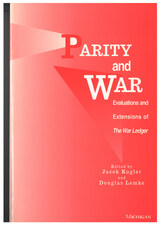
Parity and War
Evaluations and Extensions of The War Ledger
Jacek Kugler and Douglas Lemke, Editors
University of Michigan Press, 1996
Parity and War is an impressive explanation of why peace predominates in the international arena and why, on occasion, wars do start. Useful for college students and scholars alike, the work scrutinzes and tests ideas about power preponderance, first discussed over a decade ago in the widely acclaimed book The War Ledger. An alternative to traditional realism, power preponderence contends that peace is preserved when a preponderant nation supports the status quo. The theory convincingly accounts for war initiation, recovery, and peace by analyzing military arms buildups, alliances, territorial threats, economic cycles, and nuclear environment deterrence and proliferation. The contributors to this volume examine and analyze cases as diverse as the peaceful collapse of the Soviet Union, the presence of interstate war in South America in the last century and the absence thereof--despite domestic war--in this century, the economic and political consequences of the American Civil War, and the observation of long-term patterns of conflict and peace in international relations. Moreover, contributors to Parity and War utilize game theory, expected utility, and differential calculus techniques to model major war and to formalize the originally intuitive propositions of power preponderance. Their timely research shows that, in this era of nuclear weapons dominated by a single super power, effective regime guidance by the United States can insure peace for the next century.Contributors include Arina Arbetman, Bruce Bueno de Mesquita, Vesna Danilovic, Daniel S. Geller, Kenk W. Houweling, Kelly M. Kadera, Woosang Kim, Jacek Kugler, Douglas Lemke, Ross A. Miller, James D. Morrow, A. F. K. Organski, Jan G. Siccama, Randoph M. Siverson, Ronald Tammen, William R. Thompson, John A. Vasquez, Frank Whelon Wayman, Suzanne Werner, and Frank C. Zagare.
[more]