
 A SCHOLARLY BOOK REPOSITORY
Results by Title
3 books about Kelly, Raymond C.
3 books about Kelly, Raymond C.
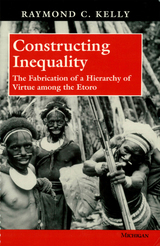
Constructing Inequality
The Fabrication of a Hierarchy of Virtue among the Etoro
Raymond C. Kelly
University of Michigan Press, 1993
In Constructing Inequality, Raymond C. Kelly makes a crucial contribution to a central and enduring issue in social theory: the primary source and central locus for the production of inequality in simple (classless) societies. Kelly grounds his thesis in an incisive critique of prior theoretical formulations and a comprehensive analysis of a key ethnographic case, the Etoro of Papua New Guinea.Previous theorists have designated “brideservice” or “simple” societies—in which age, gender, and personal characteristics are the predominant basis of social differentiation—as models of egalitarian societies. But Kelly departs from this view. He evaluates such theories against the relevant data derived from studying the Etoro, and, in so doing, shows that a close examination of the Etoro case reveals basic flaws in both the brideservice model and the theory of social inequality that informs it.Kelly traces the foundations of Etoro social inequality to a male-exclusive shamanic elite’s propagation of a metaphysical doctrine that comprehends reproduction, the spiritual constitution of a person, and the life-cycle transformations of ‘growth, maturation, senescence, and death. Kelly determines that this cosmological system grounds a scheme of social differentiation in which moral evaluation is intrinsically embedded. Social inequality is thus fabricated as a moral hierarchy, or hierarchy of virtue.
[more]
Nuer Conquest
The Structure and Development of an Expansionist System
Raymond C. Kelly
University of Michigan Press, 1985
The Nuer conquest entailed a fourfold increase in territorial domain achieved during the short span of seventy years (ca. 1820—90). This represents one of the most prominent and widely discussed instances of tribal imperialism contained in the ethnographic record. Professor Kelly’s comprehensive examination of the causes and means of Nuer expansion caps nearly a half century of scholarly inquiry that encompasses a capsule history of anthropological approaches to a central theoretical issue: the interrelationship between social and material causes in historical and developmental processes. This book will be of interest to anthropologists concerned with social theory, economic anthropology, ecological anthropology, social organization, and warfare.
[more]
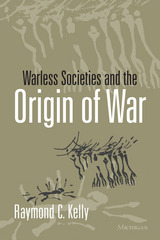
Warless Societies and the Origin of War
Raymond C. Kelly
University of Michigan Press, 2000
Warless Societies and the Origin of War employs a comparative ethnographic analysis of warless and warlike hunting and gathering societies to isolate distinctive features of peaceful preagricultural people and to develop a theoretical model of the origin of war and the early coevolution of war and society. Examining key Upper Paleolithic cave paintings and burials that document lethal violence, Raymond Kelly's illumination of the transition from warlessness to warfare in several specific locales in Europe and the Middle East confounds understandings of the origin of war prevalent today.
Kelly addresses fundamental questions concerning the trinity of interrelationship between human nature, war, and the constitution of society: Is war a primordial and pervasive feature of human existence or a set of practices that arose at a certain time in our recent prehistoric past? Are there peaceful societies in which war is absent and, if so, what are they like and how do they differ from warlike societies? Do the critical differentiating features pertain to child-rearing practices, to modes of conflict resolution, to social and economic inequality, to resource competition, or to the constitution of social groups?
As the conclusions of such an inquiry are central to our conceptions of human nature, the book will interest a wide range of readers, from those curious about the origins of collective violence to those studying the roles social institutions play in society.
Raymond C. Kelly is Professor of Anthropology, University of Michigan.
Kelly addresses fundamental questions concerning the trinity of interrelationship between human nature, war, and the constitution of society: Is war a primordial and pervasive feature of human existence or a set of practices that arose at a certain time in our recent prehistoric past? Are there peaceful societies in which war is absent and, if so, what are they like and how do they differ from warlike societies? Do the critical differentiating features pertain to child-rearing practices, to modes of conflict resolution, to social and economic inequality, to resource competition, or to the constitution of social groups?
As the conclusions of such an inquiry are central to our conceptions of human nature, the book will interest a wide range of readers, from those curious about the origins of collective violence to those studying the roles social institutions play in society.
Raymond C. Kelly is Professor of Anthropology, University of Michigan.
[more]
READERS
Browse our collection.
PUBLISHERS
See BiblioVault's publisher services.
STUDENT SERVICES
Files for college accessibility offices.
RECENTLY PUBLISHED


UChicago Accessibility Resources
home | accessibility | search | about | contact us
BiblioVault ® 2001 - 2026
The University of Chicago Press