 A SCHOLARLY BOOK REPOSITORY
Results by Title
2 books about Jordan, Donald Allan
2 books about Jordan, Donald Allan
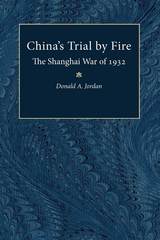
China's Trial by Fire
The Shanghai War of 1932
Donald A. Jordan
University of Michigan Press, 2001
China's Trial by Firepresents the balanced history of how, ten years before Pearl Harbor, Japan tested modern China in a thirty-three-day war, now known as the Shanghai War of1932. Often obscured by the larger World War II, this history details how the Chinese fought from trenches against Japan's modern bombers and navy, and formed a defense that brought the country together for the first time.
Unlike other histories' brief generalizations of the incident, this study traces the war from the initial January 28th Japanese marine raid on Chinese Shanghai. It also studies the roles played by the prevailing Japanese leaders, including the last prewar civilian Prime Minister, Emperor Hirohito, and Admiral Nomura, who was later assigned to pre-Pearl Harbor negotiations.
Not least, the work bridges scholarly boundaries by highlighting the economics of China's leading trade metropolis, Shanghai; the desperate attempts of Chinese politicians and press to manipulate anti-imperialist and anti-Japanese propaganda; and the ways in which the failure of positional trench warfare against Japanese mechanized mobility provided lessons to German observers and the Communists.
Donald Jordan has drawn from as complete a range of primary sources as are available. Both the Nanking and Taipei archives, as well as resources from Tokyo, Settlement Shanghai's police records, Washington, the League of Nations, and London were researched.
Knowing how greatly the Nationalist defense in 1932 influenced the Chinese Communists expands the relevance for scholars of this illustrated study. Others, especially those curious about the U. S. entanglement leading to Pearl Harbor, will find much more than the story of a regional skirmish.
Donald Jordan is Professor of East Asian History, Ohio University.
Unlike other histories' brief generalizations of the incident, this study traces the war from the initial January 28th Japanese marine raid on Chinese Shanghai. It also studies the roles played by the prevailing Japanese leaders, including the last prewar civilian Prime Minister, Emperor Hirohito, and Admiral Nomura, who was later assigned to pre-Pearl Harbor negotiations.
Not least, the work bridges scholarly boundaries by highlighting the economics of China's leading trade metropolis, Shanghai; the desperate attempts of Chinese politicians and press to manipulate anti-imperialist and anti-Japanese propaganda; and the ways in which the failure of positional trench warfare against Japanese mechanized mobility provided lessons to German observers and the Communists.
Donald Jordan has drawn from as complete a range of primary sources as are available. Both the Nanking and Taipei archives, as well as resources from Tokyo, Settlement Shanghai's police records, Washington, the League of Nations, and London were researched.
Knowing how greatly the Nationalist defense in 1932 influenced the Chinese Communists expands the relevance for scholars of this illustrated study. Others, especially those curious about the U. S. entanglement leading to Pearl Harbor, will find much more than the story of a regional skirmish.
Donald Jordan is Professor of East Asian History, Ohio University.
[more]
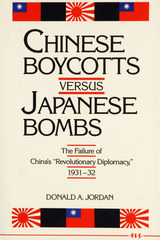
Chinese Boycotts versus Japanese Bombs
The Failure of China's "Revolutionary Diplomacy," 1931-32
Donald A. Jordan
University of Michigan Press, 1991
Chinese Boycotts versus Japanese Bombs highlights economic competition as a key to understanding how China and Japan, leading trade partners, slipped toward war in the early 1930s. It describes and evaluates the Nationalist Chinese government's “Revolutionary Diplomacy” — its own brand of foreign policy toward Japan in 1931-32. This approach, which utilized popular boycotts, strikes, and demonstrations, was both innovative and a reflection of Chinas profound anger toward Japan, brought about by the desperation of Chinese industrialists in the face of the efficiency of Japanese producers. Although the anti-Japanese acts failed to break Japanese economic dominion and halt Japanese aggression in Manchuria, the sanctions enticed the United States and England to enter the Chinese market and led them into the role of codefenders against Japan. Battered by the Chinese boycott, Japanese businesses demanded military intervention. In addition, internal domestic strife in China tempted the Japanese military into seizing Manchuria and making an attack on Shanghai in 1932, thus dashing any hope for a peaceable relationship between Japan and China. These events set the stage for what was to become the Asian arena of World War Il.
[more]
READERS
Browse our collection.
PUBLISHERS
See BiblioVault's publisher services.
STUDENT SERVICES
Files for college accessibility offices.
RECENTLY PUBLISHED



UChicago Accessibility Resources
home | accessibility | search | about | contact us
BiblioVault ® 2001 - 2026
The University of Chicago Press