
 A SCHOLARLY BOOK REPOSITORY
Results by Title
2 books about Jones, Douglas A.
2 books about Jones, Douglas A.
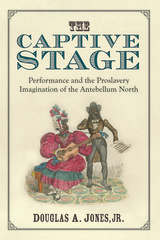
The Captive Stage
Performance and the Proslavery Imagination of the Antebellum North
Douglas A. Jones, Jr.
University of Michigan Press, 2014
In The Captive Stage, Douglas A. Jones, Jr. argues that proslavery ideology remained the dominant mode of racial thought in the antebellum north, even though chattel slavery had virtually disappeared from the region by the turn of the nineteenth century—and that northerners cultivated their proslavery imagination most forcefully in their performance practices. Jones explores how multiple constituencies, ranging from early national artisans and Jacksonian wage laborers to patrician elites and bourgeois social reformers, used the stage to appropriate and refashion defenses of black bondage as means to affirm their varying and often conflicting economic, political, and social objectives. Joining performance studies with literary criticism and cultural theory, he uncovers the proslavery conceptions animating a wide array of performance texts and practices, such as the “Bobalition” series of broadsides, blackface minstrelsy, stagings of the American Revolution, reform melodrama, and abolitionist discourse. Taken together, he suggests, these works did not amount to a call for the re-enslavement of African Americans but, rather, justifications for everyday and state-sanctioned racial inequities in their post-slavery society. Throughout, The Captive Stage elucidates how the proslavery imagination of the free north emerged in direct opposition to the inclusionary claims black publics enacted in their own performance cultures. In doing so, the book offers fresh contexts and readings of several forms of black cultural production, including early black nationalist parades, slave dance, the historiography of the revolutionary era, the oratory of radical abolitionists and the black convention movement, and the autobiographical and dramatic work of ex-slave William Wells Brown.
[more]
Pragmatics of Democracy
A Political Theory of African American Literature Before Emancipation
Douglas A. Jones
University of Chicago Press, 2025
This study argues early African American literature constitutes an abiding repository of modern democratic thought that is lacking in the political philosophy we normally analyze.
Douglas A. Jones’s Pragmatics of Democracy reads African American literature, from its beginnings through the mid-nineteenth century, to theorize how we have come to regard democracy as the most excellent form of political life. Jones notes that the aims of democracy, especially consent of the governed and equality under the law, can seem like tenets of governance that humans desire instinctively. But human nature does not correlate absolutely to politics. Jones argues that political selfhood is formed by “bodily events.” He proposes a typology of such experiences that dispose persons toward democratic subjectivity: ecstasy, impersonality, violence, respectability, and care.
African American literature before Emancipation reveals the democratic features of these categories that conventional political philosophy ignores or obscures. Given their lives as enslaved persons or the descendants of enslaved persons, early black writers crafted narratives about achieving democratic subjectivity that were missing in other Anglo-American canons. Pragmatics of Democracy discusses the works of well-known figures such as Phillis Wheatley, Harriet E. Wilson, and Frederick Douglass as well as those of more neglected writers such as Richard Allen, Peter Paul Simmons, James McCune Smith, and Frank J. Webb.
Douglas A. Jones’s Pragmatics of Democracy reads African American literature, from its beginnings through the mid-nineteenth century, to theorize how we have come to regard democracy as the most excellent form of political life. Jones notes that the aims of democracy, especially consent of the governed and equality under the law, can seem like tenets of governance that humans desire instinctively. But human nature does not correlate absolutely to politics. Jones argues that political selfhood is formed by “bodily events.” He proposes a typology of such experiences that dispose persons toward democratic subjectivity: ecstasy, impersonality, violence, respectability, and care.
African American literature before Emancipation reveals the democratic features of these categories that conventional political philosophy ignores or obscures. Given their lives as enslaved persons or the descendants of enslaved persons, early black writers crafted narratives about achieving democratic subjectivity that were missing in other Anglo-American canons. Pragmatics of Democracy discusses the works of well-known figures such as Phillis Wheatley, Harriet E. Wilson, and Frederick Douglass as well as those of more neglected writers such as Richard Allen, Peter Paul Simmons, James McCune Smith, and Frank J. Webb.
[more]
READERS
Browse our collection.
PUBLISHERS
See BiblioVault's publisher services.
STUDENT SERVICES
Files for college accessibility offices.
RECENTLY PUBLISHED





UChicago Accessibility Resources
home | accessibility | search | about | contact us
BiblioVault ® 2001 - 2026
The University of Chicago Press