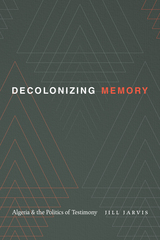
Decolonizing Memory
Algeria and the Politics of Testimony
Jill Jarvis
Duke University Press, 2021
The magnitude of the legal violence exercised by the French to colonize and occupy Algeria (1830–1962) is such that only aesthetic works have been able to register its enduring effects. In Decolonizing Memory Jill Jarvis examines the power of literature to provide what demographic data, historical facts, and legal trials have not in terms of attesting to and accounting for this destruction. Taking up the unfinished work of decolonization since 1962, Algerian writers have played a crucial role in forging historical memory and nurturing political resistance—their work helps to make possible what state violence has rendered almost unthinkable. Drawing together readings of multilingual texts by Yamina Mechakra, Waciny Laredj, Zahia Rahmani, Fadhma Aïth Mansour Amrouche, Assia Djebar, and Samira Negrouche alongside theoretical, juridical, visual, and activist texts from both Algeria’s national liberation war (1954–1962) and war on civilians (1988–1999), this book challenges temporal and geographical frameworks that have implicitly organized studies of cultural memory around Euro-American reference points. Jarvis shows how this literature rewrites history, disputes state authority to arbitrate justice, and cultivates a multilingual archive for imagining decolonized futures.
[more]