
 A SCHOLARLY BOOK REPOSITORY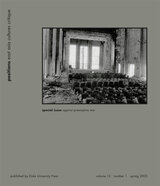
Gathering material from politically active scholars, artists, and authors from Europe, Asia, and North America, this collection reflects on the likely fallout from the corruptive U.S. strategy of preemption. In the introduction, the editors criticize the American press for being, with few exceptions, easily if not willingly deceived by the Bush administration’s propaganda regarding weapons of mass destruction. One contributor redefines fascism as a situation in which contradictions are evident but blatantly ignored, one which creates a false sense of cohesion between events. Another argues that U.S. military bases around the world are now maintained not for military defense and quick mobilization but to create a culture of American militarism, noting that troops were sent from the U.S. for the invasion of Iraq rather than from closer bases around the world. Finally, the issue raises a formidable question: how do we end war waged against what might come to pass rather than what actually is?
Contributors. Tani Barlow, Jim Bonk, Josh Brown, Bei Dao, Carolyn Eisenberg, Lawrence Ferlinghetti, Matthew Fryslie, Sue Golding (as johnny de philo), Freda Guttman, Yukiko Hanawa, Harry Harootunian, Sharon Hayashi, Reynaldo C. Ileto, Joy Kogawa, Thomas LaMarre, The Liberal Islam Network, Sumit K. Mandal, Edoarda Masi, Brian Massumi, Anne McKnight, Carel Moiseiwitsch, Alberto Moreiras, Claudia Pozzana, Alessandro Russo, Ukai Satoshi, Laurie Sears, Kuang Xinnian, Marilyn Young
While many associate the concept commonly referred to as the “military-industrial complex” with President Dwight D. Eisenhower’s 1961 farewell address, the roots of it existed two hundred years earlier. This concept, as Benjamin Franklin Cooling writes, was “part of historical lore” as a burgeoning American nation discovered the inextricable relationship between arms and the State. In Arming America through the Centuries, Cooling examines the origins and development of the military-industrial complex (MIC) over the course of American history. He argues that the evolution of America’s military-industrial-business-political experience is the basis for a contemporary American Sparta. Cooling explores the influence of industry on security, the increasing prevalence of outsourcing, ever-present economic and political influence, and the evolving nature of modern warfare. He connects the budding military-industrial relations of the colonial era and Industrial Revolution to their formal interdependence during the Cold War down to the present-day resurrection of Great Power competition. Across eight chronological chapters, Cooling weaves together threads of industry, finance, privatization, appropriations, and technology to create a rich historical tapestry of US national defense in one comprehensive volume.
Integrating information from both recent works as well as canonical, older sources, Cooling’s ambitious single-volume synthesis is a uniquely accessible and illuminating survey not only for scholars and policymakers but for students and general readers as well.

Why did the invasion of Iraq result in cultural destruction and killings of intellectuals? Convention sees accidents of war and poor planning in a campaign to liberate Iraqis. The authors argue instead that the invasion aimed to dismantle the Iraqi state to remake it as a client regime.
Post-invasion chaos created conditions under which the cultural foundations of the state could be undermined. The authors painstakingly document the consequences of the occupiers' willful inaction and worse, which led to the ravaging of one of the world's oldest recorded cultures. Targeted assassination of over 400 academics, kidnapping and the forced flight of thousands of doctors, lawyers, artists and other intellectuals add up to cultural cleansing.
This important work lays to rest claims that the invasion aimed to free an educated population to develop its own culture of democracy.
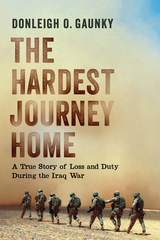
“Sergeant Donleigh Gaunky’s moving memoir speaks to everyone who has lost a loved one in defense of our great nation. It serves as a reminder that freedom is not free, and it is our responsibility to continue to care for our service members, veterans, and their families. I am touched that Fisher House provided a refuge for Sergeant Gaunky during such a difficult journey.”—Ken Fisher, Chairman and CEO, Fisher House Foundation
“Fewer and fewer Americans have any close association with anyone serving in the Armed Forces. Donleigh Gaunky offers a heart-rending glimpse into his family as he, and they, grapple with the loss of Donleigh’s brother on a battlefield in Iraq. Every American should read this and, in so doing, learn what “Thank You for Your Service” really means.”
—Gen. Carter F. Ham, USA, Ret., President and CEO, Association of the United States Army
In November 2005, while analyzing live action reports at his base in Baghdad, Iraq, Donleigh O. Gaunky froze. His younger brother Alex’s unit had been hit by the enemy. Almost immediately, arrangements were made for Donleigh to meet his wounded brother in Germany, but Alex succumbed to his injuries before he arrived. Instead, Donleigh was asked to assume the role of remains escort. Most of the time a remains escort is picked at random from the appropriate branch of service or is someone with a relationship to the deceased, most often from the soldier’s own unit. Rarely—if ever in modern times—is the escort a family member. In The Hardest Journey Home: A True Story of Loss and Duty During the Iraq War, Donleigh O. Gaunky describes the events that unfolded over the course of a few days, from the front line in Iraq to the Landstuhl military hospital in Germany to their small town in Wisconsin, where he arrived with his brother’s body on Thanksgiving Day. In an effort to keep his mind off the tragedy and remain focused on his task, the author describes the protocol for escorting a body home—paperwork, appropriate attire, the proper use of the flag, when and where to salute—as well as how his divorced parents coped with the loss of one of their four sons serving in the military. Relying on commercial flights to bring Alex home, there was no military reception when they first landed in the United States and the author learned how little his brother’s sacrifice meant on a national level. But he was uplifted by his town’s response to his family’s loss when they unexpectedly lined the streets to pay their respects to one of their own. An important and moving story, The Hardest Journey Home reveals the human cost of a long, seemingly invisible war.
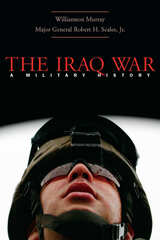
In this unprecedented account of the intensive air and ground operations in Iraq, two of America’s most distinguished military historians bring clarity and depth to the first major war of the new millennium. Reaching beyond the blaring headlines, embedded videophone reports, and daily Centcom briefings, Williamson Murray and Robert Scales analyze events in light of past military experiences, present battleground realities, and future expectations.
The Iraq War puts the recent conflict into context. Drawing on their extensive military expertise, the authors assess the opposing aims of the Coalition forces and the Iraqi regime and explain the day-to-day tactical and logistical decisions of infantry and air command, as British and American troops moved into Basra and Baghdad. They simultaneously step back to examine long-running debates within the U.S. Defense Department about the proper uses of military power and probe the strategic implications of those debates for America’s buildup to this war. Surveying the immense changes that have occurred in America’s armed forces between the Gulf conflicts of 1991 and 2003—changes in doctrine as well as weapons—this volume reveals critical meanings and lessons about the new “American way of war” as it has unfolded in Iraq.
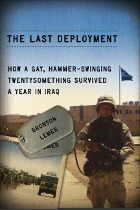
In 2003, after serving five and a half years as a carpenter in a North Dakota National Guard engineer unit, Bronson Lemer was ready to leave the military behind. But six months short of completing his commitment to the army, Lemer was deployed on a yearlong tour of duty to Iraq. Leaving college life behind in the Midwest, he yearns for a lost love and quietly dreams of a future as an openly gay man outside the military. He discovers that his father’s lifelong example of silent strength has taught him much about being a man, and these lessons help him survive in a war zone and to conceal his sexuality, as he is required to do by the U.S. military.
Finalist, Minnesota Book Awards
Finalist, Over the Rainbow Selection, American Library Association
Amazon Top Ten 10 Gay & Lesbian Books of 2011
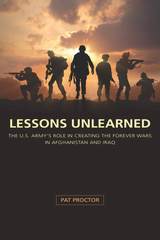
In this blunt critique of the senior leadership of the U.S. Army, Proctor contends that after the fall of the Soviet Union, the U.S. Army stubbornly refused to reshape itself in response to the new strategic reality, a decision that saw it struggle through one low-intensity conflict after another—some inconclusive, some tragic—in the 1980s and 1990s, and leaving it largely unprepared when it found itself engaged—seemingly forever—in wars in Afghanistan and Iraq. The first book-length study to connect the failures of these wars to America’s disastrous performance in the war on terror, Proctor’s work serves as an attempt to convince Army leaders to avoid repeating the same mistakes.
The Iraq war defined the first decade of the twenty-first century – leading to mass protests and raising profound questions about domestic politics and the use of military force. Yet most explanations of the war have a narrow focus either on political personalities or oil.
Christopher Doran provides a unique perspective, arguing that the drive to war came from the threat Iraq might pose to American economic hegemony if the UN sanctions regime was ended. Doran argues that this hegemony is rooted in third world debt and corporate market access. It was protection of these arrangements that motivated US action, not Iraq’s alleged weapons of mass destruction or a simplistic desire to seize its oil.
This book will provide new insights on the war which still casts a shadow over global politics, and will have wide appeal to all those concerned about the Middle East, world peace and global development.
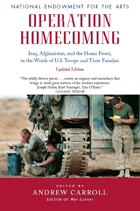
“One of the chanted mantras of our time is, ‘But I support the troops.’ Terrific. Now read Operation Homecoming to find out who they are, what they think, feel, want, have learned, won and lost in Iraq and Afghanistan.”—Daniel Henninger, Wall Street Journal
“This anthology is the honest voice of war. . . . In the end, they are all one voice, a voice we must hear, and must not forget.”—Jeff Shaara
“These voices are stirring, chilling, and unforgettable.”—Bobbie Ann Mason
“[Captures] what journalists cannot, no matter how close they get—firsthand accounts from the warriors and the families they leave behind.”—Chicago Tribune
As it seeks to win the hearts and minds of citizens in the Muslim world, the United States has poured millions of dollars into local television and radio programming, hoping to generate pro-American currents on Middle Eastern airwaves. However, as this fascinating new book shows, the Middle Eastern media producers who rely on these funds are hardly puppets on an American string, but instead contribute their own political and creative agendas while working within U.S. restrictions.
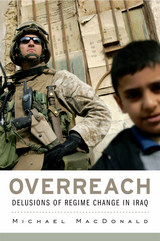
In the run-up to the 2003 invasion of Iraq, a fair number of Americans thought the idea was crazy. Now everyone, except a few die-hards, thinks it was. So what was going through the minds of the talented and experienced men and women who planned and initiated the war? What were their assumptions? Overreach aims to recover those presuppositions.
Michael MacDonald examines the standard hypotheses for the decision to attack, showing them to be either wrong or of secondary importance: the personality of President George W. Bush, including his relationship with his father; Republican electoral considerations; the oil lobby; the Israeli lobby. He also undermines the argument that the war failed because of the Bush administration’s incompetence.
The more fundamental reasons for the Iraq War and its failure, MacDonald argues, are located in basic axioms of American foreign policy, which equate America’s ideals with its interests (distorting both in the process) and project those ideals as universally applicable. Believing that democratic principles would bring order to Iraq naturally and spontaneously, regardless of the region’s history and culture or what Iraqis themselves wanted, neoconservative thinkers, with support from many on the left, advocated breaking the back of state power under Saddam Hussein. They maintained that by bringing about radical regime change, the United States was promoting liberalism, capitalism, and democracy in Iraq. But what it did instead was unleash chaos.
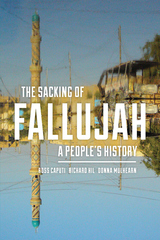
Unlike dominant military accounts that focus on American soldiers and U.S. leaders and perpetuate the myth that the United States "liberated" the city, this book argues that Fallujah was destroyed by coalition forces, leaving public health crises, political destabilization, and mass civilian casualties in their wake. This meticulously researched account cuts through the propaganda to uncover the lived experiences of Fallujans under siege and occupation, and contextualizes these events within a broader history of U.S. policy in the Middle East. Relying on testimony from Iraqi civilians, the work of independent journalists, and documentation from human rights organizations, Ross Caputi, Richard Hil, and Donna Mulhearn place the experiences of Fallujah's residents at the center of this city's recent history.
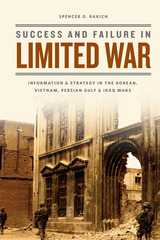
Traditional assessments of wartime strategy focus on the relationship between the military and civilians, but Bakich argues that we must take into account the information flow patterns among top policy makers and all national security organizations. By examining the fate of American military and diplomatic strategy in four limited wars, Bakich demonstrates how not only the availability and quality of information, but also the ways in which information is gathered, managed, analyzed, and used, shape a state’s ability to wield power effectively in dynamic and complex international systems.
Utilizing a range of primary and secondary source materials, Success and Failure in Limited War makes a timely case for the power of information in war, with crucial implications for international relations theory and statecraft.
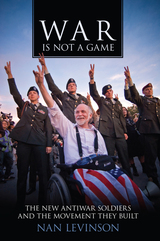

The War of My Generation is the first essay collection to focus specifically on how the terrorist attacks and their aftermath have shaped these new generations of Americans. Drawing from a variety of disciplines, including anthropology, sociology, cultural studies, and literary studies, the essays cover a wide range of topics, from graphic war images in the classroom to computer games designed to promote military recruitment to emails from parents in the combat zone. The collection considers what cultural factors and products have shaped young people's experience of the 9/11 attacks, the wars that have followed, and their experiences as emerging citizen-subjects in that moment. Revealing how young people understand the War on Terror—and how adults understand the way young people think—The War of My Generation offers groundbreaking research on catastrophic events still fresh in our minds.
READERS
Browse our collection.
PUBLISHERS
See BiblioVault's publisher services.
STUDENT SERVICES
Files for college accessibility offices.
RECENTLY PUBLISHED



UChicago Accessibility Resources
home | accessibility | search | about | contact us
BiblioVault ® 2001 - 2024
The University of Chicago Press