
 A SCHOLARLY BOOK REPOSITORY
Refugee to Revolutionary examines the national and transnational world the female cadres of the Greek communist movement traversed, situated between their own aspirations, the objectives of the Greek Communist Party (KKE), and the global ambitions of the Comintern. Drawing largely on data contained in the individual files (anketas) of the KKE cadres located in the Comintern archive at the Russian State Archive for Socio-Political History (RGASPI), as well as Greek Communist Party archival materials, this history is told largely in the voice, albeit the “official” voice, of the subjects themselves. These voices reveal much about the personal, cultural, social, and gendered dimensions of their experience. They convey a story of opportunity and sacrifice and the sense of being part of something historic and extraordinary.
The overarching purpose of this book is two-pronged: The first is to address a historiographical void attributable to a combination of factors, which includes the inaccessibility of Soviet archival materials and a persistent hegemonic masculinity that continues to define the historiography of Greek communism. Second, this work is situated within a new literature represented by scholars such as Brigitte Studer, Lisa Kirschenbaum, Francisca De Haan, and others, which destabilizes Cold War paradigms that have long dominated evaluations of agency, identity, and subjectivity in the Western historiography of communism.
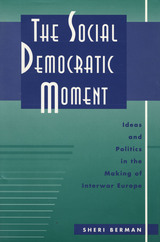
In addition to revising our view of the interwar period and the building of European democracies, this book cuts against the grain of most current theorizing in political science by explicitly discussing when and how ideas influence political behavior. Even though German and Swedish Social Democrats belonged to the same transnational political movement and faced similar political and social conditions in their respective countries before and after World War I, they responded very differently to the challenges of democratization and the Great Depression--with crucial consequences for the fates of their countries and the world at large.
Explaining why these two social democratic parties acted so differently is the primary task of this book. Berman's answer is that they had very different ideas about politics and economics--what she calls their programmatic beliefs. The Swedish Social Democrats placed themselves at the forefront of the drive for democratization; a decade later they responded to the Depression with a bold new economic program and used it to build a long period of political hegemony. The German Social Democrats, on the other hand, had democracy thrust upon them and then dithered when faced with economic crisis; their haplessness cleared the way for a bolder and more skillful political actor--Adolf Hitler.
This provocative book will be of interest to anyone concerned with twentieth-century European history, the transition to democracy problem, or the role of ideas in politics.
READERS
Browse our collection.
PUBLISHERS
See BiblioVault's publisher services.
STUDENT SERVICES
Files for college accessibility offices.
RECENTLY PUBLISHED





UChicago Accessibility Resources
home | accessibility | search | about | contact us
BiblioVault ® 2001 - 2025
The University of Chicago Press