
 A SCHOLARLY BOOK REPOSITORY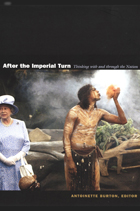
While most of the contributors discuss British imperialism and its repercussions, the volume also includes, as counterpoints, essays on the history and historiography of France, Germany, Spain, and the United States. Whether looking at the history of the passport or the teaching of history from a postnational perspective, this collection explores such vexed issues as how historians might resist the seduction of national narratives, what—if anything—might replace the nation’s hegemony, and how even history-writing that interrogates the idea of the nation remains ideologically and methodologically indebted to national narratives. Placing nation-based studies in international and interdisciplinary contexts, After the Imperial Turn points toward ways of writing history and analyzing culture attentive both to the inadequacies and endurance of the nation as an organizing rubric.
Contributors. Tony Ballantyne, Antoinette Burton, Ann Curthoys, Augusto Espiritu, Karen Fang, Ian Christopher Fletcher, Robert Gregg, Terri Hasseler, Clement Hawes, Douglas M. Haynes, Kristin Hoganson, Paula Krebs, Lara Kriegel, Radhika Viyas Mongia, Susan Pennybacker, John Plotz, Christopher Schmidt-Nowara, Heather Streets, Hsu-Ming Teo, Stuart Ward, Lora Wildenthal, Gary Wilder
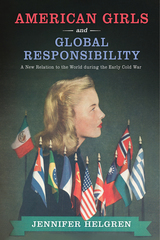
Jennifer Helgren argues that a new internationalist girl citizenship took root in the country in the years following World War II in youth organizations such as Camp Fire Girls, Girl Scouts, YWCA Y-Teens, schools, and even magazines like Seventeen. She shows the particular ways that girls’ identities and roles were configured, and reveals the links between internationalist youth culture, mainstream U.S. educational goals, and the U.S. government in creating and marketing that internationalist girl, thus shaping the girls’ sense of responsibilities as citizens.
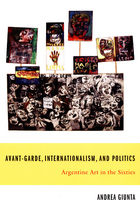
The renowned Argentine art historian and critic Andrea Giunta analyzes projects specifically designed to internationalize Argentina’s art and avant-garde during the 1960s: the importation of exhibitions of contemporary international art, the sending of Argentine artists abroad to study, the organization of prize competitions involving prestigious international art critics, and the export of exhibitions of Argentine art to Europe and the United States. She looks at the conditions that made these projects possible—not least the Alliance for Progress, a U.S. program of “exchange” and “cooperation” meant to prevent the spread of communism through Latin America in the wake of the Cuban Revolution—as well as the strategies formulated to promote them. She describes the influence of Romero Brest, prominent art critic, supporter of abstract art, and director of the Centro de Artes Visuales del Instituto Tocuato Di Tella (an experimental art center in Buenos Aires); various group programs such as Nueva Figuración and Arte Destructivo; and individual artists including Antonio Berni, Alberto Greco, León Ferrari, Marta Minujin, and Luis Felipe Noé. Giunta’s rich narrative illuminates the contentious postwar relationships between art and politics, Latin America and the United States, and local identity and global recognition.
"Like W. E. B. Du Bois, Michel Foucault, Sylvia Wynter, and Edward Said, Robinson was that rare polymath capable of seeing the whole....He left behind a body of work to which we must return constantly and urgently"—Robin D. G. Kelley, author of Freedom Dreams
Cedric J. Robinson is one of the doyens of Black Studies and a pioneer in study of the Black Radical Tradition. His works have been essential texts, deconstructing racial capitalism and inspiring insurgent movements from Ferguson, Missouri to the West Bank. For the first time, Robinson's essays come together, spanning over four decades and reflective of his diverse interests in the interconnections between culture and politics, radical social theory, and classic and modern political philosophy.
Themes explored include Africa and Black internationalism, World politics, race and US Foreign Policy, representations of blackness in popular culture, and reflections on popular resistance to racial capitalism, white supremacy and more. Essays here include:
*The Black Detective and American Memory
*Slavery and the Platonic Origins of Anti-Democracy
*Africa: In Hock to History and the Banks
*Blaxploitation and the Misrepresentation of Liberalism
*The Mulatta on Film
*Race, Capitalism, and Anti-democracy
*The Killing in Ferguson
*And much more!
Accompanied by an introduction by H. L. T. Quan and a foreword by Ruth Wilson Gilmore, this collection, which includes previously unpublished materials, extends the many contributions by a giant in Black radical thought.

-Todd Sandler, Robert R. and Katheryn A. Dockson Professor of International Relations & Economics, University of Southern California
"Boyer and Bobrow's well-written, data-rich analysis of such pressing issues as development assistance, debt management, UN peacekeeping, and environmental protection makes Defensive Internationalism a highly original and provocative contribution to the study of global governance."
-Yale H. Ferguson, Co-Director, Center for Global Change and Governance, Rutgers University
In this pathbreaking study, authors Davis B. Bobrow and Mark A. Boyer argue for "muted optimism" about the future of international cooperation. Leaders of a growing movement that integrates constructivism into traditional international studies concepts and methods, Bobrow and Boyer analyze four key international issues: development cooperation, debt management, peacekeeping operations, and environmental affairs. Their approach integrates elements of public goods theory, identity theory, new institutionalism, and rational choice. Defensive Internationalism is a well-written, creative and coherent synthesis of ideas that have up to now been considered irreconcilable. It is appropriate for upper-level undergraduate and graduate students in international relations, conflict studies, and political economy, and promises to become a foundational work in its field.
Davis B. Bobrow is Professor of Public and International Affairs and Political Science at the University of Pittsburgh.
Mark A. Boyer is Professor of Political Science at the University of Connecticut.
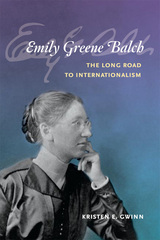
A well-known American academic and cofounder of Boston's first settlement house, Emily Greene Balch was an important Progressive Era reformer and advocate for world peace. Balch served as a professor of economics and sociology at Wellesley College for twenty years until her opposition to World War I resulted with the board of trustees to refusing to renew her contract. Afterwards, Balch continued to emphasize the importance of international institutions for preventing and reconciling conflicts. She was awarded a Nobel Peace Prize in 1946 for her efforts in cofounding and leading the Women's International League for Peace and Freedom (WILPF).
In tracing Balch's work at Wellesley, for the WILPF, and for other peace movements, Kristen E. Gwinn draws on a rich collection of primary sources such as letters, lectures, a draft of Balch's autobiography, and proceedings of the WILPF and other organizations in which Balch held leadership roles. Gwinn illuminates Balch's ideas on negotiated peace, internationalism, global citizenship, and diversity while providing pointed insight into her multifaceted career, philosophy, and temperament. Detailing Balch's academic research on Slavic immigration and her arguments for greater cultural and monetary cohesion in Europe, Gwinn shows how Balch's scholarship and teaching reflected her philosophical development.
This first scholarly biography of Balch helps contextualize her activism while taking into consideration changes in American attitudes toward war and female intellectuals in the early twentieth century.
The End of White World Supremacy explores a complex issue— integration of Blacks into White America—from multiple perspectives: within the United States, globally, and in the context of movements for social justice. Roderick Bush locates himself within a tradition of African American activism that goes back at least to W.E.B. Du Bois. In so doing, he communicates between two literatures—worldsystems analysis and radical Black social movement history—and sustains the dialogue throughout the book.
Bush explains how racial troubles in the U.S. are symptomatic of the troubled relationship between the white and dark worlds globally. Beginning with an account of white European dominance leading to capitalist dominance by White America, The End of White World Supremacy ultimately wonders whether, as Myrdal argued in the 1940s, the American creed can provide a pathway to break this historical conundrum and give birth to international social justice.
Throughout his career, Dussel has sought to open a space for articulating new possibilities for humanity out of, and in light of, the suffering, dignity, and creative drive of those who have been excluded from Western Modernity and neoliberal rationalism. Grounded in engagement with the oppressed, his thinking has figured prominently in philosophy, political theory, and liberation movements around the world.
In Ethics of Liberation, Dussel provides a comprehensive world history of ethics, demonstrating that our most fundamental moral and ethical traditions did not emerge in ancient Greece and develop through modern European and North American thought. The obscured and ignored origins of Modernity lie outside the Western tradition. Ethics of Liberation is a monumental rethinking of the history, origins, and aims of ethics. It is a critical reorientation of ethical theory.
The breakdown of the “consensus” approach to American foreign policy after the Cold War years has become the subject of much analysis. This study contributes to revisionist scholarship by describing the beliefs and preferences that have emerged in the wake of this breakdown. Wittkopf counters traditional views by demonstrating the persistence of U.S. public opinion defined by two dominant and distinct attitudes in the post-Vietnam war years—cooperative and militant internationalism.
The author explores the nature of these two “faces” of internationalism, focusing on the extent to which elites and masses share similar opinions and the political and sociodemographic correlates of belief systems. Wittkopf also offers an original examination of the relationship between beliefs and preferences.
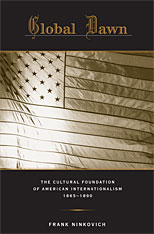
Why did the United States become a global power? Frank Ninkovich shows that a cultural predisposition for thinking in global terms blossomed in the late nineteenth century, making possible the rise to world power as American liberals of the time took a wide-ranging interest in the world. At the center of their attention was the historical process they called “civilization,” whose most prominent features—a global economy, political democracy, and a global culture—anticipated what would later come to be known as globalization.
The continued spread of civilization, they believed, provided the answer to worrisome contemporary problems such as the faltering progress of democracy, a burgeoning arms race in Europe, and a dangerous imperialist competition. In addition to transforming international politics, a global civilization quickened by commercial and cultural exchanges would advance human equality and introduce the modern industrial way of life to traditional societies. Consistent with their universalist outlook, liberal internationalists also took issue with scientific racism by refusing to acknowledge racial hierarchy as a permanent feature of relations with nonwhite peoples.
Of little practical significance during a period when isolationism reigned supreme in U.S. foreign policy, this rich body of thought would become the cultural foundation of twentieth-century American internationalism.

The Global Village offers fifteen essays by leading scholars and thinkers who weigh the pros and cons and come up with individual conclusions as well as a consensus. Included are “Turning McLuhan on His Head” by James E. Grunig, “The Vanishing Global Village” by Ray B. Browne, and “Global Village—Writ Small” by Marshall Fishwick. This book speaks to concerns in journalism, media, popular culture, and communications.
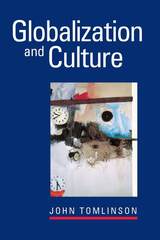
Tomlinson begins this ambitious project by studying the relationship between globalization and contemporary culture, explaining the importance of time and space concerns, cultural imperialism, "deterritorialization," the impact of the media and communication technologies, and the possible growth of more cosmopolitan culture. We come to understand how someone may face unemployment as a result of downsizing decisions made at a company's head office on another continent, or how the food we find in our grocery stores is radically different today from twenty years ago. He discusses the uneven nature of the experience of global modernity in relation to first and third world countries, and concludes that a genuinely cosmopolitan culture is unlikely to emerge unless we respect cultural differences and share a common sense of commitment about the world.
Winner of the Robert H. Ferrell Book Prize
“The Idealist is a powerful book, gorgeously written and consistently insightful. Samuel Zipp uses the 1942 world tour of Wendell Willkie to examine American attitudes toward internationalism, decolonization, and race in the febrile atmosphere of the world’s first truly global conflict.”
—Andrew Preston, author of Sword of the Spirit, Shield of Faith
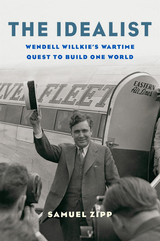
A dramatic account of the plane journey undertaken by businessman-turned-maverick-internationalist Wendell Willkie to rally US allies to the war effort. Willkie’s tour of a planet shrunk by aviation and war inspired him to challenge Americans to fight a rising tide of nationalism at home.
In August 1942, as the threat of fascism swept the world, a charismatic Republican presidential contender boarded the Gulliver at Mitchel Airfield for a seven-week journey around the world. Wendell Willkie covered 31,000 miles as President Roosevelt’s unofficial envoy. He visited the battlefront in North Africa with General Montgomery, debated a frosty de Gaulle in Beirut, almost failed to deliver a letter to Stalin in Moscow, and allowed himself to be seduced by Chiang Kai-shek in China. Through it all, he was struck by the insistent demands for freedom across the world.
In One World, the runaway bestseller he published on his return, Willkie challenged Americans to resist the “America first” doctrine espoused by the war’s domestic opponents and warned of the dangers of “narrow nationalism.” He urged his fellow citizens to end colonialism and embrace “equality of opportunity for every race and every nation.” With his radio broadcasts regularly drawing over 30 million listeners, he was able to reach Americans directly in their homes. His call for a more equitable and interconnected world electrified the nation, until he was silenced abruptly by a series of heart attacks in 1944. With his death, America lost its most effective globalist, the man FDR referred to as “Private Citizen Number One.”
At a time when “America first” is again a rallying cry, Willkie’s message is at once chastening and inspiring, a reminder that “one world” is more than a matter of supply chains and economics, and that racism and nationalism have long been intertwined.

An Imperial Path to Modernity examines the role of liberal intellectuals in reshaping transnational ideas and internationalist aspirations into national values and imperial ambitions in early twentieth-century Japan. Perceiving the relationship between liberalism and the international world order, a cohort of Japanese thinkers conformed to liberal ideas and institutions to direct Japan’s transformation into a liberal empire in Asia. To sustain and rationalize the imperial enterprise, these Japanese liberals sought to make the domestic political stage less hostile to liberalism. Facilitating the creation of print-mediated public opinion, liberal intellectuals attempted to enlist the new middle class as a social ally in circulating liberal ideas and practices within Japan and throughout the empire.
In tracing the interconnections between liberalism and the imperial project, Jung-Sun N. Han focuses on the ideas and activities of Yoshino Sakuzo (1878–1933), who was and is remembered as a champion of prewar Japanese liberalism and Taisho democracy. Drawing insights from intellectual history, cultural studies, and international relations, this study argues that prewar Japanese liberalism grew out of the efforts of intellectuals such as Yoshino who worked to devise a transnational institution to govern the Japanese empire.

Internationalism and Its Betrayal was first published in 1995. Minnesota Archive Editions uses digital technology to make long-unavailable books once again accessible, and are published unaltered from the original University of Minnesota Press editions.
A new world order, proclaimed Western leaders after the cold war, could extend liberal democracy and human rights around the globe. Yet the specter of nationalism once again haunts the world, threatening to extinguish the spirit of internationalism.
Although internationalism is typically understood to be diametrically opposed to nationalism, Micheline Ishay argues to the contrary, maintaining that internationalism often incorporates an individualist element that manifests itself as nationalism during critical periods such as war. For example, the new liberal internationalism invoked after the cold war is now revealing its limits-as reflected by the UN's inability to interfere promptly to stop ethnic and nationalist conflicts in Bosnia, Rwanda, and elsewhere.
Internationalism and Its Betrayal explores the tensions and contradictions between ideas of nationalism and internationalism, focusing on the major political thinkers from the early modern period into the nineteenth century. Ishay examines the writings of Vico, Grotius, Rousseau, Kant, Paine, Robespierre, Burke, Fichte, de Maistre, and Hegel. She speaks to an audience of individuals interested in the spread of democracy, students of human rights and international relations, historians of the French Revolution, and political theorists.
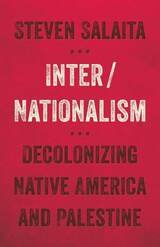
“The age of transnational humanities has arrived.” According to Steven Salaita, the seemingly disparate fields of Palestinian Studses and American Indian studies have more in common than one may think. In Inter/Nationalism, Salaita argues that American Indian and Indigenous studies must be more central to the scholarship and activism focusing on Palestine.
Salaita offers a fascinating inside account of the Boycott, Divestment, and Sanctions (BDS) movement—which, among other things, aims to end Israel’s occupation of Palestinian land. In doing so, he emphasizes BDS’s significant potential as an organizing entity as well as its importance in the creation of intellectual and political communities that put Natives and other colonized peoples such as Palestinians into conversation. His discussion includes readings of a wide range of Native poetry that invokes Palestine as a theme or symbol; the speeches of U.S. President Andrew Jackson and early Zionist thinker Ze’ev Jabotinsky; and the discourses of “shared values” between the United States and Israel.
Inter/Nationalism seeks to lay conceptual ground between American Indian and Indigenous studies and Palestinian studies through concepts of settler colonialism, indigeneity, and state violence. By establishing Palestine as an indigenous nation under colonial occupation, this book draws crucial connections between the scholarship and activism of Indigenous America and Palestine.
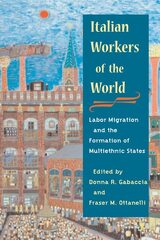
In Italian Workers of the World, a distinguished roster of contributors examines how the reception of immigrants in their new countries shaped their sense of national identity and shaped the multiethnic states where they settled. Argentina and Brazil welcomed Italian migrants as a civilizing influence, and these immigrant workers played an instrumental part in establishing and leading movements committed to labor internationalism. In the United States, by contrast, the American Federation of Labor's hostility to socialism, internationalism, and unskilled laborers fueled distrust and xenophobia that steered Italian immigrants into ethnically mixed unions like radical Industrial Workers of the World. Essays also focus on specific topics ranging from the work of republican Garibaldians in South America to antifascist currents among Italian migrants in France and the United States, and from a 1912 textile strike in Lawrence, Massachusetts, to Mussolini's invasion of Ethiopia.
Contributors: Antonio Bechelloni, Fernando J. Devoto, Pietro Rinaldo Fanesi, Donna R. Gabaccia, Mirta Zaida Lobato, Fraser M. Ottanelli, Carina Frid de Silberstein, Michael Miller Topp, Angelo Trento, Nadia Venturini, and Elisabetta Vezzosi

Offering a nuanced reading of a figure that was simultaneously conservative and radical, Reich considers how the cinematic black soldier lent a human face to ongoing debates about racial integration, black internationalism, and American militarism. Militant Visions thus not only presents a new history of how American cinema represented race, but also demonstrates how film images helped to make history, shaping the progress of the civil rights movement itself.
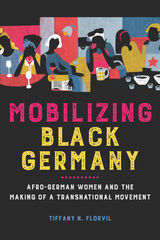
Tiffany N. Florvil examines the role of queer and straight women in shaping the contours of the modern Black German movement as part of the Black internationalist opposition to racial and gender oppression. Florvil shows the multifaceted contributions of women to movement making, including Audre Lorde’s role in influencing their activism; the activists who inspired Afro-German women to curate their own identities and histories; and the evolution of the activist groups Initiative of Black Germans and Afro-German Women. These practices and strategies became a rallying point for isolated and marginalized women (and men) and shaped the roots of contemporary Black German activism.
Richly researched and multidimensional in scope, Mobilizing Black Germany offers a rare in-depth look at the emergence of the modern Black German movement and Black feminists’ politics, intellectualism, and internationalism.
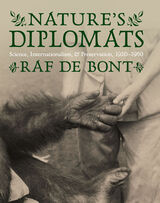
By examining international efforts to protect migratory birds, the threatened European bison, and the mountain gorilla in the interior of the Belgian Congo, Nature’s Diplomats sheds new light on the launch of major international organizations for nature protection in the aftermath of World War II. Additionally, it covers how the rise of ecological science, the advent of the Cold War, and looming decolonization forced a rethinking of approach and rhetoric; and how old ideas and practices lingered on. It provides much-needed historical context for present-day convictions about and approaches to the preservation of species and the conservation of natural resources, the involvement of local communities in conservation projects, the fate of extinct species and vanished habitats, and the management of global nature.
This interdisciplinary work brings the humanities and social sciences into dialogue by examining issues such as globalized capital, discourses of antiterrorism, and identity politics. Essayists from the fields of postcolonial studies and globalization theory address the ethical and pragmatic ramifications of opposing interpretations of these issues and, for the first time, seek common ground.
Contributors: Pal Ahluwalia, U of California, San Diego; Arjun Appadurai, New School U; Geoffrey Bowker, Santa Clara U; Timothy Brennan, U of Minnesota; Ruth Buchanan, U of British Columbia; Verity Burgmann, U of Melbourne; Pheng Cheah, U of California, Berkeley; Inderpal Grewal, U of California, Irvine; Ramon Grosfoguel, U of California, Berkeley; Barbara Harlow, U of Texas, Austin; Anouar Majid, U of New England; John McMurtry, U of Guelph; Walter D. Mignolo, Duke U; Sundhya Pahuja, U of Melbourne; R. Radhakrishnan, U of California, Irvine; Ileana Rodriguez, Ohio State U; E. San Juan, Philippine Forum, New York; Saskia Sassen, U of Chicago; Ella Shohat, New York U; Leslie Sklair, London School of Economics; Robert Stam, New York U; Madina Tlostanova, Russian Peoples’ Friendship U; Harish Trivedi, U of Delhi.
Revathi Krishnaswamy is associate professor of English at San Jose State University.
John C. Hawley is professor and chair of English at Santa Clara University.
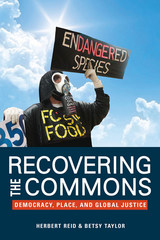
This penetrating work culls key concepts from grassroots activism to hold critical social theory accountable to the needs, ideas, and organizational practices of the global justice movement. The resulting critique of neoliberalism hinges on place-based struggles of groups marginalized by globalization and represents a brave rethinking of politics, economy, culture, and professionalism.
Providing new practical and conceptual tools for responding to human and environmental crises in Appalachia and beyond, Recovering the Commons radically revises the framework of critical social thought regarding our stewardship of the civic and ecological commons. Herbert Reid and Betsy Taylor ally social theory, field sciences, and local knowledge in search of healthy connections among body, place, and commons that form a basis for solidarity as well as a vital infrastructure for a reliable, durable world. Drawing particularly on the work of philosophers Maurice Merleau-Ponty, John Dewey, and Hannah Arendt, the authors reconfigure social theory by ridding it of the aspects that reduce place and community to sets of interchangeable components. Instead, they reconcile complementary pairs such as mind/body and society/nature in the reclamation of public space.
With its analysis embedded in philosophical and material contexts, this penetrating work culls key concepts from grassroots activism to hold critical social theory accountable to the needs, ideas, and organizational practices of the global justice movement. The resulting critique of neoliberalism hinges on place-based struggles of groups marginalized by globalization and represents a brave rethinking of politics, economy, culture, and professionalism.
A Foreign Affairs Best Book of the Year
“Even in these dismal times genuinely important books do occasionally make their appearance…You really ought to read it…A tour de force…While Wertheim is not the first to expose isolationism as a carefully constructed myth, he does so with devastating effect.”
—Andrew J. Bacevich, The Nation
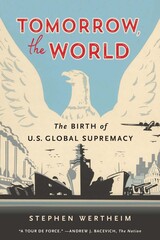
For most of its history, the United States avoided making political and military commitments that would entangle it in power politics. Then, suddenly, it conceived a new role for itself as an armed superpower—and never looked back. In Tomorrow, the World, Stephen Wertheim traces America’s transformation to World War II, right before the attack on Pearl Harbor.
As late as 1940, the small coterie formulating U.S. foreign policy wanted British preeminence to continue. Axis conquests swept away their assumptions, leading them to conclude that America should extend its form of law and order across the globe, and back it at gunpoint. No one really favored “isolationism”—a term introduced by advocates of armed supremacy to burnish their cause. We live, Wertheim warns, in the world these men created. A sophisticated and impassioned account that questions the wisdom of U.S. supremacy, Tomorrow, the World reveals the intellectual path that brought us to today’s endless wars.
“Its implications are invigorating…Wertheim opens space for Americans to reexamine their own history and ask themselves whether primacy has ever really met their interests.”
—New Republic
“For almost 80 years now, historians and diplomats have sought not only to describe America’s swift advance to global primacy but also to explain it…Any writer wanting to make a novel contribution either has to have evidence for a new interpretation, or at least be making an older argument in some improved and eye-catching way. Tomorrow, the World does both.”
—Paul Kennedy, Wall Street Journal
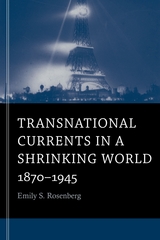
Transnational Currents in a Shrinking World examines the wide variety of social and cultural networks that emerged from the global exchanges of the late-nineteenth and twentieth centuries. Emily Rosenberg shows how transnational connections were being formed many decades before “globalization” became a commonplace term in economic and political discourse.
Suggesting crisscrossing flows of power, “currents” provide an especially apt metaphor for transnational exchanges in the age of the telegraph and incandescent light bulb. Rosenberg traces the internationalizing currents that impelled a desire to create global rule-setting institutions, from the Universal Postal Union to the International Olympic Committee to the League of Nations. Other transnational currents coalesced around social networks of class, ethnic, gender, and religious affiliations; around exhibitions such as world fairs, museums, and botanical gardens; around networks of expertise in engineering, medicine, social science, and urban planning; and around mass media and cultures of consumption.
Rosenberg suggests that these currents brought a modernity that mixed faith in the rationality of science and technology with a fascination for emotional and spectacle-driven entertainments. In this age of nationalism and imperialism, they both assisted and disrupted ambitions for territorial expansion; they ushered in a new world in which fast-moving technologies of representation brought multiple and shifting codes of meaning. Often overlooked in histories centered on nation-states, transnational currents highlight the irregular patterns of global change and underscore the fluidity of spatial and personal identifications in the period from 1870 to the end of World War II.
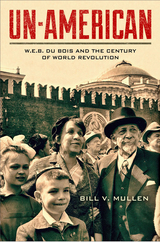
Un-American is Bill Mullen’s revisionist account of renowned author and activist W.E.B. Du Bois’s political thought toward the end of his life, a period largely dismissed and neglected by scholars. He describes Du Bois’s support for what the Communist International called “world revolution” as the primary objective of this aged radical’s activism. Du Bois was a champion of the world’s laboring millions and critic of the Cold War, a man dedicated to animating global political revolution.
Mullen argues that Du Bois believed that the Cold War stalemate could create the conditions in which the world powers could achieve not only peace but workers’ democracy. Un-American shows Du Bois to be deeply engaged in international networks and personal relationships with revolutionaries in India, China, and Africa. Mullen explores how thinkers like Karl Marx, Jawaharlal Nehru, Mohandas Gandhi, and C.L.R. James helped him develop a theory of world revolution at a stage in his life when most commentators regard him as marginalized. This original political biography also challenges assessments of Du Bois as an American “race man.”
READERS
Browse our collection.
PUBLISHERS
See BiblioVault's publisher services.
STUDENT SERVICES
Files for college accessibility offices.
RECENTLY PUBLISHED


UChicago Accessibility Resources
home | accessibility | search | about | contact us
BiblioVault ® 2001 - 2024
The University of Chicago Press