
 A SCHOLARLY BOOK REPOSITORY
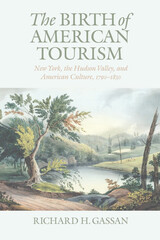
According to Gassan, the origins of American tourism in the Hudson Valley can be traced to a confluence of historical accidents, including the proximity of the region to the most rapidly growing financial and population center in the country, with its expanding middle class, and the remarkable beauty of the valley itself. But other developments also played a role, from the proliferation of hotels to accommodate tourists, to the construction of an efficient transportation network to get them to their destinations, to the creation of a set of cultural attractions that invested their experience with meaning. In the works of Washington Irving and James Fenimore Cooper and the paintings of Thomas Cole and others of the Hudson River School, travelers in the region encountered the nation's first literary and artistic movements. Tourism thus did more than provide an escape from the routines of everyday urban life; it also helped Americans of the early republic shape a sense of national identity.

Is a native-born tour guide who has sex with tourists—in exchange for dinner or gifts or cash—merely a prostitute or gigolo? What if the tourist continues to send gifts or money to the tour guide after returning home? As this original and provocative book demonstrates, when it comes to sex—and the effects of capitalism and globalization—nothing is as simple as it might seem.
Based on ten years of research, Economies of Desire is the first ethnographic study to examine the erotic underpinnings of transnational tourism. It offers startling insights into the commingling of sex, intimacy, and market forces in Cuba and the Dominican Republic, two nations where tourism has had widespread effects. In her multi-layered analyses, Amalia Cabezas reconceptualizes our understandings of informal economies (particularly “affective economies”), “sex workers,” and “sexual tourism,” and she helps us appreciate how money, sex and love are intertwined within the structure of globalizing capitalism.
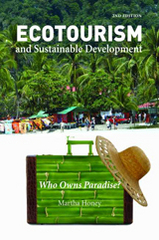
Ecotourism and Sustainable Development, originally published in 1998, was among the first books on the subject. For years it has defined the debate on ecotourism: Is it possible for developing nations to benefit economically from tourism while simultaneously helping to preserve pristine environments? This long-awaited second edition provides new answers to this vital question.
Ecotourism and Sustainable Development is the most comprehensive overview of worldwide ecotourism available today, showing how both the concept and the reality have evolved over more than twenty-five years. Here Honey revisits six nations she profiled in the first edition—the Galapagos Islands, Costa Rica, Tanzania, Zanzibar, Kenya, and South Africa—and adds a fascinating new chapter on the United States. She examines the growth of ecotourism within each country’s tourism strategy, its political system, and its changing economic policies. Her useful case studies highlight the economic and cultural impacts of expanding tourism on indigenous populations as well as on ecosystems.
Honey is not a “travel writer.” She is an award-winning journalist and reporter who lived in East Africa and Central America for nearly twenty years. Since writing the first edition of this book, she has led the International Ecotourism Society and founded a new center to lead the way to responsible ecotourism. Her experience and her expertise resonate throughout this beautifully written and highly informative book.
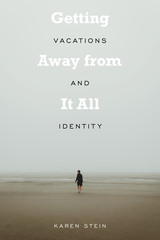
Vacations are a delimited period during which social rules and responsibilities are eased, removed, or shifted, and people have increased autonomy over what they choose to do. Recent trends in the travel industry emphasize the appeal of vacations for voluntary identity changes—when bankers can become bikers for a week or when “Momcations” allow mothers to leave their families behind. But how do our vacations allow us to shape our identity?
Getting Away from It All is a study of individuality and flexibility and the intersection of self-definition and social constraint. Karen Stein interviews vacationers about their travels and down time, focusing on “identity transitions.” She shows how objects, settings, temporal environments and social interactions limit or facilitate identity shifts, and how we arrange our vacations to achieve the shifts we desire. Stein also looks at the behavior, values, attitudes, and worldview of individuals to illuminate how people engage in either identity work or identity play.
Vacations say a lot about individuals. They signal class and economic standing and reveal aspirations and goals. Getting Away from It All insists that vacations are about more than just taking time off to relax and rejuvenate—they are about having some time to work on the person one wants to be.

With Housekeeping by Design, David Brody introduces us to those people—the housekeepers whose labor keeps the rooms clean and the guests happy. Through unprecedented access to staff at several hotels, Brody shows us just how much work goes on behind the scenes—and how much management goes out of its way to make sure that labor stays hidden. We see the incredible amount of hard physical work that is involved in cleaning and preparing a room, how spaces, furniture, and other objects are designed to facilitate a smooth flow of hidden labor, and, crucially, how that design could be improved for workers and management alike if front-line staff were involved in the design process. After reading this fascinating exposé of the ways hotels work—or don’t for housekeepers—one thing is certain: checking in will never be the same again.
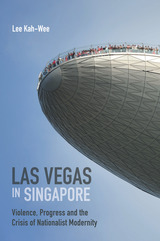
The first history begins in colonial Singapore in the 1880s, when British administrators revised gambling laws in response to the political threat posed by Chinese-run gambling syndicates. Following the tracks of these punitive laws and practices, the book moves into the 1960s when the newly independent city-state created a national lottery while criminalizing both organized and petty gambling in the name of nation-building. The second history shifts the focus to corporate Las Vegas in the 1950s when digital technology and corporate management practices found each other on the casino floor. Tracing the emergence of the specialist casino designer, the book reveals how casino development evolved into a highly rationalized spatial template designed to maximize profits. Today an iconic landmark of Singapore, Marina Bay Sands is also an artifact of these two histories, an attempt by Singapore to normalize what was once criminalized in its nationalist history.
Lee Kah-Wee argues that the historical project of the control of vice is also about the control of space and capital. The result is an uneven landscape where the legal and moral status of gambling is contingent on where it is located. As the current wave of casino expansion spreads across Asia, he warns that these developments should not be seen as liberalization but instead as a continuation of the project of concentrating power by modern states and corporations.

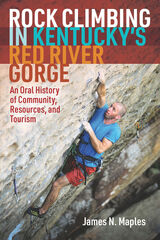
Rock Climbing in Kentucky’s Red River Gorge documents, for the first time, fifty years of oral history from this famous climbing community. Through extensive interviews, Maples reconstructs the growth of rock climbing in the region—including a twice-failed dam project, mysterious first routes, unauthorized sport-route growth on public lands, and a controversial archaeological dig. The book details five decades of collaborations to secure ongoing access to some of the world’s most beautiful and technically demanding routes and the challenges along the way.
More than a recounting of the past, however, Rock Climbing in Kentucky’s Red River Gorge uses the region’s extraordinary history to argue that climbing has the potential to be a valuable source of sustainable economic activity in rural areas throughout Appalachia today and in the years to come. The book concludes by offering policy recommendations and lessons learned about building beneficial partnerships among climbers, local communities, and public land managers to encourage community development and ecotourism alongside preservation.
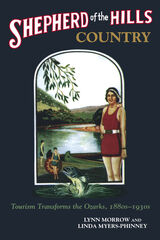
Modern tourism in the Ozark Mountains of Missouri and Arkansas is concentrated around the area’s glistening man-made lakes, its fish-filled streams and rivers, and the entertainment mecca of Branson. But recreational excursions into this part of the country began over one hundred years ago as urban Midwesterners, many of them captivated by Harold Bell Wright’s novel The Shepherd of the Hills, sought the outdoors for spiritual and physical regeneration.
Morrow and Myers-Phinney excavate the beginnings of commercial tourism in the region and follow it through six decades as the influx of visitors who became familiar with the Ozarks and its investment opportunities brought capital, new commerce, and additional residents to the hills. Chapters focus on float fishing, game parks, cave exploration, the influence of the railroad, and the men who were instrumental in the region’s transformation. The authors discuss traditional lifestyles rooted in “living off the land,” with stock raising and lumbering providing basic subsistence, and changes wrought by tourism, which affected all classes of people across the White River landscape. They describe the flowering of “Ozarks folklore”—how stories told around gravel-bar fishing camps and retold by newspaper journalists translated the hills’ oral tradition for mass audiences.
While the main theme of this study is the development of tourism, it is also a social history of the interior highlands of the Ozarks. We see how the residents and their way of life were discovered, exploited, and changed by new opportunities and the demands of tourism and increasing trade. As such, this book is a valuable new addition to the University of Arkansas Press’s Ozarks Collection.
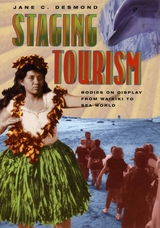
Gathering together written accounts, postcards, photographs, advertisements, films, and oral histories as well as her own interpretations of these displays, Desmond gives us a vibrant account of U.S. tourism in Waikiki from 1900 to the present. She then juxtaposes cultural tourism with "animal tourism" in the United States, which takes place at zoos, aquariums, and animal theme parks. In each case, Desmond argues, the relationship between the viewer and the viewed is ultimately based on concepts of physical difference harking back to the nineteenth century.
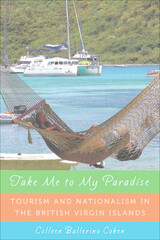
Interweaving more than twenty years of field notes, Cohen provides a firsthand analysis of how tourism transformed the BVI from a small neglected British colony to a modern nation that competes in a global economic market. With its close reading of everything from advertisements to political manifestos and constitutional reforms, Take Me to My Paradise deepens our understanding of how nationalism develops hand-in-hand with tourism, and documents the uneven impact of economic prosperity upon different populations. We hear multiple voices, including immigrants working in a tourism economy, nationalists struggling to maintain some control, and the anthropologist trying to make sense of it all. The result is a richly detailed and accessible ethnography on the impact of tourism on a country that came into being as a tourist destination.
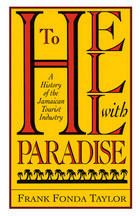
In the course of the nineteenth century, Jamaica transformed itself from a pestilence-ridden “white man’s graveyard” to a sun-drenched tourist paradise. Deftly combining economics with political and cultural history, Frank Fonda Taylor examines this puzzling about-face and explores the growth of the tourist industry into the 1990s. He argues that the transformations in image and reality were not accidental or due simply to nature’s bounty. They were the result of a conscious decision to develop this aspect of Jamaica’s economy.
Jamaican tourism emerged formally at an international exhibition held on the island in 1891. The international tourist industry, based on the need to take a break from stressful labor and recuperate in healthful and luxurious surroundings, was a newly awakened economic giant. A group of Jamaican entrepreneurs saw its potential and began to cultivate a tourism psychology which has led, more than one hundred years later, to an economy dependent upon the tourist industry.
The steamships that carried North American tourists to Jamaican resorts also carried U.S. prejudices against people of color. “To Hell withParadise” illustrates the problems of founding a tourist industry for a European or U.S. clientele in a society where the mass of the population is poor, black, and with a historical experience of slavery and colonialism. By the 1990s, tourism had become the lifeblood of the Jamaican economy, but at an enormous cost: enclaves of privilege and ostentation that exclude the bulk of the local population, drug trafficking and prostitution, soaring prices, and environmental degradation. No wonder some Jamaicans regard tourism as a new kind of sugar.
Taylor explores timely issues that have not been previously addressed. Along the way, he offers a series of valuable micro histories of the Jamaican planter class, the origins of agricultural dependency (on bananas), the growth of shipping and communications links, the process of race relations, and the linking of infrastructural development to tourism. The text is illustrated with period photographs of steamships and Jamaican tourist hotels.
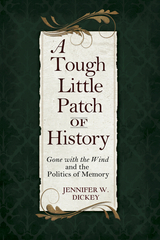
More than seventy-five years after its publication, Gone with the Wind remains thoroughly embedded in American culture. Margaret Mitchell’s novel and the film produced by David O. Selznick have melded with the broader forces of southern history, southern mythology, and marketing to become, and remain, a cultural phenomenon.
A Tough Little Patch of History (the phrase was coined by a journalist in 1996 to describe the Margaret Mitchell home after it was spared from destruction by fire) explores how Gone with the Wind has remained an important component of public memory in Atlanta through an analysis of museums and historic sites that focus on this famous work of fiction. Jennifer W. Dickey explores how the book and film threw a spotlight on Atlanta, which found itself simultaneously presented as an emblem of both the Old South and the New South. Exhibitions produced by the Atlanta History Center related to Gone with the Wind are explored, along with nearby Clayton County’s claim to fame as “the Home of Gone with the Wind,” a moniker bestowed on the county by Margaret Mitchell’s estate in 1969. There’s a recounting of the saga of “the Dump,” the tiny apartment in midtown Atlanta where Margaret Mitchell wrote the book, and how this place became a symbol for all that was right and all that was wrong with Mitchell’s writing.

No longer the dreary sheep farm at the end of the world, the New Zealand of the new millennium is a hot global ticket, heralded for its bicultural dynamism, laid-back lifestyle, and scenery extraordinary enough to pass for Tolkien’s Middle Earth. How this image was crafted is the story The Tourist State tells. In a series of narratives that address the embodied dimensions of biopolitics and explore the collision of race, performance, and the cultural poetics of the state, Margaret Werry exposes the real drama behind the new New Zealand, revealing how a nation was sold to the world—and to itself.
The story stretches back to the so-called Liberal Era at the beginning of the twentieth century, in which the young settler colony touted itself as the social laboratory of the world. Focusing on where tourism and liberal governmentality coincide, The Tourist State takes us from military diplomacy at the dawn of the American Pacific to the exotic blandishments of Broadway and Coney Island, from landscape preservation to health reform and town planning, from blockbuster film to knowledge economy policy.
Weaving together interpretive history, performance ethnography, and cultural criticism, Werry offers new ways to think about race and indigeneity—and about the role of human agency in state-making.
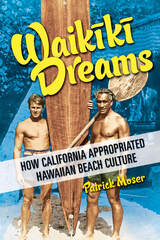
Despite a genuine admiration for Native Hawaiian culture, white Californians of the 1930s ignored authentic relationships with Native Hawaiians. Surfing became a central part of what emerged instead: a beach culture of dressing, dancing, and acting like an Indigenous people whites idealized.
Patrick Moser uses surfing to open a door on the cultural appropriation practiced by Depression-era Californians against a backdrop of settler colonialism and white nationalism. Recreating the imagined leisure and romance of life in Waikīkī attracted people buffeted by economic crisis and dislocation. California-manufactured objects like surfboards became a physical manifestation of a dream that, for all its charms, emerged from a white impulse to both remove and replace Indigenous peoples. Moser traces the rise of beach culture through the lives of trendsetters Tom Blake, John “Doc” Ball, Preston “Pete” Peterson, Mary Ann Hawkins, and Lorrin “Whitey” Harrison while also delving into California’s control over images of Native Hawaiians via movies, tourism, and the surfboard industry.
Compelling and innovative, Waikīkī Dreams opens up the origins of a defining California subculture.
READERS
Browse our collection.
PUBLISHERS
See BiblioVault's publisher services.
STUDENT SERVICES
Files for college accessibility offices.
RECENTLY PUBLISHED





UChicago Accessibility Resources
home | accessibility | search | about | contact us
BiblioVault ® 2001 - 2024
The University of Chicago Press