
 A SCHOLARLY BOOK REPOSITORY
Results by Title
2 books about Historical Thinking
2 books about Historical Thinking

Academic Languaging and Historical Thinking
Cultivating Students' Language Skills for Argument Writing
Undarmaa Maamuujav and Jacob Steiss
University of Michigan Press, 2026
Academic Languaging and Historical Thinking prepares teachers to assess where students are in their written and critical thinking skills and to develop the art of teaching historical argumentative writing to students. The use of effective language to communicate historical, social, and civic arguments is a key competence future citizens need, and teaching writing through history is especially effective because of the grounded nature of historical documentation and the balance between clear facts and blurrier areas of interpretation.
Starting with a pedagogical approach, the book takes readers through research on the relationship between language and writing, the ways that historians make claims and the kinds of evidence they use, and how to successfully find and evaluate sources. It then offers instructional activities and strategies that center around key disciplinary practices in historical argumentation: making claims, sourcing and integrating evidence, presenting reasoning, and addressing counterarguments. These activities can be easily modified for different teaching and learning contexts, including supporting multilingual learners of English. Whether readers are practicing teachers, pre-service teachers, or instructional coaches, this book will help them learn how to integrate academic language skills with argument writing instruction in history to teach students to be confident academic writers and competent language users.
Starting with a pedagogical approach, the book takes readers through research on the relationship between language and writing, the ways that historians make claims and the kinds of evidence they use, and how to successfully find and evaluate sources. It then offers instructional activities and strategies that center around key disciplinary practices in historical argumentation: making claims, sourcing and integrating evidence, presenting reasoning, and addressing counterarguments. These activities can be easily modified for different teaching and learning contexts, including supporting multilingual learners of English. Whether readers are practicing teachers, pre-service teachers, or instructional coaches, this book will help them learn how to integrate academic language skills with argument writing instruction in history to teach students to be confident academic writers and competent language users.
[more]
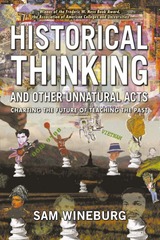
Historical Thinking
Sam Wineburg
Temple University Press, 2001
Since ancient times, the pundits have lamented young people's lack of historical knowledge and warned that ignorance of the past surely condemns humanity to repeating its mistakes. In the contemporary United States, this dire outlook drives a contentious debate about what key events, nations, and people are essential for history students. Sam Wineburg says that we are asking the wrong questions. This book demolishes the conventional notion that there is one true history and one best way to teach it.
Although most of us think of history -- and learn it -- as a conglomeration of facts, dates, and key figures, for professional historians it is a way of knowing, a method for developing and understanding about the relationships of peoples and events in the past. A cognitive psychologist, Wineburg has been engaged in studying what is intrinsic to historical thinking, how it might be taught, and why most students still adhere to the "one damned thing after another" concept of history.
Whether he is comparing how students and historians interpret documentary evidence or analyzing children's drawings, Wineburg's essays offer "rough maps of how ordinary people think about the past and use it to understand the present." Arguing that we all absorb lessons about history in many settings -- in kitchen table conversations, at the movies, or on the world-wide web, for instance -- these essays acknowledge the role of collective memory in filtering what we learn in school and shaping our historical thinking.
Although most of us think of history -- and learn it -- as a conglomeration of facts, dates, and key figures, for professional historians it is a way of knowing, a method for developing and understanding about the relationships of peoples and events in the past. A cognitive psychologist, Wineburg has been engaged in studying what is intrinsic to historical thinking, how it might be taught, and why most students still adhere to the "one damned thing after another" concept of history.
Whether he is comparing how students and historians interpret documentary evidence or analyzing children's drawings, Wineburg's essays offer "rough maps of how ordinary people think about the past and use it to understand the present." Arguing that we all absorb lessons about history in many settings -- in kitchen table conversations, at the movies, or on the world-wide web, for instance -- these essays acknowledge the role of collective memory in filtering what we learn in school and shaping our historical thinking.
[more]
READERS
Browse our collection.
PUBLISHERS
See BiblioVault's publisher services.
STUDENT SERVICES
Files for college accessibility offices.
RECENTLY PUBLISHED



UChicago Accessibility Resources
home | accessibility | search | about | contact us
BiblioVault ® 2001 - 2026
The University of Chicago Press