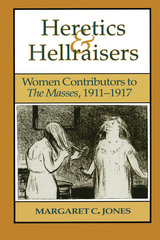
front cover of Heretics and Hellraisers
Heretics and Hellraisers
Women Contributors to The Masses, 1911-1917
By Margaret C. Jones
University of Texas Press, 1993

The Masses was the most dynamic and influential left-wing magazine of the early twentieth century, a touchstone for understanding radical thought and social movements in the United States during that era. As a magazine that supported feminist issues, it played a crucial role in shaping public discourse about women's concerns. Women editors, fiction writers, poets, and activists like Mary Heaton Vorse, Louise Bryant, Adriana Spadoni, Elsie Clews Parsons, Inez Haynes Gillmore, and Helen Hull contributed as significantly to the magazine as better-known male figures.

In this major revisionist work, Margaret C. Jones calls for reexamination of the relevance of Masses feminism to that of the 1990s. She explores women contributors' perspectives on crucial issues: patriarchy, birth control, the labor movement, woman suffrage, pacifism, and ethnicity. The book includes numerous examples of the writings and visual art of Masses women and a series of biographical/bibliographical sketches designed to aid other researchers.


[more]

logo for Harvard University Press
Heretics, Saints and Martyrs
Frederic Palmer
Harvard University Press
In these seven essays on one or another aspect of theology. Dr. Palmer has pointed out the bond of unity that exists beneath all our ephemeral systems, the bond of a deep soul-breathing consciousness of close fellowship with God. What may be called the humanization of church history resets in the revelation in it of this unifying divine element. The papers discuss such topics as the Anabaptists and their relation to civil and religious liberty; Mani and dualism; the synoptic, Johannine, and Pauline conceptions of Jesus; Isaac Watts; Joachim of Floris; Angelus Silesius; and Perpetua and Felicitas, Martyrs and Saints.
[more]

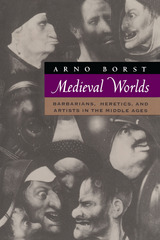
front cover of Medieval Worlds
Medieval Worlds
Barbarians, Heretics and Artists in the Middle Ages
Arno Borst
University of Chicago Press, 1992
In Medieval Worlds: Barbarians, Heretics, and Artists, medieval historian Arno Borst offers at once an imaginatively narrated tour of medieval society. Issues of language, power, and cultural change come to life as he examines how knights, witches and heretics, monks and kings, women poets, and disputatious university professors existed in the medieval world.

Clearly interested in the forms of medieval behavior which gave rise to the seeds of modern society, Borst focuses on three in particular that gave momentum to medieval religious, social, and intellectual movements: the barbaric, heretical, and artistic. Borst concludes by reflecting on his own life as a scholar and draws out lessons for us from the turbulence of the Middle Ages.
[more]


Send via email Share on Facebook Share on Twitter