
 A SCHOLARLY BOOK REPOSITORY
Results by Title
2 books about Green, Toby
2 books about Green, Toby
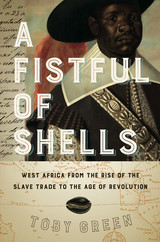
A Fistful of Shells
West Africa from the Rise of the Slave Trade to the Age of Revolution
Toby Green
University of Chicago Press, 2019
By the time the “Scramble for Africa” among European colonial powers began in the late nineteenth century, Africa had already been globally connected for centuries. Its gold had fueled the economies of Europe and the Islamic world for nearly a millennium, and the sophisticated kingdoms spanning its west coast had traded with Europeans since the fifteenth century. Until at least 1650, this was a trade of equals, using a variety of currencies—most importantly, cowrie shells imported from the Maldives and nzimbu shells imported from Brazil. But, as the slave trade grew, African kingdoms began to lose prominence in the growing global economy. We have been living with the effects of this shift ever since.
With A Fistful of Shells, Toby Green transforms our view of West and West-Central Africa by reconstructing the world of these kingdoms, which revolved around trade, diplomacy, complex religious beliefs, and the production of art. Green shows how the slave trade led to economic disparities that caused African kingdoms to lose relative political and economic power. The concentration of money in the hands of Atlantic elites in and outside these kingdoms brought about a revolutionary nineteenth century in Africa, parallel to the upheavals then taking place in Europe and America. Yet political fragmentation following the fall of African aristocracies produced radically different results as European colonization took hold.
Drawing not just on written histories, but on archival research in nine countries, art, oral history, archaeology, and letters, Green lays bare the transformations that have shaped world politics and the global economy since the fifteenth century and paints a new and masterful portrait of West Africa, past and present.
With A Fistful of Shells, Toby Green transforms our view of West and West-Central Africa by reconstructing the world of these kingdoms, which revolved around trade, diplomacy, complex religious beliefs, and the production of art. Green shows how the slave trade led to economic disparities that caused African kingdoms to lose relative political and economic power. The concentration of money in the hands of Atlantic elites in and outside these kingdoms brought about a revolutionary nineteenth century in Africa, parallel to the upheavals then taking place in Europe and America. Yet political fragmentation following the fall of African aristocracies produced radically different results as European colonization took hold.
Drawing not just on written histories, but on archival research in nine countries, art, oral history, archaeology, and letters, Green lays bare the transformations that have shaped world politics and the global economy since the fifteenth century and paints a new and masterful portrait of West Africa, past and present.
[more]

The Heretic of Cacheu
Crispina Peres and the Struggle over Life in Seventeenth-Century West Africa
Toby Green
University of Chicago Press, 2025
Tells the extraordinary story of seventeenth-century West African slave trader Crispina Peres to explore the shifting, sophisticated world in which she lived.
In 1665, Crispina Peres, the most powerful trader in the West African slave-trafficking port of Cacheu, was arrested by the Portuguese Inquisition. Her enemies had conspired to denounce her for taking treatments prescribed by Senegambian healers, the djabakós. But who was Peres? And why was the Inquisition so concerned with policing the faith of a West African woman in today’s Guinea-Bissau?
In The Heretic of Cacheu, award-winning historian Toby Green takes us to the heart of this conundrum, immersing us in the atmosphere of an otherwise distant setting. We learn how people in seventeenth-century Cacheu built their houses; styled their clothes; healed themselves from illness; and worshipped, worked, and played. Green renders the haunting realities of the growing slave trade and the rise of European empires in shocking detail. By the 1650s, the relationships between Europe, West Africa, and the Americas were already old and tangled, with slaving ports, colonies, and military bases having intermingled over many generations. But Cacheu also profoundly troubled this dynamic. It was globally connected to places ranging from China and India to Brazil and Colombia, and women such as Crispina Peres ran the town and challenged the patriarchy of empire.
For the first time, through surviving documents recording Peres’s case, The Heretic of Cacheu lets readers experience the reality of this unique place and time through a remarkable act of historical recovery.
In 1665, Crispina Peres, the most powerful trader in the West African slave-trafficking port of Cacheu, was arrested by the Portuguese Inquisition. Her enemies had conspired to denounce her for taking treatments prescribed by Senegambian healers, the djabakós. But who was Peres? And why was the Inquisition so concerned with policing the faith of a West African woman in today’s Guinea-Bissau?
In The Heretic of Cacheu, award-winning historian Toby Green takes us to the heart of this conundrum, immersing us in the atmosphere of an otherwise distant setting. We learn how people in seventeenth-century Cacheu built their houses; styled their clothes; healed themselves from illness; and worshipped, worked, and played. Green renders the haunting realities of the growing slave trade and the rise of European empires in shocking detail. By the 1650s, the relationships between Europe, West Africa, and the Americas were already old and tangled, with slaving ports, colonies, and military bases having intermingled over many generations. But Cacheu also profoundly troubled this dynamic. It was globally connected to places ranging from China and India to Brazil and Colombia, and women such as Crispina Peres ran the town and challenged the patriarchy of empire.
For the first time, through surviving documents recording Peres’s case, The Heretic of Cacheu lets readers experience the reality of this unique place and time through a remarkable act of historical recovery.
[more]
READERS
Browse our collection.
PUBLISHERS
See BiblioVault's publisher services.
STUDENT SERVICES
Files for college accessibility offices.
RECENTLY PUBLISHED





UChicago Accessibility Resources
home | accessibility | search | about | contact us
BiblioVault ® 2001 - 2025
The University of Chicago Press