
 A SCHOLARLY BOOK REPOSITORY
In a new introduction Adkison reveals Across the Plains to be far more than a simple narrative of one pioneer woman’s journey west. She explains that Royce wrote the book at the request of her son, Josiah Royce, a well-known professor of philosophy at Harvard University with motives of his own. She crafted the narrative that her son wanted: an argument for spiritual faith and fortitude as foundational to California’s history. Yet the narrative itself, in addition to offering a window into a world that has long lacked close documentation, gives us the opportunity to study the ways in which nineteenth-century western women asserted this primacy of faith and crafted their experience into stories with larger cultural and social resonance.
Scholars have long used Across the Plains to mold and support an iconic image of the resolute pioneer woman. However, until now no one has considered Royce’s own self-conscious creation of this persona. Readers will discover that in many ways, Sarah Royce’s careful construction of this cultural portrait deepens our respect for her and our delight in her travels, travails, and triumphs.
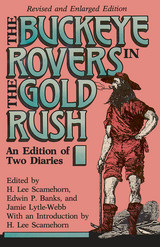
When “California Fever” raced through southeastern Ohio in the spring of 1849, a number of residents of Athens County organized a cooperative venture for traveling overland to the mines. Known as the “Buckeye Rovers,” the company began its trip westward in early April. The Buckeye Rovers, along with thousands who traveled the overland route to California, endured numerous hardships and the seemingly constant threat of attacks from hostile Indians. On reaching their destination, the Ohioans discovered that rich deposits of gold were extremely rare, and that except for a few lucky fortune–seekers, mining required hard physical labor and yielded small rewards. They persisted nonetheless and most of the company returned to Athens in late 1851 or early 1852 with modest fortunes.
The arduous experiences of the overland trek were recorded by two Buckeye Rover diarists. The more compete account was compiled by John Banks. He wrote effusively while on the trail and throughout his stay of more than two years in the gold regions. J. Elza Armstrong, by contrast, was brief, even laconic, and his journal ended upon reaching California. The contrast between the two brings into focus the divergent personalities who were drawn to California by the lure of gold.
A nine–month segment of Bank’s diary, from February to November, 1851, had been missing at the time the story of the Buckeye Rovers was first published in 1965. This revised and enlarged edition contains the complete diaries. They offer valuable record of the Buckeyes’ adventures from the time they left home until the time they departed California for the return trip to Ohio.
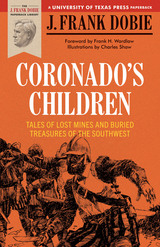
Written in 1930, Coronado's Children was one of J. Frank Dobie's first books, and the one that helped gain him national prominence as a folklorist. In it, he recounts the tales and legends of those hardy souls who searched for buried treasure in the Southwest following in the footsteps of that earlier gold seeker, the Spaniard Coronado.
"These people," Dobie writes in his introduction, "no matter what language they speak, are truly Coronado's inheritors.... l have called them Coronado's children. They follow Spanish trails, buffalo trails, cow trails, they dig where there are no trails; but oftener than they dig or prospect they just sit and tell stories of lost mines, of buried bullion by the jack load... "
This is the tale-spinning Dobie at his best, dealing with subjects as irresistible as ghost stories and haunted houses.
Popular media depict miners as a rough-and-tumble lot who diligently worked the placers along scenic rushing rivers while living in roaring mining camps in the foothills of the Sierra Nevada Mountains. Trafzer and Hyer destroy this mythic image by offering a collection of original newspaper articles that describe in detail the murder, rape, and enslavement perpetrated by those who participated in the infamous gold rush. "It is a mercy to the Red Devils," wrote an editor of the Chico Courier, "to exterminate them." Newspaper accounts of the era depict both the barbarity and the nobility in human nature, but while some protested the inhumane treatment of Native Americans, they were not able to end the violence. Native Americans fought back, resisting the invasion, but they could not stop the tide of white miners and settlers. They became "strangers in a stolen land."
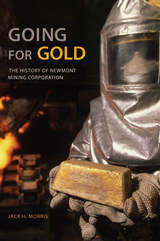
Jack H. Morris asserts that Newmont is the link between early gold mining and today’s technology-driven industry. We learn how the company’s founder and several early leaders grew up in gold camps and how, in 1917, the company helped finance South Africa’s largest gold company and later owned famous gold mines in California and Colorado. In the 1960s the company developed the process to capture “invisible gold” from small distributions of the metal in large quantities of rock, thereby opening up the rich gold field at Carlin, Nevada.
Modern gold mining has all the excitement and historic significance of the metal’s colorful past. Instead of panning for ready nuggets, today’s corporate miners must face heavy odds by extracting value from ores containing as little as one-hundredth of an ounce per ton. In often-remote locations, where the capital cost of a new mine can top $2 billion, 250-ton trucks crawl from half mile deep pits and ascend, beetle-like, loaded with ore for extraction of the minute quantities of gold locked inside.
Morris had unique access to company records and the cooperation of more than 80 executives and employees of the firm, but the company exercised no control over content. The author tells a story of discovery and scientific breakthrough; strong-willed, flamboyant leaders like founder Boyce Thompson; corporate raiders such as T. Boone Pickens and Jimmy Goldsmith; shakedowns by the Indonesian government and monumental battles with the French over the richest mine in Peru; and learning to operate in the present environmental regulatory climate. This is a fascinating story of the metal that has ignited passions for centuries and now sells for over $1,000 an ounce.
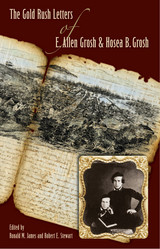
The Groshes’ letters are rich in color and important historical details. Generously annotated and with an introduction that provides a context for the brothers’ career and the setting in which they tried to make their fortune, these documents powerfully depict the often harsh realities of Gold Rush life and society.
For Golden Rules, Mark Kanazawa draws on previously untapped historical sources to trace the emergence of the current framework for resolving water-rights issues to California in the 1850s, when Gold Rush miners flooded the newly formed state. The need to circumscribe water use on private property in support of broader societal objectives brought to light a number of fundamental issues about how water rights ought to be defined and enforced through a system of laws. Many of these issues reverberate in today’s contentious debates about the relative merits of government and market regulation. By understanding how these laws developed across California’s mining camps and common-law courts, we can also gain a better sense of the challenges associated with adopting new property-rights regimes in the twenty-first century.

Golden Treasures of the San Juan contains fabulous stories of lost mines, bullion, and valuable prospects of one of the most beautiful mountain areas of the United States. Many of the stories are based on the personal adventures of author Cornelius.
When the Indian Mountain Lands (the San Juan) were ceded in 1874, the wild region was thrown open to prospectors seeking its gold and silver riches. Many prospects were valuable discoveries, yet were lost and became legendary mines. Further, the Spanish explorers had been through this area much earlier with their bullion, and their caches added to the legends of gold discovered or to be discovered. The authors of this book trace complete stories about these long-lost hoards.
Volume 3, Life Writings of Frontier Women series, ed. Maureen Ursenbach Beecher
In her memoir, and 1870s revision of her journal and diary, Louisa Barnes Pratt tells of childhood in Massachusetts and Canada during the War of 1812, and independent career as a teacher and seamstress in New England, and her marriage to the Boston seaman Addison Pratt.
Converting to the LDS Church, the Pratts moved to Nauvoo, Illinois, from where Brigham Young sent Addison on the first of the long missions to the Society Islands that would leave Louisa on her own. As a sole available parent, she hauled her children west to Winter Quarters, to Utah in 1848, to California, and, in Addison's wake, to Tahiti in 1850.
The Pratts joined the Mormon colony at San Bernardino, California. When in 1858 a federal army's march on Utah led to the colonists' recall, Addision—alienated from the Mormon Church after long absences—chose not to go. Mostly separated thereafter (Addison died in 1872), Louisa settled in Beaver, Utah, where she campaigned for women's rights, contributed to the Woman's Exponent, and depended on her own means, as she had much of her life, until her death in 1880.
Challenging the myth that the only women who participated in gold rushes were prostitutes and gold-diggers of the euphemistic sort, Melanie Mayer shows us that Klondike women came from all walks of life—socialites to poor immigrants, single women, wives, widows, and children. They planned to make their money through many different undertakings including mining, business, entertainment, professional, and service enterprises. Their approaches to life were as varied as their roles—optimistic or skeptical; cautious or adventuresome; gregarious or self-contained; contemplative or active. There was no typical Klondike woman. Individually, their stories can be funny, hopeful, tragic, or poignant. Taken together, they give rich, complex images of the people, times, and places of the gold rush.
A visually exciting book, Klondike Women features over 150 photographs and illustrations. This volume should appeal not only to the general reader, but to those interested in history, women’s studies, and the Pacific Northwest as well.
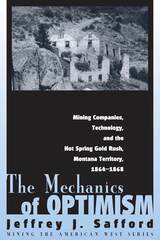
Historian Jeffrey J. Safford examines how gold mining ventures were developed and financed during and after the Civil War, and how men, primarily Easterners with scant knowledge of mining, were willing to invest large sums in gold mines that promised quick and lucrative returns.
Safford explains how these mining companies were organized and underwritten, and why a little-known district in southwestern Montana was chosen as a center of operations. Relying on extensive primary sources, Safford addresses the mind-set of the businessmen, the expectations and realities of new mining technology, the financial strategies, and the universality of the Hot Spring experience.
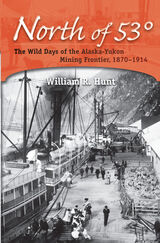
“Saints and sinners, whores and housewives, swindlers and laborers alike attempted a hasty adjustment to novel conditions in a land that seemed strange and forbidding,” writes William R. Hunt in his narrative history of Alaska mining. Hunt offers an exciting anecdotal account that follows hungry prospectors, canny shopkeepers, hopeful hangers-on, and crafty lawyers through the gold mining camps and temporary towns of nineteenth-century Alaska. Hunt has hiked and mined many of the same claims he writes about in the book, and North of 53 offers a rare glimpse into far-flung communities from Skagway to the Yukon to the deep interior of Alaska to the Ididarod and Nome on the Bering Sea.
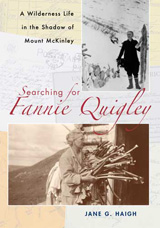
At the age of 27, Fannie Sedlacek left her Bohemian homestead in Nebraska to join the gold rush to the Klondike. From the Klondike to the Tanana, Fannie continued north, finally settling in Katishna near Mount McKinley. This woman, later known as Fannie Quigley, became a prospector who staked her own claims and a cook who ran a roadhouse. She hunted and trapped and thrived for nearly forty years in an environment that others found unbearable.
Her wilderness lifestyle inspired many of those who met her to record their impressions of this self-sufficient woman, who died in 1944. To many of the 700,000 annual visitors to Denali National Park she is a symbol of the enduring spirit of the original pioneers.
Searching for Fannie Quigley: A Wilderness Life in the Shadow of Mount McKinley goes beyond the mere biographical facts of this unique woman’s journey. It also tells historian Jane G. Haigh’s own story of tracking and tracing the many paths that Fannie Quigley’s intriguing life took. Uncovering remote clues, digging through archives, and listening to oral accounts from a wide array of sources, Haigh has fashioned this rich lode into a compelling narrative.
In Searching for Fannie Quigley, Haigh separates fact from fiction to reveal the true story of this highly mythologized pioneer woman.
In Staking Her Claim, Melanie Mayer and Robert N. DeArmond provide a faithful and comprehensive portrait of this unique character in North American frontier history. Their exhaustive research has resulted in a sweeping saga of determination and will, tempered by disaster and opportunity.
Like any good Horatio Alger hero, Belinda overcame the challenges that confronted her, including poverty, prejudice, a lack of schooling, and the early loss of parents. Her travels took her from her native Ireland as a young girl to a coal town in Pennsylvania to Chicago, San Francisco, and finally, in 1897, to the Yukon.
Staking Her Claim is a testament to the human spirit and to the idea of the frontier. It is a biography of a woman who made her own way in the world and in doing so left an indelible mark.
In Staking Her Claim, Melanie Mayer and Robert N. DeArmond provide a faithful and comprehensive portrait of this unique character in North American frontier history. Their exhaustive research has resulted in a sweeping saga of determination and will, tempered by disaster and opportunity.
Like any good Horatio Alger hero, Belinda overcame the challenges that confronted her, including poverty, prejudice, a lack of schooling, and the early loss of parents. Her travels took her from her native Ireland as a young girl to a coal town in Pennsylvania to Chicago, San Francisco, and finally, in 1897, to the Yukon.
Staking Her Claim is a testament to the human spirit and to the idea of the frontier. It is a biography of a woman who made her own way in the world and in doing so left an indelible mark.
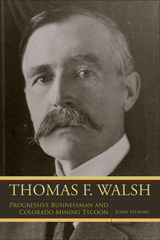
In the first complete biography of Thomas Walsh, John Stewart recounts the tycoon's life from his birth in 1850 and his beginnings as a millwright and carpenter in Ireland to his tenacious, often fruitless mining work in the Black Hills and Colorado, which finally led to his discovery of an extremely rich vein of gold ore in the Imogene Basin. Walsh's Camp Bird Mine yielded more than $20 million worth of gold and other minerals in twenty years, and the mine's 1902 sale to British investors made Walsh very wealthy.
He achieved national prominence, living with his family in mansions in Colorado and Washington, D.C., and maintaining a rapport with Presidents McKinley, Theodore Roosevelt, and Taft, as well as King Leopold II of Belgium.
Despite his fame and lavish lifestyle, Walsh is remembered as an unassuming and philanthropic man who treated his employees well. In addition to making many anonymous donations, he established the Walsh Library in Ouray and a library near his Irish birthplace, and helped establish a research fund for the study of radium and other rare western minerals at the Colorado School of Mines. Walsh gave his employees at the Camp Bird Mine top pay and lodged them in an alpine boardinghouse featuring porcelain basins, electric lighting, and excellent food.
Stewart's engaging account explores the exceptional path of this Colorado mogul in detail, bringing Walsh and his time to life.
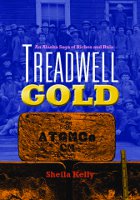
A century ago, Treadwell, Alaska, was a featured stop on steamship cruises, a rich, up-to-date town that was the most prominent and proud in all Alaska. Its wealth, however, was founded on the remarkably productive gold mines on Douglas Island, and when those caved in and flooded in the early decades of the twentieth century, Treadwell sank into relative obscurity.
Treadwell Gold presents first-person accounts from the sons and daughters of the miners, machinists, hoist operators, and superintendents who together dug and blasted the gold that made Treadwell rich. Alongside these stories are vintage photos that capture both the industrial vigor of the mines and the daily lives that made up Treadwell society. The book will fascinate anyone interested in Alaskan history or the romance of gold mining’s past.
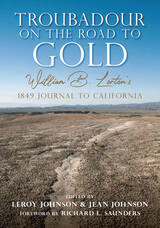
Lorton’s work is revealing and entertaining. It captures glimpses of a growing Salt Lake City, the hardships of Death Valley, and the extraordinary and mundane aspects of daily life on the road to gold. With resilience and a droll sense of humor, Lorton shares accounts of life-threatening stampedes, dangerous hailstorms, mysteriously moving rocks, and slithering sidewinders. The inclusion of images, maps, and the editors’ detailed notes make this a volume that will entertain and inform.
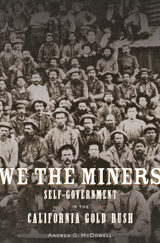
A Financial Times Best History Book of the Year
A surprising account of frontier law that challenges the image of the Wild West. In the absence of state authority, Gold Rush miners crafted effective government by the people—but not for all the people.
Gold Rush California was a frontier on steroids: 1,500 miles from the nearest state, it had a constantly fluctuating population and no formal government. A hundred thousand single men came to the new territory from every corner of the nation with the sole aim of striking it rich and then returning home. The circumstances were ripe for chaos, but as Andrea McDowell shows, this new frontier was not nearly as wild as one would presume. Miners turned out to be experts at self-government, bringing about a flowering of American-style democracy—with all its promises and deficiencies.
The Americans in California organized and ran meetings with an efficiency and attention to detail that amazed foreign observers. Hundreds of strangers met to adopt mining codes, decide claim disputes, run large-scale mining projects, and resist the dominance of companies financed by outside capital. Most notably, they held criminal trials on their own authority. But, mirroring the societies back east from which they came, frontiersmen drew the boundaries of their legal regime in racial terms. The ruling majority expelled foreign miners from the diggings and allowed their countrymen to massacre the local Native Americans. And as the new state of California consolidated, miners refused to surrender their self-endowed authority to make rules and execute criminals, presaging the don’t-tread-on-me attitudes of much of the contemporary American west.
In We the Miners, Gold Rush California offers a well-documented test case of democratic self-government, illustrating how frontiersmen used meetings and the rules of parliamentary procedure to take the place of the state.
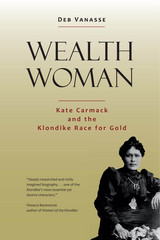
In Wealth Woman, Deb Vanasse recounts Kate’s life from her early years on the frontier with George, through the history-making discovery of gold, and on to her subsequent fame, when she traveled alone down the West Coast through Washington and California, telling her story and fighting for her wealth, her family, and her reputation. Recovering the lost story of a true pioneer and a fiercely independent woman, Wealth Woman brings gold rush Alaska to life in all its drama and glory.
READERS
Browse our collection.
PUBLISHERS
See BiblioVault's publisher services.
STUDENT SERVICES
Files for college accessibility offices.
RECENTLY PUBLISHED



UChicago Accessibility Resources
home | accessibility | search | about | contact us
BiblioVault ® 2001 - 2024
The University of Chicago Press